A 12-year-old boy vows he will never do to his future family what his father did by leaving the boy, his sister and mother. Yet, 30 years later, the boy now a man leaves his own family. A young woman who's broken off an abusive relationship is now attracted to the same kind of personality in a potential boyfriend. And an attorney who grew up with an impossible-to-please father takes a job in a firm where the boss thinks praise is never productive. These are the kind of repetitive cycles that Stanley Rosner has seen time and again in his practice across 40 years as a clinical psychologist. A past president of the Connecticut Psychological Association, Rosner examines in this book whether there is for some people a compulsion to repeat self-destructive acts, and what the foundation for that compulsion might be, as well as how it can be changed to afford better, happier living.
Assisted by popular author Patricia Hermes, Rosner offers many eye-opening vignettes from his therapy rooms, showing us clearly how early life events can create unconscious dilemmas that move us to repeat the situation in other forms. He aims to show us how we can resolve the issues that linger, explaining how to recognize these issues, then move forward to put them to rest in ways that are not self-sabotaging. What I have to offer, says Rosner, is the opportunity for change.
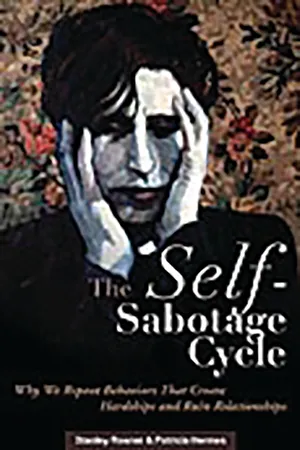
eBook - PDF
The Self-Sabotage Cycle
Why We Repeat Behaviors That Create Hardships and Ruin Relationships
- 193 pages
- English
- PDF
- Available on iOS & Android
eBook - PDF
The Self-Sabotage Cycle
Why We Repeat Behaviors That Create Hardships and Ruin Relationships
About this book
Information
Table of contents
- Contents
- Acknowledgments
- Introduction
- Chapter 1 Repetition of Early Identifications: Conformity vs. Autonomy
- Chapter 2 Repetitions in Marriage: Unwritten Contracts and Complementary Repetitions
- Chapter 3 Repetitions in Child Rearing
- Chapter 4 Penitential Repetitions: Repetitions of Rescue and Repentance
- Chapter 5 Repetitions on the Job
- Chapter 6 Repetitions in the Addictions
- Chapter 7 The Repetition Compulsion
- Chapter 8 Recognizing and Resolving Self-Sabotaging Repetitions
- References
- Bibliography
- Index
Trusted by 375,005 students
Access to over 1.5 million titles for a fair monthly price.
Study more efficiently using our study tools.
Frequently asked questions
Yes, you can cancel anytime from the Subscription tab in your account settings on the Perlego website. Your subscription will stay active until the end of your current billing period. Learn how to cancel your subscription
No, books cannot be downloaded as external files, such as PDFs, for use outside of Perlego. However, you can download books within the Perlego app for offline reading on mobile or tablet. Learn how to download books offline
Perlego offers two plans: Essential and Complete
- Essential is ideal for learners and professionals who enjoy exploring a wide range of subjects. Access the Essential Library with 800,000+ trusted titles and best-sellers across business, personal growth, and the humanities. Includes unlimited reading time and Standard Read Aloud voice.
- Complete: Perfect for advanced learners and researchers needing full, unrestricted access. Unlock 1.5M+ books across hundreds of subjects, including academic and specialized titles. The Complete Plan also includes advanced features like Premium Read Aloud and Research Assistant.
We are an online textbook subscription service, where you can get access to an entire online library for less than the price of a single book per month. With over 1.5 million books across 990+ topics, we’ve got you covered! Learn about our mission
Look out for the read-aloud symbol on your next book to see if you can listen to it. The read-aloud tool reads text aloud for you, highlighting the text as it is being read. You can pause it, speed it up and slow it down. Learn more about Read Aloud
Yes! You can use the Perlego app on both iOS and Android devices to read anytime, anywhere — even offline. Perfect for commutes or when you’re on the go.
Please note we cannot support devices running on iOS 13 and Android 7 or earlier. Learn more about using the app
Please note we cannot support devices running on iOS 13 and Android 7 or earlier. Learn more about using the app
Yes, you can access The Self-Sabotage Cycle by Stanley Rosner,Patricia Hermes in PDF and/or ePUB format, as well as other popular books in Psychology & History & Theory in Psychology. We have over 1.5 million books available in our catalogue for you to explore.