Employee participation programs have many faces, many definitions, many forms—and they change all the time. For some people they are meant to solve every problem in the workplace. For others they are ways to reduce resistance to management and its efforts to bring about organizational change. Still others see them as totally redundant and a hindrance to efficency and the implementation of good management practices. To make sense of it all, Bar-Haim integrates—historically, thematically, analytically—the wide but often incoherent knowledge we have about these programs, and in doing so portrays them in a clear, useful, multidimensional manner. The result is a work of scholarship and practical guidance that students, scholars, researchers, and executives will find important, an action-oriented source of vital information.
Bar-Haim shows that participation programs in work organizations have always attempted to solve three basic human problems, problems stemming from industrial democracy and equality, work alienation, and occupational and managerial effectiveness. To do this he uses a rare multidimensional technique. He describes and analyzes the processes and behavior of participation, participants, and organizational forms using a a variety of conceptual and theoretical frames drawn from the social and management sciences. He enhances our understanding of participation programs on micro and macro levels, and then provides practical guidelines from the real-world experience of other scholars and executives. Among the several ironies he discovers are that the roles of enthusiasts, opponents, and skeptics changed during the course of a jubilee of these programs. By integrating a large body of research and suggesting a formal model to evaluate existing employee programs and projected ones, his book attempts to ease the enigmatic ambivalence we have toward worker participation in general. In fact, he shows that by better understanding the dynamics of participation programs, it is possible for those who desire such programs to create, construct, and maintain better ones.
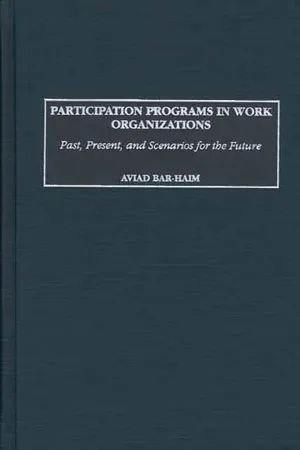
eBook - PDF
Participation Programs in Work Organizations
Past, Present, and Scenarios for the Future
- 190 pages
- English
- PDF
- Available on iOS & Android
eBook - PDF
Participation Programs in Work Organizations
Past, Present, and Scenarios for the Future
Table of contents
- Contents
- Acknowledgments
- Introduction
- Part I: Participation Programs: Mapping the Field
- Part II: Two Generations of Participation Programs
- Part III: A General Model of Participation Programs
- Part IV: Future of Participation Programs
- Appendix A Co-determination in German Coal, Iron, and Steel Industries
- Appendix B Data for Two Israeli Programs
- Appendix C “The Challenge of Mondragon”
- References
- Index
Trusted by 375,005 students
Access to over 1.5 million titles for a fair monthly price.
Study more efficiently using our study tools.
Frequently asked questions
Yes, you can cancel anytime from the Subscription tab in your account settings on the Perlego website. Your subscription will stay active until the end of your current billing period. Learn how to cancel your subscription
No, books cannot be downloaded as external files, such as PDFs, for use outside of Perlego. However, you can download books within the Perlego app for offline reading on mobile or tablet. Learn how to download books offline
Perlego offers two plans: Essential and Complete
- Essential is ideal for learners and professionals who enjoy exploring a wide range of subjects. Access the Essential Library with 800,000+ trusted titles and best-sellers across business, personal growth, and the humanities. Includes unlimited reading time and Standard Read Aloud voice.
- Complete: Perfect for advanced learners and researchers needing full, unrestricted access. Unlock 1.5M+ books across hundreds of subjects, including academic and specialized titles. The Complete Plan also includes advanced features like Premium Read Aloud and Research Assistant.
We are an online textbook subscription service, where you can get access to an entire online library for less than the price of a single book per month. With over 1.5 million books across 990+ topics, we’ve got you covered! Learn about our mission
Look out for the read-aloud symbol on your next book to see if you can listen to it. The read-aloud tool reads text aloud for you, highlighting the text as it is being read. You can pause it, speed it up and slow it down. Learn more about Read Aloud
Yes! You can use the Perlego app on both iOS and Android devices to read anytime, anywhere — even offline. Perfect for commutes or when you’re on the go.
Please note we cannot support devices running on iOS 13 and Android 7 or earlier. Learn more about using the app
Please note we cannot support devices running on iOS 13 and Android 7 or earlier. Learn more about using the app
Yes, you can access Participation Programs in Work Organizations by Aviad Bar-Haim in PDF and/or ePUB format, as well as other popular books in Business & Business General. We have over 1.5 million books available in our catalogue for you to explore.