Parents, teachers, friends, and even many clinicians are both horrified and mystified upon discovering teenagers who intentionally cut, burn, and otherwise inflict pain upon themselves. Often causing permanent and extensive scarring, as well as infections, cutting is increasingly prevalent among today's youth. As many as 1 in 100 adolescents report cutting themselves, representing a growing epidemic of scarred and tormented youths, as we see in this revealing work. As author Plante discusses here, the threat of suicide must always be carefully evaluated, although the majority of cutters are not in fact suicidal. Instead, cutting represents a growing teenage method for easing emotional pain and suffering. Bleeding from self-inflicted wounds not only helps to numb and vent the despair, it can also be a dramatic means of communicating, controlling, and asking for help from others.
Parents, teachers, friends, and even many clinicians are both horrified and mystified upon discovering teenagers who intentionally cut, burn, and otherwise inflict pain on themselves. Often causing permanent and extensive scarring, as well as infections, cutting is increasingly prevalent among today's youth. As many as 1 in 100 adolescents report cutting themselves, representing a growing epidemic of scarred and tormented youth, as we see in this revealing work. Author Plante explains the threat of suicide must always be carefully evaluated, although the vast majority of cutters are not in fact suicidal. Instead, cutting represents a growing teenage method for easing emotional pain and suffering. Bleeding from self-inflicted wounds not only helps to numb and vent despair, it can also be a dramatic means of communicating, controlling, and asking for help from others.
In this book, Plante features the stories of self-injurers and helps the reader understand the meaning of the injuries, and how to help teens stop. This author, who is a psychologist, a parent, and a Stanford University Medical School faculty member, explains in clear detail how cutters and the adults who love them can heal the pain and stop self-injury. Plante describes the frightening developmental tasks teenagers and young adults face, and how the central challenges of the three I's (Independence, Intimacy, and Identity) compel them to cope through self-destructive acts. Readers will feel as if they are in the therapy room with Plante and these struggling teenagers as they seek to overcome their internal pain and that desperate need to cut and self-injure.
eBook - PDF
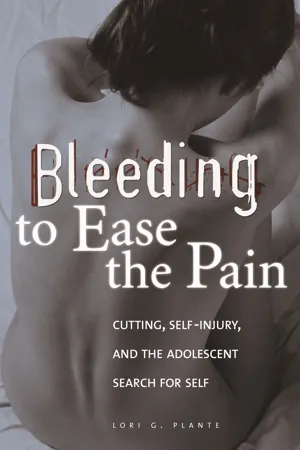
Bleeding to Ease the Pain
Cutting, Self-Injury, and the Adolescent Search for Self
- 201 pages
- English
- PDF
- Available on iOS & Android
eBook - PDF
About this book
Information
Table of contents
- Contents
- Foreword
- Preface
- 1 Self-Injury on the Rampage
- 2 Special Populations, Special Concerns: Teenagers Most at Risk
- 3 Developmental Challenges in Adolescence: The Agony, the Ecstasy, the Cell Phone, and the Internet
- 4 Why Teens Self-Injure: Doing All the Wrong Things for the Right Reasons
- 5 Laying the Foundation for Intervention: Composure, Compassion, and Comprehension
- 6 Professional Treatment of Self-Injury: Understanding the Therapeutic Process
- 7 Specialized Approaches and Adjuncts in Treating Self-Injury
- 8 The Brain as an Attitude Pharmacy: Neurochemical Roles and Remedies in Self-Injury
- 9 Intervention in Action: How It Works
- 10 Stepping Up to the Plate: How Parents Can Help
- 11 Health and Happiness Are Verbs: The Responsibilities of the Adolescent in Treatment
- 12 Depathologizing Adolescent Self-Injury: Cutting on a Continuum
- Conclusions: Reconceptualizing Cutting
- Notes
- Bibliography
- Index
- About the Series Editor and Advisers
Trusted by 375,005 students
Access to over 1.5 million titles for a fair monthly price.
Study more efficiently using our study tools.
Frequently asked questions
Yes, you can cancel anytime from the Subscription tab in your account settings on the Perlego website. Your subscription will stay active until the end of your current billing period. Learn how to cancel your subscription
No, books cannot be downloaded as external files, such as PDFs, for use outside of Perlego. However, you can download books within the Perlego app for offline reading on mobile or tablet. Learn how to download books offline
Perlego offers two plans: Essential and Complete
- Essential is ideal for learners and professionals who enjoy exploring a wide range of subjects. Access the Essential Library with 800,000+ trusted titles and best-sellers across business, personal growth, and the humanities. Includes unlimited reading time and Standard Read Aloud voice.
- Complete: Perfect for advanced learners and researchers needing full, unrestricted access. Unlock 1.5M+ books across hundreds of subjects, including academic and specialized titles. The Complete Plan also includes advanced features like Premium Read Aloud and Research Assistant.
We are an online textbook subscription service, where you can get access to an entire online library for less than the price of a single book per month. With over 1.5 million books across 990+ topics, we’ve got you covered! Learn about our mission
Look out for the read-aloud symbol on your next book to see if you can listen to it. The read-aloud tool reads text aloud for you, highlighting the text as it is being read. You can pause it, speed it up and slow it down. Learn more about Read Aloud
Yes! You can use the Perlego app on both iOS and Android devices to read anytime, anywhere — even offline. Perfect for commutes or when you’re on the go.
Please note we cannot support devices running on iOS 13 and Android 7 or earlier. Learn more about using the app
Please note we cannot support devices running on iOS 13 and Android 7 or earlier. Learn more about using the app
Yes, you can access Bleeding to Ease the Pain by Lori G. Plante in PDF and/or ePUB format, as well as other popular books in Psychology & History & Theory in Psychology. We have over 1.5 million books available in our catalogue for you to explore.