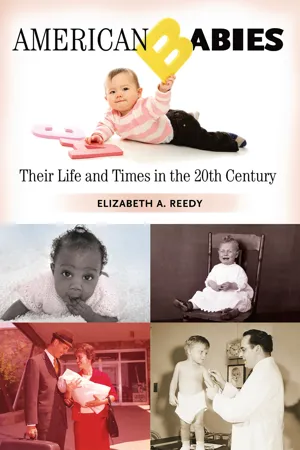
The focus of this book is the journey babies have made over the past century. The rise of the middle class in America dictated major changes in the ways babies were fed, cared for, and raised. Social programs focused on improving water and sanitation programs for all, which led directly to decreased infection among infants and improved morbidity and mortality rates. Other programs also focused attention on babies. Advances in medicine allowed infants to be immunized against once-deadly and disabling diseases and to survive congenital defects, premature birth, and infectious disease. Physicians helped infertile couples conceive and carry a baby to term. Prenatal care helped mothers give birth to a healthy baby. Early intervention services gave infants an advantage as they faced growing up in the modern era. Today, most American babies are better off than they were in 1901. Overall they are bigger, healthier, and much more likely to survive the first year. But challenges remain. By reviewing the events of the past century, Reedy hopes we can make even more of a difference in the lives of American babies in the century to come.
In 1900, most babies were born at home. Infant mortality was high and most families could expect to lose one or more of their babies within the first year of life. A family was expected to have babies, and they were certainly wanted in most situations, however, they did not generally receive the attention they do today. In the early years of the 21st century, the birth of a baby is a time of joy for most parents and extended families. Birth occurs most often in a hospital delivery room with the father and sometimes other family members present. While the infant mortality rate in the United States still lags behind many other developed countries, it has significantly improved over the past century, and infant death is not a family expectation.
The main focus of this book is the journey babies have made over the past century. The rise of the middle class in America dictated major changes in the ways babies were fed, cared for, and raised. No longer a financial necessity as in an agrarian society, babies became a symbol of middle class prosperity and parents basked in the reflected glow. Social programs, authorized and regulated by federal and state government, became a reality. Progressive Era reformers focused on improving water and sanitation programs for all, which led directly to decreased infection among infants and improved the dismal morbidity and mortality rates prevalent among all social classes. Other programs, such as the Shepard-Towner Act, the Social Security Act, and Lyndon Johnson's Great Society initiatives also focused attention on babies. Advances in medicine allowed infants to be immunized against once-deadly and disabling diseases and to survive congenital defects, premature birth, and infectious disease. Physicians discovered the means to help infertile couples conceive and carry a baby to term. Prenatal care helped mothers prepare for the birth of a healthy baby. Early intervention services by educators, social workers, and others gave infants an advantage as they faced growing up in the modern era.
At the beginning of the 21st century, most American babies are better off than they were in 1901. Overall they are bigger, healthier, and much more likely to survive the first year. But challenges remain. By reviewing the events of the past century, Reedy hopes we can make even more of a difference in the lives of American babies in the century to come.
- 214 pages
- English
- PDF
- Available on iOS & Android
eBook - PDF
About this book
Information
Table of contents
- Contents
- Series Foreword
- Acknowledgments
- Introduction
- Chapter 1 American Babies in 1901
- Chapter 2 The General Public and Babies: Attitudes, Advice, and Altruism
- Chapter 3 Health, Illness, and the American Baby
- Chapter 4 From Weaklings to Fighters
- Chapter 5 The Economics of Infancy
- Chapter 6 Racism and the American Baby
- Chapter 7 Population and Immigration
- Chapter 8 Infertility and the Quest for American Babies
- Chapter 9 Beginning the World Again—American Babies at the Start of a New Century
- Bibliography
- Index
- About the Author
Trusted by 375,005 students
Access to over 1.5 million titles for a fair monthly price.
Study more efficiently using our study tools.
Frequently asked questions
Yes, you can cancel anytime from the Subscription tab in your account settings on the Perlego website. Your subscription will stay active until the end of your current billing period. Learn how to cancel your subscription
No, books cannot be downloaded as external files, such as PDFs, for use outside of Perlego. However, you can download books within the Perlego app for offline reading on mobile or tablet. Learn how to download books offline
Perlego offers two plans: Essential and Complete
- Essential is ideal for learners and professionals who enjoy exploring a wide range of subjects. Access the Essential Library with 800,000+ trusted titles and best-sellers across business, personal growth, and the humanities. Includes unlimited reading time and Standard Read Aloud voice.
- Complete: Perfect for advanced learners and researchers needing full, unrestricted access. Unlock 1.5M+ books across hundreds of subjects, including academic and specialized titles. The Complete Plan also includes advanced features like Premium Read Aloud and Research Assistant.
We are an online textbook subscription service, where you can get access to an entire online library for less than the price of a single book per month. With over 1.5 million books across 990+ topics, we’ve got you covered! Learn about our mission
Look out for the read-aloud symbol on your next book to see if you can listen to it. The read-aloud tool reads text aloud for you, highlighting the text as it is being read. You can pause it, speed it up and slow it down. Learn more about Read Aloud
Yes! You can use the Perlego app on both iOS and Android devices to read anytime, anywhere — even offline. Perfect for commutes or when you’re on the go.
Please note we cannot support devices running on iOS 13 and Android 7 or earlier. Learn more about using the app
Please note we cannot support devices running on iOS 13 and Android 7 or earlier. Learn more about using the app
Yes, you can access American Babies by Elizabeth A. Reedy in PDF and/or ePUB format, as well as other popular books in Scienze sociali & Cultura popolare. We have over 1.5 million books available in our catalogue for you to explore.