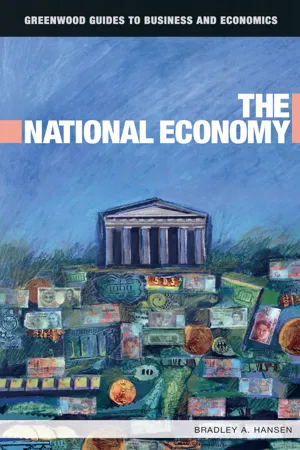
From the impact of rising gas prices to debates over free trade agreements, the workings of the economy remain a mystery to most, even as the demands on our economic resources increase. This volume presents a basic introduction to the national economy—how it works and how various political and business decisions affect it. Chapters one through four explain the concept of Gross Domestic Product, with an emphasis on supply and demand, long-term growth, and short-term fluctuations, resulting from such factors as interest rates and inflation. Chapters five through eight highlight the four basic sectors of the economy—businesses, households, the government, and the international arena—and how they interact.
The national economy is the engine of growth for any country—whether it is a superpower with global reach or a small nation struggling to emerge from poverty. Every citizen is a participant in the economy, as they work to create income for their families, pay taxes, spend their earnings of products and services, or draw from government programs, such as welfare or Social Security. And yet the workings of the economy remain a mystery to most, even as the demands on our economic resources increase.
eBook - PDF
The National Economy
Table of contents
- Contents
- Illustrations
- Series Foreword by Wesley B. Truitt
- Preface
- Chronology of American Economic History
- 1. The Market Economy of the United States
- 2. Measuring the Performance of the American Economy
- 3. Economic Growth
- 4. Business Cycles
- 5. Business and the National Economy
- 6. Households and the National Economy
- 7. Government and the National Economy
- 8. The International Sector and the National Economy
- Sources of Current Economic Information
- Glossary
- References
- Index
- TABLE 1.1 The Money Supply (M1), March 2005 (billion $)
- TABLE 2.1 Nominal U.S. GDP and Its Components, 2003 (billion $)
- TABLE 2.2 Nominal National Income and Its Components, 2003 (billion $)
- TABLE 2.3 Reconciling Nominal GDP and Nominal National Income in 2003 (billion $)
- TABLE 2.4 CPI and Components, 1993–2004
- TABLE 2.5 GNP Comparisons Using Actual Exchange Rates and PPP Exchange Rates, 1994
- TABLE 3.1 GNP and Life Expectancy, 1999
- TABLE 3.2 Percentage of Growth in Output
- TABLE 3.3 Time and Expense of Doing Business
- TABLE 5.1 Number of Businesses and Sales, 2001
- TABLE 6.1 Education, Experience, and Average Earnings, 2001
- TABLE 6.2 Income, Poverty, and Education by Race, 2001
- TABLE 7.1 Tax Schedule for a Single Filer, 2005
- TABLE 7.2 Government Employment, 1980–2000
- TABLE 8.1 The Benefits of Trade
- TABLE 8.2 Cost of Saving Jobs
- TABLE 8.3 Foreign Direct Investment Position, 2003
- TABLE 8.4 America’s Top Trading Partners
- FIGURE 1.1 Demand Shifts
- FIGURE 1.2 Supply Shifts
- FIGURE 1.3 Supply and Demand
- FIGURE 1.4 The Circular Flow of a Market Economy
- FIGURE 2.1 Real Per Capita GDP in (chained) 1996 dollars, 1929–2002
- FIGURE 2.2 Labor Force and Unemployment
- FIGURE 3.1 Air Pollution Emissions in 1,000s of Tons, 1940–2000
- FIGURE 3.2 Changing Distribution of the Workforce, 1840–2000
- FIGURE 3.3 Average Annual Increases in Productivity, 1873–2003
- FIGURE 4.1 Rate of Inflation, 1914–2002
- FIGURE 4.2 Unemployment Rate, 1929–2002
- FIGURE 4.3 Changes in M1 and Changes in the CPI
- FIGURE 6.1 Distribution of Income in the United States, 2002
- FIGURE 6.2 Savings as a Percent of Personal Disposable Income,1959–2004
- FIGURE 6.3 School Enrollment per 100 Children Aged 5–19, 1850–1970
- FIGURE 6.4 Births per 1,000 People, 1909–2001
- FIGURE 7.1 Distribution of Federal Spending, 2003
- FIGURE 7.2 Distribution of Federal Government Revenues, 2003
- FIGURE 7.3 Impact of a $2.00-a-Pack Cigarette Tax
- FIGURE 8.1 Immigration, 1820–2000
Trusted by 375,005 students
Access to over 1.5 million titles for a fair monthly price.
Study more efficiently using our study tools.
Frequently asked questions
Yes, you can cancel anytime from the Subscription tab in your account settings on the Perlego website. Your subscription will stay active until the end of your current billing period. Learn how to cancel your subscription
No, books cannot be downloaded as external files, such as PDFs, for use outside of Perlego. However, you can download books within the Perlego app for offline reading on mobile or tablet. Learn how to download books offline
Perlego offers two plans: Essential and Complete
- Essential is ideal for learners and professionals who enjoy exploring a wide range of subjects. Access the Essential Library with 800,000+ trusted titles and best-sellers across business, personal growth, and the humanities. Includes unlimited reading time and Standard Read Aloud voice.
- Complete: Perfect for advanced learners and researchers needing full, unrestricted access. Unlock 1.5M+ books across hundreds of subjects, including academic and specialized titles. The Complete Plan also includes advanced features like Premium Read Aloud and Research Assistant.
We are an online textbook subscription service, where you can get access to an entire online library for less than the price of a single book per month. With over 1.5 million books across 990+ topics, we’ve got you covered! Learn about our mission
Look out for the read-aloud symbol on your next book to see if you can listen to it. The read-aloud tool reads text aloud for you, highlighting the text as it is being read. You can pause it, speed it up and slow it down. Learn more about Read Aloud
Yes! You can use the Perlego app on both iOS and Android devices to read anytime, anywhere — even offline. Perfect for commutes or when you’re on the go.
Please note we cannot support devices running on iOS 13 and Android 7 or earlier. Learn more about using the app
Please note we cannot support devices running on iOS 13 and Android 7 or earlier. Learn more about using the app
Yes, you can access The National Economy by Bradley A. Hansen in PDF and/or ePUB format, as well as other popular books in Economics & Business General. We have over 1.5 million books available in our catalogue for you to explore.