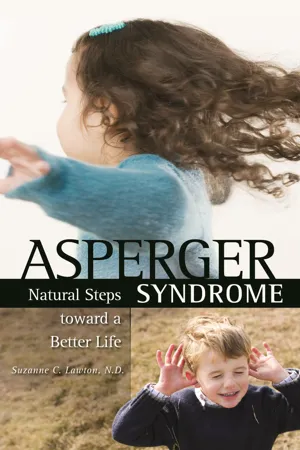
Asperger Syndrome now affects an estimated 10 million children and adults in the United States. Here, Lawton takes an evenhanded look at AS, its development and symptoms, the biological and potential genetic components, the associated physical complaints, and how natural medicine can help. She includes a history of early treatment and current drug and psychotherapy treatments, and explains how diet, blood sugar, and food sensitivities or allergies can play a role. She also looks at the controversy over vaccinations and explains blood tests that can pinpoint a rationale for herbal and homeopathic treatments. The book includes a chapter specifically addressing what is safe to do on your own and when you should seek the help of a medical practitioner. Resources include a listing of AS traits, books that are reliable sources of information, and authoritative Web sites.
The spotlight on Asperger Syndrome has been widening with recent attention from mainstream media. This neurological condition, often misdiagnosed as Attention Deficit Disorder, Obsessive Compulsive Disorder, or high-functioning autism is increasingly being recognized, and now affects an estimated 10 million children and adults in the United States alone. Unlike autistic individuals, Asperger sufferers have normal or above normal language, intelligence and cognition, and are often seen as brilliant—verbose with formal speech patterns and superior memory—but they have odd interests, unusual reactions to the environment, inflexibility in routines, poor interaction with people, and inability to form age-appropriate relationships. There is no known cure, but as Suzanne Lawton explains in this work, there are approaches that can reduce or remove the symptoms. While traditional medications are the only option for some sufferers, there are those who can benefit from the natural treatments offered by herbal medicine, diet and nutrition, homeopathy, and amino acids. These drug-free approaches also reduce the physical problems common to Asperger suffers, including stomachaches and headaches and irritable bowel syndrome. says Lawton.
Recent FDA warnings regarding the use of psychotropic medications with children (previous treatment has focused on anti-anxiety, anti-depressant, and mood-stabilizing drugs) have fueled the outcry of parents who want to get their children off drugs to avoid the side effects. Here, Lawton takes an evenhanded look at Asperger Syndrome, its development and symptoms, the biological and potential genetic components, the associated physical complaints, and how natural medicine can help. She includes a history of early treatment and current drug and psychotherapy treatments, and explains how diet, blood sugar, and food sensitivities or allergies can play a role. She also looks at the controversy over vaccinations and explains blood tests that can pinpoint a rationale for herbal and homeopathic treatments. Lawton includes a chapter specifically addressing what is safe to do on your own and when you should seek the help of a medical practitioner. Resources include a listing of AS traits, books that are reliable sources of information, and authoritative Web sites.
- 201 pages
- English
- PDF
- Available on iOS & Android
eBook - PDF
About this book
Information
Table of contents
- Contents
- Series Foreword
- Foreword by Judyth Reichenberg-Ullman, N.D.
- Preface
- Chapter 1: Asperger Syndrome: What It Is and What It Isn't
- Chapter 2: What Asperger Syndrome Looks Like in Children and Teenagers
- Chapter 3: What Asperger Syndrome Looks Like in an Adult
- Chapter 4: Face Blindness and Place Blindness—Who Are You and Where Am I Going?
- Chapter 5: Conventional Asperger Treatment: Then and Now
- Chapter 6: Physical Symptoms Associated with Asperger Syndrome
- Chapter 7: What You Eat Affects How You Act
- Chapter 8: How the Environment Affects Asperger Syndrome
- Chapter 9: Deer in the Headlights—Dealing with Anxiety, Depression, and Sleep
- Chapter 10: Homeopathy: A Giant Leap Forward
- Chapter 11: What You Can Do Right Now
- Appendix A: Resources Helpful in Addressing Asperger Syndrome
- Appendix B: Common Mercury Derivatives
- Appendix C: Tasty Pesto Recipes Which Will Also Help with Chemical Detoxification
- Notes
- Selected Bibliography
- Index
Trusted by 375,005 students
Access to over 1.5 million titles for a fair monthly price.
Study more efficiently using our study tools.
Frequently asked questions
Yes, you can cancel anytime from the Subscription tab in your account settings on the Perlego website. Your subscription will stay active until the end of your current billing period. Learn how to cancel your subscription
No, books cannot be downloaded as external files, such as PDFs, for use outside of Perlego. However, you can download books within the Perlego app for offline reading on mobile or tablet. Learn how to download books offline
Perlego offers two plans: Essential and Complete
- Essential is ideal for learners and professionals who enjoy exploring a wide range of subjects. Access the Essential Library with 800,000+ trusted titles and best-sellers across business, personal growth, and the humanities. Includes unlimited reading time and Standard Read Aloud voice.
- Complete: Perfect for advanced learners and researchers needing full, unrestricted access. Unlock 1.5M+ books across hundreds of subjects, including academic and specialized titles. The Complete Plan also includes advanced features like Premium Read Aloud and Research Assistant.
We are an online textbook subscription service, where you can get access to an entire online library for less than the price of a single book per month. With over 1.5 million books across 990+ topics, we’ve got you covered! Learn about our mission
Look out for the read-aloud symbol on your next book to see if you can listen to it. The read-aloud tool reads text aloud for you, highlighting the text as it is being read. You can pause it, speed it up and slow it down. Learn more about Read Aloud
Yes! You can use the Perlego app on both iOS and Android devices to read anytime, anywhere — even offline. Perfect for commutes or when you’re on the go.
Please note we cannot support devices running on iOS 13 and Android 7 or earlier. Learn more about using the app
Please note we cannot support devices running on iOS 13 and Android 7 or earlier. Learn more about using the app
Yes, you can access Asperger Syndrome by Suzanne C. Lawton in PDF and/or ePUB format, as well as other popular books in Medicina & Medicina alternativa e complementare. We have over 1.5 million books available in our catalogue for you to explore.