Hurricane Katrina is the latest in a series of major disasters that were not well managed, but it is not likely to be the last. Category 4 and category 5 hurricanes will, according to most predictions, become both more frequent and more intense in the future due to global warming and/or natural weather cycles. In addition, it is often said that another terrorist attack on the United States is inevitable; that it is a question of when, not whether. Add to that the scare over a possible avian flu pandemic. As a result, the United States should expect that disaster response—to natural and other types of disasters—will continue to be of vital concern to the American public and the policymakers and officials who deal with disaster response and relief, including the military.
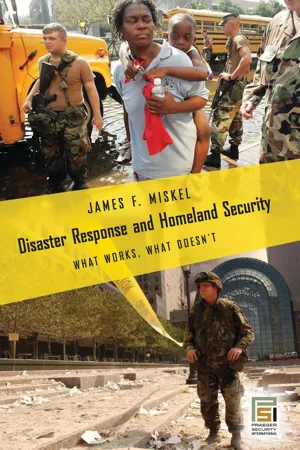
The U.S. disaster relief program reflects a basic division of responsibility between federal, state, and local governments that has generally stood the test of time. At the federal level, a single agency, FEMA—now under the Department of Homeland Security—has been charged with the responsibility for coordinating the activities of the various federal agencies that have a role in disaster relief. A successful disaster response requires three things: timely and effective coordination between state and federal governments; effective coordination among the federal agencies; and effective coordination between and among state and local government agencies. Miskel, a former Deputy Assistant Associate Director of FEMA, examines the effects that operational failures after Hurricanes Agnes, Hugo, Andrew, and Katrina have had on the organizational design and operating principles of the disaster response system program. He also discusses the impact of 9/11 and the evolving role of the military, and he identifies reforms that should be implemented to improve the nation's ability to respond in the future.
- 177 pages
- English
- PDF
- Available on iOS & Android
eBook - PDF
About this book
Information
Table of contents
- CONTENTS
- Preface
- 1. Disaster Response in the United States: How the System Is Supposed to Work
- 2. When the System Fails
- 3. Disaster Relief and the Military: Civil Defense and Homeland Security
- 4. Hurricane Agnes, Three Mile Island, and the Establishment of FEMA
- 5. Hurricanes Hugo and Andrew
- 6. Hurricane Katrina
- 7. Two Other Models
- 8. Conclusion and Recommendations
- Notes
- Selected Resources
- Index
Trusted by 375,005 students
Access to over 1.5 million titles for a fair monthly price.
Study more efficiently using our study tools.
Frequently asked questions
Yes, you can cancel anytime from the Subscription tab in your account settings on the Perlego website. Your subscription will stay active until the end of your current billing period. Learn how to cancel your subscription
No, books cannot be downloaded as external files, such as PDFs, for use outside of Perlego. However, you can download books within the Perlego app for offline reading on mobile or tablet. Learn how to download books offline
Perlego offers two plans: Essential and Complete
- Essential is ideal for learners and professionals who enjoy exploring a wide range of subjects. Access the Essential Library with 800,000+ trusted titles and best-sellers across business, personal growth, and the humanities. Includes unlimited reading time and Standard Read Aloud voice.
- Complete: Perfect for advanced learners and researchers needing full, unrestricted access. Unlock 1.5M+ books across hundreds of subjects, including academic and specialized titles. The Complete Plan also includes advanced features like Premium Read Aloud and Research Assistant.
We are an online textbook subscription service, where you can get access to an entire online library for less than the price of a single book per month. With over 1.5 million books across 990+ topics, we’ve got you covered! Learn about our mission
Look out for the read-aloud symbol on your next book to see if you can listen to it. The read-aloud tool reads text aloud for you, highlighting the text as it is being read. You can pause it, speed it up and slow it down. Learn more about Read Aloud
Yes! You can use the Perlego app on both iOS and Android devices to read anytime, anywhere — even offline. Perfect for commutes or when you’re on the go.
Please note we cannot support devices running on iOS 13 and Android 7 or earlier. Learn more about using the app
Please note we cannot support devices running on iOS 13 and Android 7 or earlier. Learn more about using the app
Yes, you can access Disaster Response and Homeland Security by James Miskel in PDF and/or ePUB format, as well as other popular books in Politics & International Relations & Military & Maritime History. We have over 1.5 million books available in our catalogue for you to explore.