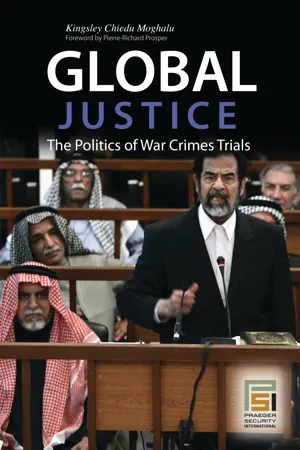
After a controversial war in which he was ousted and captured by United States forces, Saddam Hussein was arraigned before a war crimes tribunal. Slobodan Milosevic died midway through his contentious trial by an international war crimes tribunal at The Hague. Calls for intervention and war crimes trials for the massacres and rapes in Sudan's Darfur region have been loud and clear, and the United States remains fiercely opposed to the permanent International Criminal Court. Are war crimes trials impartial, apolitical forums? Has international justice for war crimes become an entrenched aspect of globalization? In Global Justice, Moghalu examines the phenomenon of war crimes trials from an unusual, political perspective—that of an anarchical international society.
After a controversial war in which he was ousted and captured by United States forces, Saddam Hussein was arraigned before a war crimes tribunal. Slobodan Milosevic died midway through his contentious trial by an international war crimes tribunal at The Hague. Calls for intervention and war crimes trials for the massacres and rapes in Sudan's Darfur region have been loud and clear, and the United States remains fiercely opposed to the permanent International Criminal Court. Are war crimes trials impartial, apolitical forums? Has international justice for war crimes become an entrenched aspect of globalization?
In Global Justice, Moghalu examines the phenomenon of war crimes trials from an unusual, political perspective—that of an anarchical international society. He argues that, contrary to conventional wisdom, war crimes trials are neither motivated nor influenced solely by abstract notions of justice. Instead, war crimes trials are the product of the interplay of political forces that have led to an inevitable clash between globalization and sovereignty on the sensitive question of who should judge war criminals. From Germany's Kaiser Wilhelm to the Japanese Emperor Hirohito, from the trials of Milosevic, Saddam Hussein, and Charles Taylor to Belgium's attempts to enforce the contested doctrine of universal jurisdiction, Moghalu renders a compelling tour de force of one of the most controversial subjects in world politics. He argues that, necessary though it was, international justice has run into a crisis of legitimacy. While international trials will remain a policy option, local or regional responses to mass atrocities will prove more durable.
- 238 pages
- English
- PDF
- Available on iOS & Android
eBook - PDF
About this book
Information
Table of contents
- Contents
- Foreword by Pierre-Richard Prosper
- Preface
- Acknowledgments
- 1. War Crimes Justice in World Politics
- 2. Prosecute or Pardon?
- 3. The Balkans: The Trial of Slobodan Milosevic
- 4. The Rise and Fall of Universal Jurisdiction
- 5. Sierra Leone: Judging Charles Taylor
- 6. The Politics of the International Criminal Court
- 7. Iraq: Chronicle of a Trial Foretold
- 8. International Justice: Not Yet the End of History
- Notes
- Selected Resources
- Index
Trusted by 375,005 students
Access to over 1.5 million titles for a fair monthly price.
Study more efficiently using our study tools.
Frequently asked questions
Yes, you can cancel anytime from the Subscription tab in your account settings on the Perlego website. Your subscription will stay active until the end of your current billing period. Learn how to cancel your subscription
No, books cannot be downloaded as external files, such as PDFs, for use outside of Perlego. However, you can download books within the Perlego app for offline reading on mobile or tablet. Learn how to download books offline
Perlego offers two plans: Essential and Complete
- Essential is ideal for learners and professionals who enjoy exploring a wide range of subjects. Access the Essential Library with 800,000+ trusted titles and best-sellers across business, personal growth, and the humanities. Includes unlimited reading time and Standard Read Aloud voice.
- Complete: Perfect for advanced learners and researchers needing full, unrestricted access. Unlock 1.5M+ books across hundreds of subjects, including academic and specialized titles. The Complete Plan also includes advanced features like Premium Read Aloud and Research Assistant.
We are an online textbook subscription service, where you can get access to an entire online library for less than the price of a single book per month. With over 1.5 million books across 990+ topics, we’ve got you covered! Learn about our mission
Look out for the read-aloud symbol on your next book to see if you can listen to it. The read-aloud tool reads text aloud for you, highlighting the text as it is being read. You can pause it, speed it up and slow it down. Learn more about Read Aloud
Yes! You can use the Perlego app on both iOS and Android devices to read anytime, anywhere — even offline. Perfect for commutes or when you’re on the go.
Please note we cannot support devices running on iOS 13 and Android 7 or earlier. Learn more about using the app
Please note we cannot support devices running on iOS 13 and Android 7 or earlier. Learn more about using the app
Yes, you can access Global Justice by Kingsley Chiedu Moghalu in PDF and/or ePUB format, as well as other popular books in Politics & International Relations & International Relations. We have over 1.5 million books available in our catalogue for you to explore.