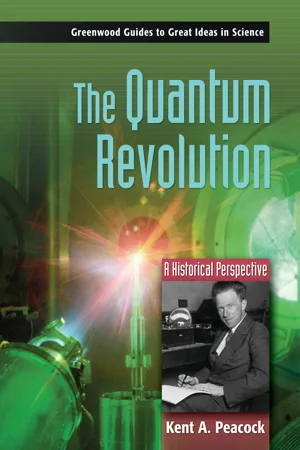
Quantum mechanics is one of the great success stories of modern physics, making sense of the very small just as Einstein's theory of relativity made sense of the very large. But, for most students, the ideas that make quantum mechanics powerful can be confusing and counterintuitive. This volume in the Greenwood Guides to Great Ideas in Science series provides a history of quantum mechanics from the early breakthroughs of Planck and Einstein, at the beginning of the 20th century, to the present frontiers of quantum computing and quantum gravity. The approach is entirely non-technical, and is aimed at the general reader who may not have much mathematical background but who has a strong curiosity about some of the most important developments in modern science.
Quantum Mechanics: A Historical Perspective traces the history of this powerful theory, including:
; The early discoveries by Max Planck and Albert Einstein regarding the quantization of radiation
; The early quantum theory, including Neils Bohr's theory of the atom
; The birth of modern quantum mechanics through the work of Heisenberg, Schrodinger, Born, Dirac and others
; Applications of quantum mechanics in chemistry, nuclear physics, electronics, and many other areas
; Recent work in quantum computation and quantum information theory
The book emphasizes the fact that despite the great success of quantum mechanics, many exciting intellectual frontiers remain open for further researchers to explore. It includes a glossary, a timeline, and a bibliography of accessible resources for further research.
- 240 pages
- English
- PDF
- Available on iOS & Android
eBook - PDF
About this book
Information
Table of contents
- Contents
- List of Illustrations
- Series Foreword
- Preface
- Acknowledgments
- Introduction: Why Learn the History of Quantum Mechanics?
- 1 The Twilight of Certainty
- 2 Einstein and Light
- 3 The Bohr Atom and Old Quantum Theory
- 4 Uncertain Synthesis
- 5 Dualities
- 6 Elements of Physical Reality
- 7 Creation and Annihilation
- 8 Quantum Mechanics Goes to Work
- 9 Symmetries and Resonances
- 10 “The Most Profound Discovery of Science”
- 11 Bits, Qubits, and the Ultimate Computer
- 12 Unfinished Business
- Timeline
- Glossary
- Further Reading
- References
- Index
- Illustration 1.1 Max Planck.
- Illustration 1.2 Light Waves.
- Illustration 1.3 The Electromagnetic Spectrum.
- Illustration 1.4 Planck’s Law.
- Illustration 2.1 Fluctuations and Brownian Motion.
- Illustration 2.2 Spacetime According to Minkowski.
- Illustration 3.1 Spectral Lines.
- Illustration 3.2 Niels Bohr.
- Illustration 3.3 Energy Levels in the Bohr Atom.
- Illustration 4.1 Werner Heisenberg.
- Illustration 4.2 Erwin Schrödinger.
- Illustration 4.3 Typical Electron Orbitals.
- Illustration 4.4 Heisenberg’s Microscope.
- Illustration 5.1 Paul Dirac.
- Illustration 5.2 The Dirac Sea.
- Illustration 5.3 The Double Slit Experiment.
- Illustration 6.1 Niels Bohr and Albert Einstein.
- Illustration 6.2 Schrödinger’s Cat.
- Illustration 6.3 The EPR Apparatus.
- Illustration 7.1 Feynman Diagrams.
- Illustration 7.2 There Is Only One Electron in the Universe!
- Illustration 7.3 Richard P. Feynman.
- Illustration 8.1 Barrier Penetration.
- Illustration 8.2 Lise Meitner.
- Illustration 8.3 The Laser.
- Illustration 9.1 Typical Bubble Chamber Tracks.
- Illustration 9.2 Table of “Elementary” Particles in the Standard Model.
- Illustration 10.1 David Bohm.
- Illustration 10.2 John S. Bell.
- Illustration 10.3 The Aspect Experiment.
- Illustration 10.4 Bob Phones Alice on the Bell Telephone.
- Illustration 11.1 Classical Turing Machine.
- Illustration 11.2 Quantum Turing Machine.
- Illustration 11.3 Quantum Teleportation.
- Illustration 12.1 The Hawking Effect.
- Illustration 12.2 The Unruh Effect.
- Illustration 12.3 Stephen Hawking.
Trusted by 375,005 students
Access to over 1.5 million titles for a fair monthly price.
Study more efficiently using our study tools.
Frequently asked questions
Yes, you can cancel anytime from the Subscription tab in your account settings on the Perlego website. Your subscription will stay active until the end of your current billing period. Learn how to cancel your subscription
No, books cannot be downloaded as external files, such as PDFs, for use outside of Perlego. However, you can download books within the Perlego app for offline reading on mobile or tablet. Learn how to download books offline
Perlego offers two plans: Essential and Complete
- Essential is ideal for learners and professionals who enjoy exploring a wide range of subjects. Access the Essential Library with 800,000+ trusted titles and best-sellers across business, personal growth, and the humanities. Includes unlimited reading time and Standard Read Aloud voice.
- Complete: Perfect for advanced learners and researchers needing full, unrestricted access. Unlock 1.5M+ books across hundreds of subjects, including academic and specialized titles. The Complete Plan also includes advanced features like Premium Read Aloud and Research Assistant.
We are an online textbook subscription service, where you can get access to an entire online library for less than the price of a single book per month. With over 1.5 million books across 990+ topics, we’ve got you covered! Learn about our mission
Look out for the read-aloud symbol on your next book to see if you can listen to it. The read-aloud tool reads text aloud for you, highlighting the text as it is being read. You can pause it, speed it up and slow it down. Learn more about Read Aloud
Yes! You can use the Perlego app on both iOS and Android devices to read anytime, anywhere — even offline. Perfect for commutes or when you’re on the go.
Please note we cannot support devices running on iOS 13 and Android 7 or earlier. Learn more about using the app
Please note we cannot support devices running on iOS 13 and Android 7 or earlier. Learn more about using the app
Yes, you can access The Quantum Revolution by Kent A. Peacock in PDF and/or ePUB format, as well as other popular books in Biological Sciences & Science General. We have over 1.5 million books available in our catalogue for you to explore.