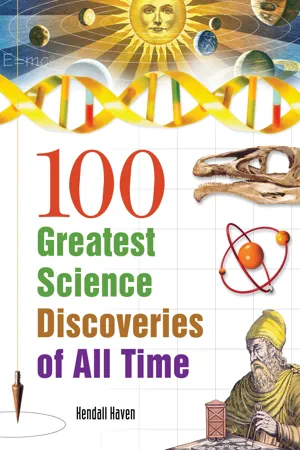
Brimming with fascinating and fun facts about 100 scientific breakthroughs, this collection presents the real stories behind the history of science, at the same time offering a panoramic overview of the history of science and an introduction to some of the most important scientists in history. Grades 6 and up. Throughout history, science has changed lives and dramatically altered the way in which the universe is perceived. Focusing on the 100 most significant scientific events of all time—from Archimedes' discovery of the two fundamental principles underlying physics and engineering (levers and buoyancy) in 260 B.C.E. to human anatomy, Jupiter's moons, electrons, black holes, the human genome, and more—storyteller Kendall Haven has created a ready reference for those seeking information on science discoveries.
- 273 pages
- English
- PDF
- Available on iOS & Android
eBook - PDF
100 Greatest Science Discoveries of All Time
About this book
Information
Table of contents
- Contents
- Acknowledgments
- Introduction
- How to Use this Book
- Levers and Buoyancy
- The Sun Is the Center of the Universe
- Human Anatomy
- The Law of Falling Objects
- Planetary Motion
- Jupiter’s Moons
- Human Circulatory System
- Air Pressure
- Boyle’s Law
- The Existence of Cells
- Universal Gravitation
- Fossils
- Distance to the Sun
- Bacteria
- Laws of Motion
- Order in Nature
- Galaxies
- The Nature of Electricity
- Oceans Control Global Weather
- Oxygen
- Photosynthesis
- Conservation of Matter
- The Nature of Heat
- Erosion of the Earth
- Vaccinations
- Infrared and Ultraviolet
- Anesthesia
- Atoms
- Electrochemical Bonding
- The Existence of Molecules
- Electromagnetism
- First Dinosaur Fossil
- Ice Ages
- Calories (Units of Energy)
- Conservation of Energy
- Doppler Effect
- Germ Theory
- The Theory of Evolution
- Atomic Light Signatures
- Electro magnetic Radiation/Radio Waves
- Heredity
- Deep-Sea Life
- Periodic Chart of Elements
- Cell Division
- X-Rays
- Blood Types
- Electron
- Virus
- Mitochondria
- Radioactivity
- Atmospheric Layers
- Hormones
- E = mc2
- Relativity
- Vitamins
- Radioactive Dating
- Function of Chromosomes
- Antibiotics
- Fault Lines
- Superconductivity
- Atomic Bonding
- Isotopes
- Earth’s Core and Mantle
- Continental Drift
- Black Holes
- Insulin
- Neurotransmitters
- Human Evolution
- Quantum Theory
- Expanding Universe
- Uncertainty Principle
- Speed of Light
- Penicillin
- Antimatter
- Neutron
- Cell Structure
- The Function of Genes
- Ecosystem
- Weak and Strong Force
- Metabolism
- Coelacanth
- Nuclear Fission
- Blood Plasma
- Semiconductor Transistor
- The Big Bang
- Definition of Information
- Jumpin’ Genes
- Fusion
- Origins of Life
- DNA
- Seafloor Spreading
- The Nature of the Atmosphere
- Quarks
- Quasars and Pulsars
- Complete Evolution
- Dark Matter
- The Nature of Dinosaurs
- Planets Exist Around Other Stars
- Accelerating Universe
- Human Genome
- References
- Appendix 1: Discoveries by Scientific Field
- Appendix 2: Scientists
- Appendix 3: The Next 40
- Index
Trusted by 375,005 students
Access to over 1.5 million titles for a fair monthly price.
Study more efficiently using our study tools.
Frequently asked questions
Yes, you can cancel anytime from the Subscription tab in your account settings on the Perlego website. Your subscription will stay active until the end of your current billing period. Learn how to cancel your subscription
No, books cannot be downloaded as external files, such as PDFs, for use outside of Perlego. However, you can download books within the Perlego app for offline reading on mobile or tablet. Learn how to download books offline
Perlego offers two plans: Essential and Complete
- Essential is ideal for learners and professionals who enjoy exploring a wide range of subjects. Access the Essential Library with 800,000+ trusted titles and best-sellers across business, personal growth, and the humanities. Includes unlimited reading time and Standard Read Aloud voice.
- Complete: Perfect for advanced learners and researchers needing full, unrestricted access. Unlock 1.5M+ books across hundreds of subjects, including academic and specialized titles. The Complete Plan also includes advanced features like Premium Read Aloud and Research Assistant.
We are an online textbook subscription service, where you can get access to an entire online library for less than the price of a single book per month. With over 1.5 million books across 990+ topics, we’ve got you covered! Learn about our mission
Look out for the read-aloud symbol on your next book to see if you can listen to it. The read-aloud tool reads text aloud for you, highlighting the text as it is being read. You can pause it, speed it up and slow it down. Learn more about Read Aloud
Yes! You can use the Perlego app on both iOS and Android devices to read anytime, anywhere — even offline. Perfect for commutes or when you’re on the go.
Please note we cannot support devices running on iOS 13 and Android 7 or earlier. Learn more about using the app
Please note we cannot support devices running on iOS 13 and Android 7 or earlier. Learn more about using the app
Yes, you can access 100 Greatest Science Discoveries of All Time by Kendall Haven in PDF and/or ePUB format, as well as other popular books in Languages & Linguistics & Library & Information Science. We have over 1.5 million books available in our catalogue for you to explore.