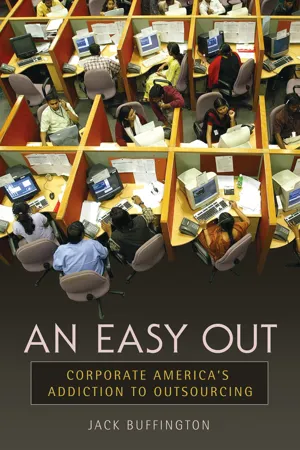
Outsourcing is as controversial as ever in today's globalized world. But for all the noise about it in the media, whether reflecting the perspectives of labor, business, consultants, academics, employees, or protestors, there is far more emotion surrounding the benefits and drawbacks of the trend than there is common sense. Not only are these messages from different constituents polarizing, they are also confusing because they muddy the waters regarding corporate performance. Buffington clarifies the role of outsourcing in business today so that Americans can focus on something that really matters—real increases in productivity and competitiveness in a global economy. In most cases, he contends, neither outsourcing nor its close cousin, offshoring, are effective as a means to their intended end. Moreover, he points out, Americans focus a lot of negative energy on offshoring, not realizing that domestic outsourcing might be more harmful to our economy in the long run. Corporations lack awareness of this distinction, according to Buffington, and therefore they don't know which should be implemented in what circumstances. That ignorance is not only an obstacle for any company seeking to implement a successful outsourcing strategy, but it is also a dire threat to the long-term growth of the American economy.
Buffington demonstrates that outsourcing often functions as an easy out for corporations that are reluctant to look instead at the root causes of their problems, whether low productivity, lack of innovation, or an unwillingness to invest in marketing, promotion, and sales. The reason that corporations aren't focusing on these core issues has a historical element as much as an evolutionary one within a global economy; the divisions today between workers and management are as sharp as they were back in the early 20th century, Buffington argues. But as much as we have to learn from the past about the impact of worker/management relations on worker productivity, we have even more to learn about all aspects of the productivity puzzle. Corporate productivity, or lack thereof, drives the success or failure of outsourcing or offshoring more than the act itself, according to Buffington. This book challenges business leaders to find their productivity and only then to make outsourcing decisions. This approach will work for corporations, consulting firms, outsourcers, and in the end, customers themselves. A more productive, worker-manager friendly business environment will lead to greater U.S. productivity, and therefore, more effective outsourcing/offshoring decisions.
- 198 pages
- English
- PDF
- Available on iOS & Android
eBook - PDF
Table of contents
- Contents
- Illustrations
- CHAPTER ONE The Need for Productivity
- CHAPTER TWO The History and Myths of Outsourcing
- CHAPTER THREE Strange Bedfellows—The Opportunists of Outsourcing
- CHAPTER FOUR Market Myopia, Enron, and Political Overreaction
- CHAPTER FIVE The Economics of Who's Right and Who's Wrong
- CHAPTER SIX Screw It, I'll Outsource
- CHAPTER SEVEN The "Difficult In" over the "Easy Out"
- CHAPTER EIGHT Fear of a Global Planet
- CHAPTER NINE The Last of the Spirits
- CHAPTER TEN Solutions, What If…
- Notes
- Bibliography
- Index
- About the Author
Trusted by 375,005 students
Access to over 1.5 million titles for a fair monthly price.
Study more efficiently using our study tools.
Frequently asked questions
Yes, you can cancel anytime from the Subscription tab in your account settings on the Perlego website. Your subscription will stay active until the end of your current billing period. Learn how to cancel your subscription
No, books cannot be downloaded as external files, such as PDFs, for use outside of Perlego. However, you can download books within the Perlego app for offline reading on mobile or tablet. Learn how to download books offline
Perlego offers two plans: Essential and Complete
- Essential is ideal for learners and professionals who enjoy exploring a wide range of subjects. Access the Essential Library with 800,000+ trusted titles and best-sellers across business, personal growth, and the humanities. Includes unlimited reading time and Standard Read Aloud voice.
- Complete: Perfect for advanced learners and researchers needing full, unrestricted access. Unlock 1.5M+ books across hundreds of subjects, including academic and specialized titles. The Complete Plan also includes advanced features like Premium Read Aloud and Research Assistant.
We are an online textbook subscription service, where you can get access to an entire online library for less than the price of a single book per month. With over 1.5 million books across 990+ topics, we’ve got you covered! Learn about our mission
Look out for the read-aloud symbol on your next book to see if you can listen to it. The read-aloud tool reads text aloud for you, highlighting the text as it is being read. You can pause it, speed it up and slow it down. Learn more about Read Aloud
Yes! You can use the Perlego app on both iOS and Android devices to read anytime, anywhere — even offline. Perfect for commutes or when you’re on the go.
Please note we cannot support devices running on iOS 13 and Android 7 or earlier. Learn more about using the app
Please note we cannot support devices running on iOS 13 and Android 7 or earlier. Learn more about using the app
Yes, you can access An Easy Out by Jack Buffington in PDF and/or ePUB format, as well as other popular books in Business & Business General. We have over 1.5 million books available in our catalogue for you to explore.