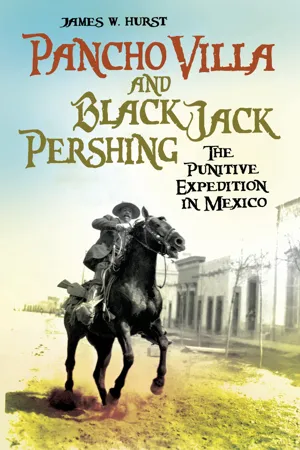
The focus of this book is the Expedition, the Villistas, and their leader Francisco Pancho Villa. Villa's early life witnessed the advent of the typewriter, the telephone, linotype, the automobile, the Kodak camera, the first motion pictures, wireless telegraphy, the airplane, and the radio. In the days before his defeat at Columbus and the subsequent routing of his bands by the Punitive Expedition, Villa had a coterie of journalists wherever he traveled, and he went to great lengths to secure their comfort. In return they provided him with what today would be called good press, and American public opinion was shaped in a generally favorable direction. Villa instinctively realized that image was everything: it was not what you were that mattered but rather what you seemed to be that really counted. In addition to the American newspaper press, both Mexican and American photographers contributed to Villa's role as a legendary hero. A photographic record unprecedented in the annals of bandit-heroes spread the legend, and motion pictures gave an extraordinary boost to his notoriety. He is arguably the most widely recognized Mexican in America, and his picture is often found on the walls of Mexican-American restaurants.
Catching Villa would prove to be difficult, and to do it, Black Jack Pershing and his force needed to rely on local intelligence. Pershing referred to his intelligence-gathering organization as the Intelligence Section, whose officers interrogated prisoners, recruited guides, interpreters, and informers, and organized a secret service of Mexican expatriates who were more than willing to provide their services against Villa. There were a number of Japanese who were employed with mixed results, and a few reliable local Mexicans were employed in the Secret Service with fairly good results. The narrative is itself a reflection of the success of the Intelligence Section in gathering information in the field and preserving what was gathered in detailed, written reports. The reports would not have been possible without the cooperation of the local population, particularly in the Guerrero district and specifically in the pueblo of Namiquipa. Both were hotbeds of Villista sentiment, and early Expedition reports stressed the hostility of the locals. Within a matter of weeks of its arrival, however, the local situation had changed radically. Local farmers were collaborating with the Americans, selling their labor and supplies to the troops and, more importantly, furnishing the invaders with military intelligence.
- 223 pages
- English
- PDF
- Available on iOS & Android
eBook - PDF
About this book
Information
Table of contents
- Contents
- Preface
- Acknowledgments
- Introduction: The Revolutionary Background To The Pershing Expedition
- Chapter One: Denouement, defeat, And The March To Columbus
- Chapter Two: Francisco's Folly: The Attack On Columbus, New Mexico
- Chapter Three: American Reaction To Villa's Raid
- Chapter Four: The Intelligence Section And An Assassination Plot
- Chapter Five: Scraps, Fights, And Skirmishes
- Chapter Six: The Fight At Carrizal
- Chapter Seven: Entering The Doldrums: Idleness, Frustration, And Withdrawal
- Chapter Eight: Wings And Wheels: Reconnaissance, Observation, And Transportation
- Chapter Nine: Logistics And The Base Of Supply
- Chapter Ten: Myth, Legend, And Reality
- Epilogue
- Appendices
- Bibliography
- Index
Trusted by 375,005 students
Access to over 1.5 million titles for a fair monthly price.
Study more efficiently using our study tools.
Frequently asked questions
Yes, you can cancel anytime from the Subscription tab in your account settings on the Perlego website. Your subscription will stay active until the end of your current billing period. Learn how to cancel your subscription
No, books cannot be downloaded as external files, such as PDFs, for use outside of Perlego. However, you can download books within the Perlego app for offline reading on mobile or tablet. Learn how to download books offline
Perlego offers two plans: Essential and Complete
- Essential is ideal for learners and professionals who enjoy exploring a wide range of subjects. Access the Essential Library with 800,000+ trusted titles and best-sellers across business, personal growth, and the humanities. Includes unlimited reading time and Standard Read Aloud voice.
- Complete: Perfect for advanced learners and researchers needing full, unrestricted access. Unlock 1.5M+ books across hundreds of subjects, including academic and specialized titles. The Complete Plan also includes advanced features like Premium Read Aloud and Research Assistant.
We are an online textbook subscription service, where you can get access to an entire online library for less than the price of a single book per month. With over 1.5 million books across 990+ topics, we’ve got you covered! Learn about our mission
Look out for the read-aloud symbol on your next book to see if you can listen to it. The read-aloud tool reads text aloud for you, highlighting the text as it is being read. You can pause it, speed it up and slow it down. Learn more about Read Aloud
Yes! You can use the Perlego app on both iOS and Android devices to read anytime, anywhere — even offline. Perfect for commutes or when you’re on the go.
Please note we cannot support devices running on iOS 13 and Android 7 or earlier. Learn more about using the app
Please note we cannot support devices running on iOS 13 and Android 7 or earlier. Learn more about using the app
Yes, you can access Pancho Villa and Black Jack Pershing by James W. Hurst in PDF and/or ePUB format, as well as other popular books in Social Sciences & Ethnic Studies. We have over 1.5 million books available in our catalogue for you to explore.