As Chiasson and his contributors illustrate, trials are media events that can have long-reaching significance. They can, and have, changed the way people think, how institutions function, and have shaped public opinions. While this collection on ten trials is about withcraft, slavery, religion, and radicalism, it is, in many ways, the story of America.
Trials are the stuff of news. Those rare moments when justice, or a reasonable facsimile, is meted out. And what offers up more high drama, or melodrama, than a highly publicized trial? Most news events enjoy short life spans. They happen; they are reported; they are quickly forgotten. As Chiasson and his contributors make clear, a trial often is a lingering, living thing that builds in tension. It is, every once in a long while, a modern Shakespearean drama with a twist: The audience becomes members of the cast because, every once in a long while, society finds itself the defendant.
Trials can have lasting importance beyond how the public perceives them. A trial can have long-reaching significance if it changes the way people think, or how institutions function, or shapes public opinion. Ten such American trials covering a span of 307 years are covered here. In each, the sociological underpinnings of events often has greater significance than either the crime or the trial. The ten trials included are the Salem witch trials, the Amistad trial, the Sioux Indian Uprising trials, the Ed Johnson/Sheriff Shipp trial, the Big Bill Haywood trial, the Ossian Sweet trial, the Clay Shaw trial, the Manuel Noriega trial, and the Matthew Shepard trial. While the book is about ten crimes, the subsequent trials, and the media coverage of each, it is also a book about witchcraft, about religion, slavery, and radicalism. It paints portraits of a racist America, a capitalistic America, an anarchist America. It relates compelling tales of compassion, greed, stupidity, and hate beginning in 17th-century colonial times and ending in present-day America. In many ways, it is the story of America.
eBook - PDF
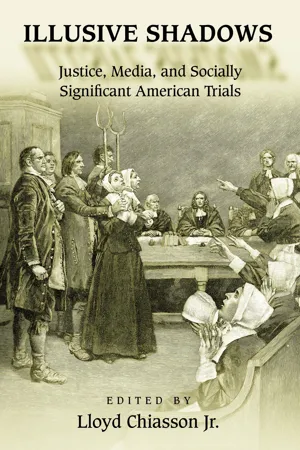
Illusive Shadows
Justice, Media, and Socially Significant American Trials
- 242 pages
- English
- PDF
- Available on iOS & Android
eBook - PDF
About this book
Information
Table of contents
- Contents
- Acknowledgments
- The Opening Statement
- 1 The Case of the Salem Witch Trials (1692) Lloyd Chiasson Jr.
- 2 The Case of the Amistad Mutiny (1839–1840) Bernell E. Tripp
- 3 The Case of the Sioux Uprisings (1862) Joseph P. McKerns
- 4 The Case of Ed Johnson (1906) Kittrell Rushing
- 5 The Case of “Big Bill” Haywood (1907) David R. Spencer
- 6 The Case of Sacco and Vanzetti (1921) Arthur J. Kaul
- 7 The Case of Ossian Sweet (1925–1926) Elijah F. Akhahenda
- 8 The Case of Clay Shaw (1967) Robert Dardenne
- 9 The Case of Manuel Noriega (1991–1992) Nancy McKenzie Dupont
- 10 The Case of Matthew Shepard (1999) Alfred N. Delahaye
- The Summation
- Bibliography
- Index
- About the Editor and Contributors
Trusted by 375,005 students
Access to over 1.5 million titles for a fair monthly price.
Study more efficiently using our study tools.
Frequently asked questions
Yes, you can cancel anytime from the Subscription tab in your account settings on the Perlego website. Your subscription will stay active until the end of your current billing period. Learn how to cancel your subscription
No, books cannot be downloaded as external files, such as PDFs, for use outside of Perlego. However, you can download books within the Perlego app for offline reading on mobile or tablet. Learn how to download books offline
Perlego offers two plans: Essential and Complete
- Essential is ideal for learners and professionals who enjoy exploring a wide range of subjects. Access the Essential Library with 800,000+ trusted titles and best-sellers across business, personal growth, and the humanities. Includes unlimited reading time and Standard Read Aloud voice.
- Complete: Perfect for advanced learners and researchers needing full, unrestricted access. Unlock 1.5M+ books across hundreds of subjects, including academic and specialized titles. The Complete Plan also includes advanced features like Premium Read Aloud and Research Assistant.
We are an online textbook subscription service, where you can get access to an entire online library for less than the price of a single book per month. With over 1.5 million books across 990+ topics, we’ve got you covered! Learn about our mission
Look out for the read-aloud symbol on your next book to see if you can listen to it. The read-aloud tool reads text aloud for you, highlighting the text as it is being read. You can pause it, speed it up and slow it down. Learn more about Read Aloud
Yes! You can use the Perlego app on both iOS and Android devices to read anytime, anywhere — even offline. Perfect for commutes or when you’re on the go.
Please note we cannot support devices running on iOS 13 and Android 7 or earlier. Learn more about using the app
Please note we cannot support devices running on iOS 13 and Android 7 or earlier. Learn more about using the app
Yes, you can access Illusive Shadows by Lloyd E. Chiasson in PDF and/or ePUB format, as well as other popular books in Social Sciences & Business General. We have over 1.5 million books available in our catalogue for you to explore.