- 650 pages
- English
- ePUB (mobile friendly)
- Available on iOS & Android
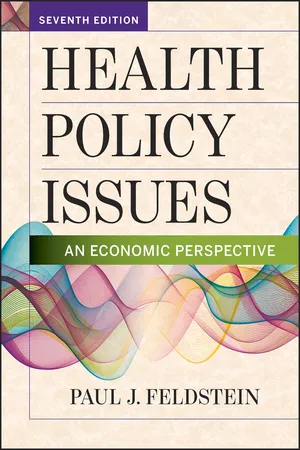
Health Policy Issues: An Economic Perspective, Seventh Edition
About this book
Instructor Resources: Test bank, PowerPoint slides, discussion points for the book's end-of-chapter discussion questions and additional questions and discussion points, teaching tips, chapter overviews, and a transition guide to the new edition. Healthcare affects the lives of most Americans and absorbs a large portion of the United States' resources. It also is continually debated, prompting ongoing legislative changes and market restructuring. One of the best ways to understand healthcare, in all its complexity, is from an economic perspective—that is, from the perspective of the financial self-interest of all involved parties. Health Policy Issues: An Economic Perspective takes just such an approach. Renowned author Paul J. Feldstein describes the forces that press for change in healthcare and explains why the US health system has evolved to its current state. This book's 38 concise, issue-oriented chapters cover various aspects of the US health system, including the cost of medical care, health insurance, Medicare and Medicaid, physician and nursing shortages, medical school admittance, malpractice reform, prescription drugs, and more. Throughout, the book integrates information about the most significant health policy enacted in many years—the Affordable Care Act (ACA). Discussion questions, key points, and further readings round out every chapter. Thoroughly revised and updated with current data and research findings, this seventh edition includes new and expanded content on the Medicare Access and CHIP Reauthorization Act, physician malpractice reform, employee health benefits, generic drug shortages, political versus economic markets, and much more. The updated content includes three new chapters:
- "Should Profits in Healthcare Be Prohibited?" discusses the role of profits and the consequences of eliminating profit.
- "Health Associations and the Political Marketplace" focuses on the types of legislation demanded by different health associations and explores the economic self-interest of each association's members and policy preferences.
- "The Affordable Care Act: Did It Achieve Its Goals?" examines one of the most important objectives of the ACA—to reduce the number of uninsured Americans—and complements the ACA coverage throughout the book.
For 25 years, Health Policy Issues: An Economic Perspective has been highly regarded in the field of health policy. By illuminating the intersection of economics and policy, this topical book helps readers gain a better understanding of the ever-changing and multifaceted healthcare delivery system.
Frequently asked questions
- Essential is ideal for learners and professionals who enjoy exploring a wide range of subjects. Access the Essential Library with 800,000+ trusted titles and best-sellers across business, personal growth, and the humanities. Includes unlimited reading time and Standard Read Aloud voice.
- Complete: Perfect for advanced learners and researchers needing full, unrestricted access. Unlock 1.4M+ books across hundreds of subjects, including academic and specialized titles. The Complete Plan also includes advanced features like Premium Read Aloud and Research Assistant.
Please note we cannot support devices running on iOS 13 and Android 7 or earlier. Learn more about using the app.
Information
Table of contents
- Cover Page
- Title Page
- Copyright Page
- Dedication Page
- Brief Contents
- Detailed Contents
- List of Exhibits
- Preface
- Chapter 1. The Rise of Medical Expenditures
- Chapter 2. How much Should we Spend on Medical Care?
- Chapter 3. Do More Medical Expenditures Produce Better Health?
- Chapter 4. In Whose Interest does the Physician Act?
- Chapter 5. Rationing Medical Services
- Chapter 6. How Much Health Insurance Should Everyone Have?
- Chapter 7. Why are those who Most Need Health Insurance Least able to Buy It?
- Chapter 8. Medicare
- Chapter 9. Medicaid
- Chapter 10. How does Medicare Pay Physicians?
- Chapter 11. The Impending Shortage of Physicians
- Chapter 12. Why is Getting into Medical School so Difficult?
- Chapter 13. The Changing Practice of Medicine
- Chapter 14. Physician Malpractice Reform
- Chapter 15. Do Nonprofit Hospitals behave Differently than For-Profit Hospitals?
- Chapter 16. Competition among Hospitals: Does it Raise or Lower Costs?
- Chapter 17. The Future Role of Hospitals
- Chapter 18. Cost Shifting
- Chapter 19. Can Price Controls Limit Medical Expenditure Increases?
- Chapter 20. The Evolution of Managed Care
- Chapter 21. Has Competition been Tried—and has it Failed—to Improve the US Healthcare System?
- Chapter 22. Comparative Effectiveness Research
- Chapter 23. Who Bears the Cost of Employee Health Benefits?
- Chapter 24. Will a Shortage of Registered Nurses Reoccur?
- Chapter 25. The High Price of Prescription Drugs
- Chapter 26. Ensuring Safety and Efficacy of New Drugs: Too Much of a Good Thing?
- Chapter 27. Why are Prescription Drugs Less Expensive Overseas?
- Chapter 28. The Pharmaceutical Industry: A Public Policy Dilemma
- Chapter 29. Should Kidneys and other Organs be Bought and Sold?
- Chapter 30. Should Profits in Healthcare be Prohibited?
- Chapter 31. The Role of Government in Medical Care
- Chapter 32. Health Associations and the Political Marketplace
- Chapter 33. Medical Research, Medical Education, Alcohol Consumption, and Pollution: Who Should Pay?
- Chapter 34. The Canadian Healthcare System
- Chapter 35. Employer-Mandated National Health Insurance
- Chapter 36. National Health Insurance: Which Approach and Why?
- Chapter 37. Financing Long-Term Care
- Chapter 38. The Affordable Care Act: Did it Achieve its Goals?
- Glossary
- Index
- About the Author
- Back Cover