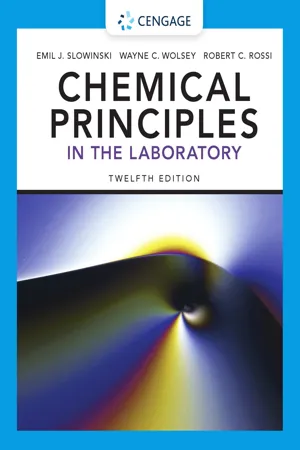
Succeed in chemistry with CHEMICAL PRINCIPLES IN THE LABORATORY, 12th Edition! Clear, user-friendly and direct, this lab manual gives you the tools you need to successfully complete lab experiments and lab reports. Analyzing the data you observe in lab sessions is easy with the manual's numerous Advance Study Assignments that give you extra practice with processing data through sample questions. In addition, a special section shows you how to use both Excel and Google Sheets to simplify making calculations.
eBook - PDF
Chemical Principles in the Laboratory
- 402 pages
- English
- PDF
- Available on iOS & Android
eBook - PDF
Chemical Principles in the Laboratory
About this book
Information
Table of contents
- Cover
- Contents
- Preface
- Safety in the Laboratory
- Experiment 1: The Densities of Liquids and Solids
- Experiment 2: Resolution of Matter into Pure Substances, I. Paper Chromatography
- Experiment 3: Resolution of Matter into Pure Substances, II. Fractional Crystallization
- Experiment 4: Determination of a Chemical Formula
- Experiment 5: Identification of a Compound by Mass Relationships
- Experiment 6: Properties of Hydrates
- Experiment 7: Analysis of an Unknown Chloride
- Experiment 8: Verifying the Absolute Zero of Temperature - Determination of the Atmospheric Pressure
- Experiment 9: Molar Mass of a Volatile Liquid
- Experiment 10: Analysis of an Aluminum-Zinc Alloy
- Experiment 11: The Atomic Spectrum of Hydrogen
- Experiment 12: The Alkaline Earths and the Halogens - Two Families in the Periodic Table
- Experiment 13: The Geometric Structure of Molecules - An Experiment Using Molecular Models
- Experiment 14: Heat Effects and Calorimetry
- Experiment 15: The Vapor Pressure and Heat of Vaporization of a Liquid
- Experiment 16: The Structure of Crystals - An Experiment Using Models
- Experiment 17: Classification of Chemical Substances
- Experiment 18: Some Nonmetals and Their Compounds - Preparations and Properties
- Experiment 19: Molar Mass Determination by Depression of the Freezing Point
- Experiment 20: Rates of Chemical Reactions, I. The Iodination of Acetone
- Experiment 21: Rates of Chemical Reactions, II. A Clock Reaction
- Experiment 22: Properties of Systems in ChemicalEquilibrium - Le Chatelier's Principle
- Experiment 23: Determination of the Equilibrium Constant for a Chemical Reaction
- Experiment 24: The Standardization of a Basic Solution and the Determination of the Molar Mass of an Acid
- Experiment 25: pH Measurements - Buffers and Their Properties
- Experiment 26: Determination of the Solubility Product of Ba(IO3)2
- Experiment 27: Relative Stabilities of Complex Ions and Precipitates Prepared from Solutions of Copper(II)
- Experiment 28: Determination of the Hardness of Water
- Experiment 29: Synthesis and Analysis of a Coordination Compound
- Experiment 30: Determination of Iron by Reaction with Permanganate - A Redox Titration
- Experiment 31: Determination of an Equivalent Mass by Electrolysis
- Experiment 32: Voltaic Cell Measurements
- Experiment 33: Preparation of Copper(I) Chloride
- Experiment 34: Development of a Scheme for Qualitative Analysis
- Experiment 35: Spot Tests for Some Common Anions
- Experiment 36: Qualitative Analysis of Group I Cations
- Experiment 37: Qualitative Analysis of Group II Cations
- Experiment 38: Qualitative Analysis of Group III Cations
- Experiment 39: Identification of a Pure Ionic Solid
- Experiment 40: The Ten Test Tube Mystery
- Experiment 41: Preparation of Aspirin
- Experiment 42: Rate Studies on the Decomposition of Aspirin
- Experiment 43: Analysis for Vitamin C
- Experiment 44: Fundamentals of Quantum Mechanics
- Appendix I: Vapor Pressure and Density of Liquid Water
- Appendix II: Summary of Solubility Properties of Ions and Solids
- Appendix IIA: Some Properties of the Cations in Groups I, II, and III
- Appendix III: Standard Atomic Weights of the Elements (Scaled relative to Carbon-12 ≡ 12 g / mol)
- Appendix IV: Making Measurements - Laboratory Techniques
- Appendix V: Mathematical Considerations - Significant Figures and Making Graphs
- Appendix VI: Suggested Locker Equipment
- Appendix VII: Introduction to Excel
- Appendix VIII: An Introduction to Google Sheets
- Appendix IX: Statistical Treatment of Laboratory Data
Trusted by 375,005 students
Access to over 1.5 million titles for a fair monthly price.
Study more efficiently using our study tools.
Frequently asked questions
Yes, you can cancel anytime from the Subscription tab in your account settings on the Perlego website. Your subscription will stay active until the end of your current billing period. Learn how to cancel your subscription
No, books cannot be downloaded as external files, such as PDFs, for use outside of Perlego. However, you can download books within the Perlego app for offline reading on mobile or tablet. Learn how to download books offline
Perlego offers two plans: Essential and Complete
- Essential is ideal for learners and professionals who enjoy exploring a wide range of subjects. Access the Essential Library with 800,000+ trusted titles and best-sellers across business, personal growth, and the humanities. Includes unlimited reading time and Standard Read Aloud voice.
- Complete: Perfect for advanced learners and researchers needing full, unrestricted access. Unlock 1.5M+ books across hundreds of subjects, including academic and specialized titles. The Complete Plan also includes advanced features like Premium Read Aloud and Research Assistant.
We are an online textbook subscription service, where you can get access to an entire online library for less than the price of a single book per month. With over 1.5 million books across 990+ topics, we’ve got you covered! Learn about our mission
Look out for the read-aloud symbol on your next book to see if you can listen to it. The read-aloud tool reads text aloud for you, highlighting the text as it is being read. You can pause it, speed it up and slow it down. Learn more about Read Aloud
Yes! You can use the Perlego app on both iOS and Android devices to read anytime, anywhere — even offline. Perfect for commutes or when you’re on the go.
Please note we cannot support devices running on iOS 13 and Android 7 or earlier. Learn more about using the app
Please note we cannot support devices running on iOS 13 and Android 7 or earlier. Learn more about using the app
Yes, you can access Chemical Principles in the Laboratory by Emil Slowinski, Wayne Wolsey, Robert Rossi,,Emil Slowinski,Emil Slowinski, Wayne Wolsey, Robert Rossi in PDF and/or ePUB format, as well as other popular books in Physical Sciences & Chemistry. We have over 1.5 million books available in our catalogue for you to explore.