Despite the intensive research carried out in recent years, modality remains an intriguing and challenging issue in linguistics. This book investigates modality from a syntactic viewpoint and with a bottom-up approach. A strong focus of the book is the interaction between the different linguistic tools that build modality (moods, modal verbs, modal adverbs, etc.), taking both the role of syntactic structure and the compositionality of modal meanings into account. The volume comprises corpus-based studies devoted to several syntactic aspects of modality in Ancient Greek, within different theoretical frameworks. The chapters shed new light on different modal categories (e.g. epistemicity, possibility, counterfactuality, evidentiality, subjectivity) and show how these modal meanings arise from the combination of different linguistic devices in specific syntactic contexts (e.g. combinations of modal elements, types of main and dependent clauses, types of illocutionary acts, etc.). By approaching modality from a different perspective and providing an up-to-date discussion of several aspects of modality, the book makes a significant contribution to current debates.
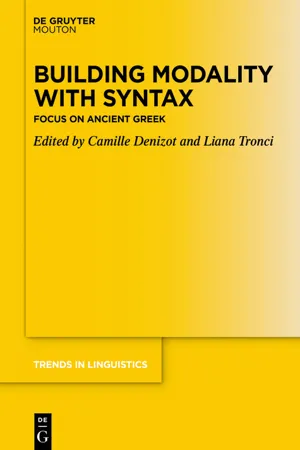
eBook - ePub
Building Modality with Syntax
Focus on Ancient Greek
- 279 pages
- English
- ePUB (mobile friendly)
- Available on iOS & Android
eBook - ePub
Building Modality with Syntax
Focus on Ancient Greek
About this book
Information
Table of contents
- Title Page
- Copyright
- Contents
- List of abbreviations
- 1 For a syntactic approach to modality and its application to Ancient Greek
- 2 Modal uses of knowledge verbs in Ancient Greek
- 3 Information source and complementation in Classical Greek. The case of verbs of seeing and knowledge acquisition
- 4 Syntactic patterns of modality in temporal clauses: Hóte vs. hótan in the diachrony of Ancient Greek
- 5 Variation and change of counterfactual conditionals in Postclassical Greek: Evidence from private papyrus letters
- 6 Conditional subordinate clauses and verbal moods. A case study
- 7 (Inter)subjectivity, modality, and syntax in Classical Greek: Dokéō and phaínomai in addressee-oriented assertions in the dialogues of Plato
- 8 A pragmatic syntax of counterfactual mood attraction and mood (a)symmetry from Archaic to Classical Greek
- 9 Mood, modality and speech acts in clause combination. The case of conditionals
- Index locorum
- Index verborum
- Index notionum
Trusted by 375,005 students
Access to over 1.5 million titles for a fair monthly price.
Study more efficiently using our study tools.
Frequently asked questions
Yes, you can cancel anytime from the Subscription tab in your account settings on the Perlego website. Your subscription will stay active until the end of your current billing period. Learn how to cancel your subscription
No, books cannot be downloaded as external files, such as PDFs, for use outside of Perlego. However, you can download books within the Perlego app for offline reading on mobile or tablet. Learn how to download books offline
Perlego offers two plans: Essential and Complete
- Essential is ideal for learners and professionals who enjoy exploring a wide range of subjects. Access the Essential Library with 800,000+ trusted titles and best-sellers across business, personal growth, and the humanities. Includes unlimited reading time and Standard Read Aloud voice.
- Complete: Perfect for advanced learners and researchers needing full, unrestricted access. Unlock 1.5M+ books across hundreds of subjects, including academic and specialized titles. The Complete Plan also includes advanced features like Premium Read Aloud and Research Assistant.
We are an online textbook subscription service, where you can get access to an entire online library for less than the price of a single book per month. With over 1.5 million books across 990+ topics, we’ve got you covered! Learn about our mission
Look out for the read-aloud symbol on your next book to see if you can listen to it. The read-aloud tool reads text aloud for you, highlighting the text as it is being read. You can pause it, speed it up and slow it down. Learn more about Read Aloud
Yes! You can use the Perlego app on both iOS and Android devices to read anytime, anywhere — even offline. Perfect for commutes or when you’re on the go.
Please note we cannot support devices running on iOS 13 and Android 7 or earlier. Learn more about using the app
Please note we cannot support devices running on iOS 13 and Android 7 or earlier. Learn more about using the app
Yes, you can access Building Modality with Syntax by Camille Denizot, Liana Tronci, Camille Denizot,Liana Tronci in PDF and/or ePUB format, as well as other popular books in Languages & Linguistics & Historical & Comparative Linguistics. We have over 1.5 million books available in our catalogue for you to explore.