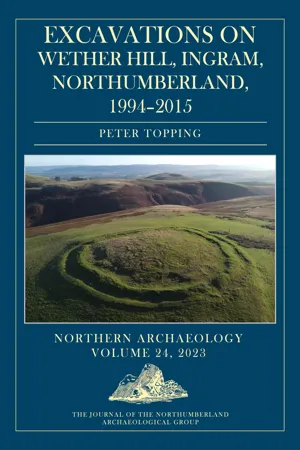
The Northumberland Archaeological Group’s (NAG) Wether Hill project spanned the years 1994–2015 and was located on the eponymous hilltop overlooking the mouth of the Breamish Valley in the Northumberland Cheviots. The project had been inspired by the RCHME’s ‘Southeast Cheviots Project’ that had discovered and recorded extensive prehistoric and later landscapes.
The NAG project investigated several sites. Over the 11 seasons of excavation, NAG recorded evidence of residual Mesolithic activity (microliths), a burial cairn containing two Beakers in an oak coffin, which was superseded by a stone-built cist containing three Food Vessels, Iron Age cord rig cultivation and clearance cairns, a series of Middle/Late Iron Age timber-built palisaded enclosures, a cross-ridge dyke, which protected the southern approach to the Wether Hill fort, and sampled the multi-period bivallate hillfort.
The hillfort sequence on Wether Hill began with a succession of palisaded enclosures, which were later replaced by bivallate earth and stone defenses; both phases appear to have been associated with timber-built houses. Eventually the fort was abandoned, and three stone-built roundhouses were constructed in the fort. The 18 radiocarbon dates obtained from various contexts in the hillfort makes this site one of the better dated forts in the Borders.
The chronology of the Wether Hill fort spanned the Middle/Late Iron Age, which corresponded with dates from palisaded enclosures excavated elsewhere on the hilltop spur. Taken together, this evidence provides a snapshot of settlement hierarchies and agricultural practices during the later Iron Age in this part of the Northumberland Cheviots. The excavations also help contextualize some of the RCHME survey evidence, providing data to model chronology, potential prehistoric settlement density and land-use patterns at different time periods in the well-preserved archaeological landscapes of the Cheviots.
- 152 pages
- English
- ePUB (mobile friendly)
- Available on iOS & Android
eBook - ePub
Excavations on Wether Hill, Ingram, Northumberland, 1994–2015
About this book
Information
Subtopic
British HistoryIndex
HistoryTable of contents
- Front Cover
- Half-Title Page
- Title Page
- Copyright Page
- Contents
- Author details
- Abstract
- Acknowledgements
- Editorial
- 1 Introduction
- 2 A geoarchaeology of Wether Hill, and summary of the palaeo-environmental history
- 3 Area 1: the cross-ridge dyke
- 4 Area 2: the field system
- 5 Area 3: the Beaker/Food Vessel pit [3:028] and palisaded enclosures
- 6 Area 4: the round cairn
- 7 Area 5: the hillfort
- 8 The stone implement assemblages
- 9 The pottery assemblages
- 10 Wether Hill hillfort and its context – a discussion
- Bibliography
Trusted by 375,005 students
Access to over 1.5 million titles for a fair monthly price.
Study more efficiently using our study tools.
Frequently asked questions
Yes, you can cancel anytime from the Subscription tab in your account settings on the Perlego website. Your subscription will stay active until the end of your current billing period. Learn how to cancel your subscription
No, books cannot be downloaded as external files, such as PDFs, for use outside of Perlego. However, you can download books within the Perlego app for offline reading on mobile or tablet. Learn how to download books offline
Perlego offers two plans: Essential and Complete
- Essential is ideal for learners and professionals who enjoy exploring a wide range of subjects. Access the Essential Library with 800,000+ trusted titles and best-sellers across business, personal growth, and the humanities. Includes unlimited reading time and Standard Read Aloud voice.
- Complete: Perfect for advanced learners and researchers needing full, unrestricted access. Unlock 1.5M+ books across hundreds of subjects, including academic and specialized titles. The Complete Plan also includes advanced features like Premium Read Aloud and Research Assistant.
We are an online textbook subscription service, where you can get access to an entire online library for less than the price of a single book per month. With over 1.5 million books across 990+ topics, we’ve got you covered! Learn about our mission
Look out for the read-aloud symbol on your next book to see if you can listen to it. The read-aloud tool reads text aloud for you, highlighting the text as it is being read. You can pause it, speed it up and slow it down. Learn more about Read Aloud
Yes! You can use the Perlego app on both iOS and Android devices to read anytime, anywhere — even offline. Perfect for commutes or when you’re on the go.
Please note we cannot support devices running on iOS 13 and Android 7 or earlier. Learn more about using the app
Please note we cannot support devices running on iOS 13 and Android 7 or earlier. Learn more about using the app
Yes, you can access Excavations on Wether Hill, Ingram, Northumberland, 1994–2015 by Peter Topping in PDF and/or ePUB format, as well as other popular books in History & British History. We have over 1.5 million books available in our catalogue for you to explore.