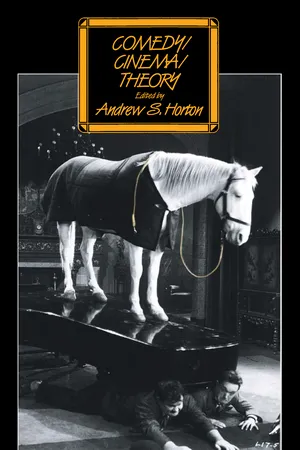
The nature of comedy has interested many thinkers, from Plato to Freud, but film comedy has not received much theoretical attention in recent years. The essays in Comedy/Cinema/Theory use a range of critical and theoretical approaches to explore this curious and fascinating subject. The result is a stimulating, informative book for anyone interested in film, humor, and the art of bringing the two together.
Comedy remains a central human preoccupation, despite the vagaries in form that it has assumed over the centuries in different media. In his introduction, Horton surveys the history of the study of comedy, from Aristophanes to the present, and he also offers a perspective on other related comic forms: printed fiction, comic books, TV sitcoms, jokes and gags.
Some essays in the collection focus on general issues concerning comedy and cinema. In lively (and often humorous) prose, such scholars as Lucy Fischer, Noel Carroll, Peter Lehman, and Brian Henderson employ feminist, post-Freudian, neo-Marxist, and Bakhtinian methodologies. The remaining essays bring theoretical considerations to bear on specific works and comic filmmakers. Peter Brunette, William Paul, Scott Bukatman, Dana Polan, Charles Eidsvik, Ruth Perlmutter, Stephen Mamber, and Andrew Horton provide different perspectives for analyzing The Three Stooges, Chaplin, Jerry Lewis, Woody Allen, Dusan Makavejev, and Alfred Hitchcock's sole comedy, Mr. and Mrs. Smith, as well as the peculiar genre of cynical humor from Eastern Europe.
As editor Horton notes, an over-arching theory of film comedy does not emanate from these essays. Yet the diversity and originality of the contributions reflect vital and growing interest in the subject, and both students of film and general moviegoers will relish the results.
The nature of comedy has interested many thinkers, from Plato to Freud, but film comedy has not received much theoretical attention in recent years. The essays in Comedy/Cinema/Theory use a range of critical and theoretical approaches to explore th
- 256 pages
- English
- ePUB (mobile friendly)
- Available on iOS & Android
eBook - ePub
Comedy/Cinema/Theory
About this book
Information
Table of contents
- Cover
- Title
- Copyright
- Contents
- Acknowledgments
- Introduction
- Notes on the Sight Gag
- Penis-size Jokes and Their Relation to Hollywood’s Unconscious
- Sometimes I Feel Like a Motherless Child
- In Search of Radical Metacinema
- Mock Realism
- Charles Chaplin and the Annals of Anality
- The Light Side of Genius
- Cartoon and Narrative in the Films of Frank Tashlin and
- The Three Stooges and the (Anti-)Narrative of Violence
- Paralysis in Motion
- Woody Allen’s Zelig
- The Mouse Who Wanted to F—k a Cow
- Selected Bibliography and Works Cited
- Contributors
- Index
Trusted by 375,005 students
Access to over 1.5 million titles for a fair monthly price.
Study more efficiently using our study tools.
Frequently asked questions
Yes, you can cancel anytime from the Subscription tab in your account settings on the Perlego website. Your subscription will stay active until the end of your current billing period. Learn how to cancel your subscription
No, books cannot be downloaded as external files, such as PDFs, for use outside of Perlego. However, you can download books within the Perlego app for offline reading on mobile or tablet. Learn how to download books offline
Perlego offers two plans: Essential and Complete
- Essential is ideal for learners and professionals who enjoy exploring a wide range of subjects. Access the Essential Library with 800,000+ trusted titles and best-sellers across business, personal growth, and the humanities. Includes unlimited reading time and Standard Read Aloud voice.
- Complete: Perfect for advanced learners and researchers needing full, unrestricted access. Unlock 1.5M+ books across hundreds of subjects, including academic and specialized titles. The Complete Plan also includes advanced features like Premium Read Aloud and Research Assistant.
We are an online textbook subscription service, where you can get access to an entire online library for less than the price of a single book per month. With over 1.5 million books across 990+ topics, we’ve got you covered! Learn about our mission
Look out for the read-aloud symbol on your next book to see if you can listen to it. The read-aloud tool reads text aloud for you, highlighting the text as it is being read. You can pause it, speed it up and slow it down. Learn more about Read Aloud
Yes! You can use the Perlego app on both iOS and Android devices to read anytime, anywhere — even offline. Perfect for commutes or when you’re on the go.
Please note we cannot support devices running on iOS 13 and Android 7 or earlier. Learn more about using the app
Please note we cannot support devices running on iOS 13 and Android 7 or earlier. Learn more about using the app
Yes, you can access Comedy/Cinema/Theory by Andrew Horton in PDF and/or ePUB format, as well as other popular books in Media & Performing Arts & Film & Video. We have over 1.5 million books available in our catalogue for you to explore.