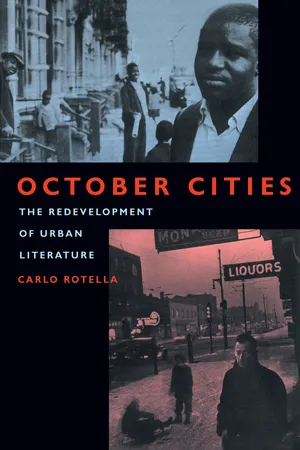
Returning to his native Chicago after World War II, Nelson Algren found a city transformed. The flourishing industry, culture, and literature that had placed prewar Chicago at center stage in American life were entering a time of crisis. The middle class and economic opportunity were leaving the inner city, and Black Southerners arriving in Chicago found themselves increasingly estranged from the nation's economic and cultural resources. For Algren, Chicago was becoming "an October sort of city even in the spring," and as Carlo Rotella demonstrates, this metaphorical landscape of fall led Algren and others to forge a literary form that traced the American city's transformation. Narratives of decline, like the complementary narratives of black migration and inner-city life written by Claude Brown and Gwendolyn Brooks, became building blocks of the postindustrial urban literature.
October Cities examines these narratives as they played out in Chicago, Philadelphia, and Manhattan. Through the work of Algren, Brown, Brooks, and other urban writers, Rotella explores the relationship of this new literature to the cities it draws upon for inspiration. The stories told are of neighborhoods and families molded by dramatic urban transformation on a grand scale with vast movements of capital and people, racial succession, and an intensely changing urban landscape.
Returning to his native Chicago after World War II, Nelson Algren found a city transformed. The flourishing industry, culture, and literature that had placed prewar Chicago at center stage in American life were entering a time of crisis. The middle class
- 384 pages
- English
- ePUB (mobile friendly)
- Available on iOS & Android
eBook - ePub
About this book
Information
Publisher
University of California PressYear
1998Print ISBN
9780520207639
Edition
1eBook ISBN
9780520920101
Table of contents
- Cover
- Title
- Copyright
- Contents
- Illustrations
- Acknowledgments
- Introduction: The City of Feeling and the City of Fact
- Part I The Decline and Fall of the Old Neighborhood
- Exposition: The Story of Decline
- The Old Neighborhood: Industrial Chicago and Its Literatures
- Closing Time: The Man with the Golden Arm
- After the End: The Story of Decline as Act One
- Part 2 The Neighborhood Novel and the Transformation of the Inner City
- Exposition: South Street and the Neighborhood Novel
- Urban Village and Black Metropolis: John Fury and South Street
- The Literature of Postindustrial South Street
- Part 3 The City of Feeling in Crisis
- Exposition: That Separate World
- Violence, the Second Ghetto, and the Logic of Urban Crisis
- Checkpoint Frederick Douglass: Warren Miller and the Boundaries of the Ghetto
- The Box of Groceries and the Omnibus Tour: Manchild in the Promised Land
- The War of Position
- Conclusion: Notes from a Cultural Sea Change
- Notes
- Index
Trusted by 375,005 students
Access to over 1.5 million titles for a fair monthly price.
Study more efficiently using our study tools.
Frequently asked questions
Yes, you can cancel anytime from the Subscription tab in your account settings on the Perlego website. Your subscription will stay active until the end of your current billing period. Learn how to cancel your subscription
No, books cannot be downloaded as external files, such as PDFs, for use outside of Perlego. However, you can download books within the Perlego app for offline reading on mobile or tablet. Learn how to download books offline
We are an online textbook subscription service, where you can get access to an entire online library for less than the price of a single book per month. With over 1.5 million books across 990+ topics, we’ve got you covered! Learn about our mission
Look out for the read-aloud symbol on your next book to see if you can listen to it. The read-aloud tool reads text aloud for you, highlighting the text as it is being read. You can pause it, speed it up and slow it down. Learn more about Read Aloud
Yes! You can use the Perlego app on both iOS and Android devices to read anytime, anywhere — even offline. Perfect for commutes or when you’re on the go.
Please note we cannot support devices running on iOS 13 and Android 7 or earlier. Learn more about using the app
Please note we cannot support devices running on iOS 13 and Android 7 or earlier. Learn more about using the app
Yes, you can access October Cities by Carlo Rotella in PDF and/or ePUB format, as well as other popular books in Literature & North American Literary Criticism. We have over 1.5 million books available in our catalogue for you to explore.