The so-called Mamluk sultans who ruled Egypt and Syria between the late thirteenth and early sixteenth centuries AD have often been portrayed as lacking in legitimacy due to their background as slave soldiers. Sultanic biographies written by chancery officials in the early period of the sultanate have been read as part of an effort of these sultans to legitimise their position on the throne. This book reconsiders the main corpus of six such biographies written by the historians Ibn ?Abd al-??hir (d. 1293) and his nephew Sh?fi? ibn ?Al? (d. 1330) and argues that these were in fact far more complex texts. An understanding of their discourses of legitimisation needs to be embedded within a broader understanding of the multi-directional discourses operating across the texts. The study proposes to interpret these texts as "spectacles", in which authors emplotted the reign of a sultan in thoroughly literary and rhetorical fashion, making especially extensive use of textual forms prevalent in the chancery. In doing so the authors reimagined the format of the biography as a performative vehicle for displaying their literary credentials and helping them negotiate positions in the chancery and the wider courtly orbit.
eBook - ePub
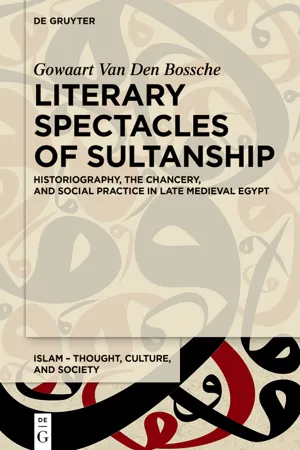
Literary Spectacles of Sultanship
Historiography, the Chancery, and Social Practice in Late Medieval Egypt
- 240 pages
- English
- ePUB (mobile friendly)
- Available on iOS & Android
eBook - ePub
Literary Spectacles of Sultanship
Historiography, the Chancery, and Social Practice in Late Medieval Egypt
About this book
Information
Topic
Scienze socialiSubtopic
Critica letteraria mediorientaleTable of contents
- Title Page
- Copyright
- Contents
- Note on transliteration and abbreviations
- Introduction
- Chapter 1 The sīra corpus: Authors and texts
- Chapter 2 The discourse of Sīra: Historiography, memory, and performance
- Chapter 3 Sīra as an act of narrative construction
- Chapter 4 Sīra as chancery practice: Composition and compilation
- Chapter 5 Sīra as literary communication
- Chapter 6 Sīra as courtly phenomenon
- Chapter 7 Final conclusions
- Index
Trusted by 375,005 students
Access to over 1.5 million titles for a fair monthly price.
Study more efficiently using our study tools.
Frequently asked questions
Yes, you can cancel anytime from the Subscription tab in your account settings on the Perlego website. Your subscription will stay active until the end of your current billing period. Learn how to cancel your subscription
No, books cannot be downloaded as external files, such as PDFs, for use outside of Perlego. However, you can download books within the Perlego app for offline reading on mobile or tablet. Learn how to download books offline
Perlego offers two plans: Essential and Complete
- Essential is ideal for learners and professionals who enjoy exploring a wide range of subjects. Access the Essential Library with 800,000+ trusted titles and best-sellers across business, personal growth, and the humanities. Includes unlimited reading time and Standard Read Aloud voice.
- Complete: Perfect for advanced learners and researchers needing full, unrestricted access. Unlock 1.5M+ books across hundreds of subjects, including academic and specialized titles. The Complete Plan also includes advanced features like Premium Read Aloud and Research Assistant.
We are an online textbook subscription service, where you can get access to an entire online library for less than the price of a single book per month. With over 1.5 million books across 990+ topics, we’ve got you covered! Learn about our mission
Look out for the read-aloud symbol on your next book to see if you can listen to it. The read-aloud tool reads text aloud for you, highlighting the text as it is being read. You can pause it, speed it up and slow it down. Learn more about Read Aloud
Yes! You can use the Perlego app on both iOS and Android devices to read anytime, anywhere — even offline. Perfect for commutes or when you’re on the go.
Please note we cannot support devices running on iOS 13 and Android 7 or earlier. Learn more about using the app
Please note we cannot support devices running on iOS 13 and Android 7 or earlier. Learn more about using the app
Yes, you can access Literary Spectacles of Sultanship by Gowaart Van Den Bossche in PDF and/or ePUB format, as well as other popular books in Scienze sociali & Critica letteraria mediorientale. We have over 1.5 million books available in our catalogue for you to explore.