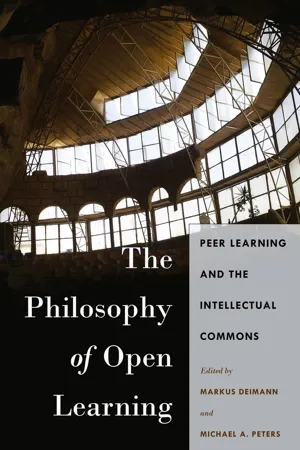
In this book, internationally recognized scholars provide in-depth insight into the emerging field of open education. The Philosophy of Open Learning provides an overview of the current debates and introduces the reader to the overall discourse on open education. The broad range of topics, including MOOCs (Massive Open Online Courses) and OERs (Open Educational Resources) is aimed at demonstrating that open education has emerged as a new principle for organizing higher education. Based on this idea, the book covers various issues that are backed up by thorough philosophical reflections that provide orientation for the heated debates. Open education is discussed in its various imbrications to other open movements, such as open access, and its relevance for education over the last fifteen years.
eBook - PDF
The Philosophy of Open Learning
Peer Learning and the Intellectual Commons
- 161 pages
- English
- PDF
- Available on iOS & Android
eBook - PDF
The Philosophy of Open Learning
Peer Learning and the Intellectual Commons
About this book
Information
Table of contents
- Cover
- Table of Contents
- Foreword (Martin Weller)
- Introduction: Open Education—The Past, the Present and the Future (Markus Deimann and Michael A. Peters)
- Chapter One: Constellations of Openness (Robert Farrow)
- Chapter Two: Openness and the Intellectual Commons (Michael A. Peters)
- Chapter Three: Opening Up Education: Opportunities, Obstacles and Future Perspectives (Petra Missomelius and Theo Hug)
- Chapter Four: MOOCs, Neoliberalism and the Role of the University (David Small)
- Chapter Five: Posthuman Openings: Looking Beyond Technology Instrumentalism (Jeremy Knox)
- Chapter Six: Of Two Contrasting Philosophies That Underpin Openness in Education and What That Entails (Peter B. Sloep and Robert Schuwer)
- Chapter Seven: Another World Is Possible: The Relationship Between Open Higher Education and Mass Intellectuality (Richard Hall)
- Chapter Eight: Open Access, Freedom and Exclusion (Martin Oliver)
- Chapter Nine: Open Learning and Social Innovation: Freedom and Democratic Culture (Michael A. Peters, Richard Heraud and Andrew Gibbons)
- Editors
Trusted by 375,005 students
Access to over 1.5 million titles for a fair monthly price.
Study more efficiently using our study tools.
Frequently asked questions
Yes, you can cancel anytime from the Subscription tab in your account settings on the Perlego website. Your subscription will stay active until the end of your current billing period. Learn how to cancel your subscription
No, books cannot be downloaded as external files, such as PDFs, for use outside of Perlego. However, you can download books within the Perlego app for offline reading on mobile or tablet. Learn how to download books offline
Perlego offers two plans: Essential and Complete
- Essential is ideal for learners and professionals who enjoy exploring a wide range of subjects. Access the Essential Library with 800,000+ trusted titles and best-sellers across business, personal growth, and the humanities. Includes unlimited reading time and Standard Read Aloud voice.
- Complete: Perfect for advanced learners and researchers needing full, unrestricted access. Unlock 1.5M+ books across hundreds of subjects, including academic and specialized titles. The Complete Plan also includes advanced features like Premium Read Aloud and Research Assistant.
We are an online textbook subscription service, where you can get access to an entire online library for less than the price of a single book per month. With over 1.5 million books across 990+ topics, we’ve got you covered! Learn about our mission
Look out for the read-aloud symbol on your next book to see if you can listen to it. The read-aloud tool reads text aloud for you, highlighting the text as it is being read. You can pause it, speed it up and slow it down. Learn more about Read Aloud
Yes! You can use the Perlego app on both iOS and Android devices to read anytime, anywhere — even offline. Perfect for commutes or when you’re on the go.
Please note we cannot support devices running on iOS 13 and Android 7 or earlier. Learn more about using the app
Please note we cannot support devices running on iOS 13 and Android 7 or earlier. Learn more about using the app
Yes, you can access The Philosophy of Open Learning by Markus Deimann,Michael Adrian Peters, A.C. (Tina) Besley,Michael Adrian Peters,Cameron McCarthy,Fazal Rizvi in PDF and/or ePUB format, as well as other popular books in Didattica & Didattica generale. We have over 1.5 million books available in our catalogue for you to explore.