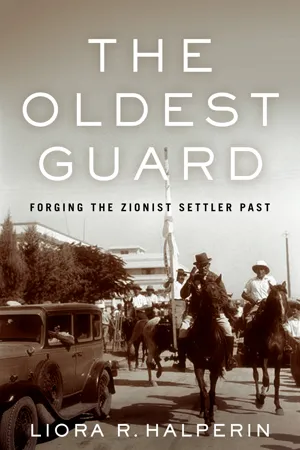
The Oldest Guard
eBook - ePub

The Oldest Guard

Forging the Zionist Settler Past

  1. 368 pages
  2. English
  3. ePUB (mobile friendly)
  4. Available on iOS & Android
eBook - ePub

The Oldest Guard

Forging the Zionist Settler Past

About this book

The Oldest Guard tells the story of Zionist settler memory in and around the private Jewish agricultural colonies (moshavot) established in late nineteenth-century Ottoman Palestine. Though they grew into the backbone of lucrative citrus and wine industries of mandate Palestine and Israel, absorbed tens of thousands of Jewish immigrants, and became known as the "first wave" (First Aliyah) of Zionist settlement, these communities have been regarded—and disregarded—in the history of Zionism as sites of conservatism, lack of ideology, and resistance to Labor Zionist politics.

Treating the "First Aliyah" as a symbol created and deployed only in retrospect, Liora R. Halperin offers a richly textured portrait of commemorative practices between the 1920s and the 1960s. Drawing connections to memory practices in other settler societies, The Oldest Guard demonstrates how private agriculturalists and their advocates in the Zionist center and on the right celebrated and forged the "First Aliyah" past, revealing the centrality of settlement to Zionist collective memory and the politics of Zionist settler "firstness."

Frequently asked questions

Yes, you can cancel anytime from the Subscription tab in your account settings on the Perlego website. Your subscription will stay active until the end of your current billing period. Learn how to cancel your subscription.
No, books cannot be downloaded as external files, such as PDFs, for use outside of Perlego. However, you can download books within the Perlego app for offline reading on mobile or tablet. Learn more here.
Perlego offers two plans: Essential and Complete
  • Essential is ideal for learners and professionals who enjoy exploring a wide range of subjects. Access the Essential Library with 800,000+ trusted titles and best-sellers across business, personal growth, and the humanities. Includes unlimited reading time and Standard Read Aloud voice.
  • Complete: Perfect for advanced learners and researchers needing full, unrestricted access. Unlock 1.4M+ books across hundreds of subjects, including academic and specialized titles. The Complete Plan also includes advanced features like Premium Read Aloud and Research Assistant.
Both plans are available with monthly, semester, or annual billing cycles.
We are an online textbook subscription service, where you can get access to an entire online library for less than the price of a single book per month. With over 1 million books across 1000+ topics, we’ve got you covered! Learn more here.
Look out for the read-aloud symbol on your next book to see if you can listen to it. The read-aloud tool reads text aloud for you, highlighting the text as it is being read. You can pause it, speed it up and slow it down. Learn more here.
Yes! You can use the Perlego app on both iOS or Android devices to read anytime, anywhere — even offline. Perfect for commutes or when you’re on the go.
Please note we cannot support devices running on iOS 13 and Android 7 or earlier. Learn more about using the app.
Yes, you can access The Oldest Guard by Liora R. Halperin in PDF and/or ePUB format, as well as other popular books in Storia & Storia ebraica. We have over one million books available in our catalogue for you to explore.

Information

Table of contents

  1. Cover
  2. Series Page
  3. Title Page
  4. Copyright
  5. Dedication
  6. Contents
  7. Acknowledgments
  8. Note on Transliteration and Translation
  9. Map of “First Aliyah” Colonies
  10. Introduction: Mother of the Colonies
  11. 1. Private Farmers and the Origins of “First Aliyah” Claims-Making
  12. 2. Arab Labor and the Rhetoric of Hierarchical Coexistence in Mandate Palestine
  13. 3. The Old Guard on Display
  14. 4. The Colony and the Village: Constructions of Coexistence after the Nakba
  15. 5. Jewish Immigrants and the Politics of Settler “First Ones”
  16. Conclusion: Thinking about the First Aliyah after 1967
  17. Notes
  18. Bibliography
  19. Index
  20. Series List