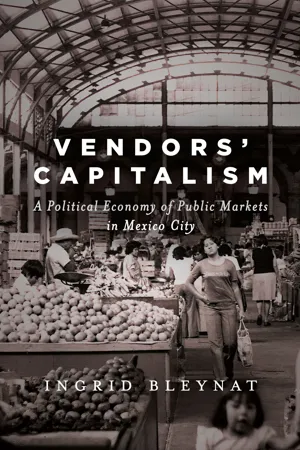
Vendors' Capitalism
eBook - ePub

Vendors' Capitalism

A Political Economy of Public Markets in Mexico City

  1. 264 pages
  2. English
  3. ePUB (mobile friendly)
  4. Available on iOS & Android
eBook - ePub

Vendors' Capitalism

A Political Economy of Public Markets in Mexico City

About this book

Mexico City's public markets were integral to the country's economic development, bolstering the expansion of capitalism from the mid-nineteenth to mid-twentieth centuries. These publicly owned and operated markets supplied households with everyday necessities and generated revenue for local authorities. At the same time, they were embedded in a wider network of economic and social relations that gave market vendors an influence far beyond the running of their stalls. As they fed the capital's population, these vendors fought to protect their own livelihoods, shaping the public sphere and broadening the scope of popular politics.

Vendors' Capitalism argues for the centrality of Mexico City's public markets to the political economy of the city from the restoration of the Republic in 1867 to the heyday of the Mexican miracle and the PRI in the 1960s. Each day vendors interacted with customers, suppliers, government officials, and politicians, and the multiple conflicts that arose repeatedly tested the institutional capacity of the state. Through a close reading of the archives and an analysis of vendors' intersecting economic and political lives, Ingrid Bleynat explores the dynamics, as well as the limits, of capitalist development in Mexico.

Frequently asked questions

Yes, you can cancel anytime from the Subscription tab in your account settings on the Perlego website. Your subscription will stay active until the end of your current billing period. Learn how to cancel your subscription.
No, books cannot be downloaded as external files, such as PDFs, for use outside of Perlego. However, you can download books within the Perlego app for offline reading on mobile or tablet. Learn more here.
Perlego offers two plans: Essential and Complete
  • Essential is ideal for learners and professionals who enjoy exploring a wide range of subjects. Access the Essential Library with 800,000+ trusted titles and best-sellers across business, personal growth, and the humanities. Includes unlimited reading time and Standard Read Aloud voice.
  • Complete: Perfect for advanced learners and researchers needing full, unrestricted access. Unlock 1.4M+ books across hundreds of subjects, including academic and specialized titles. The Complete Plan also includes advanced features like Premium Read Aloud and Research Assistant.
Both plans are available with monthly, semester, or annual billing cycles.
We are an online textbook subscription service, where you can get access to an entire online library for less than the price of a single book per month. With over 1 million books across 1000+ topics, we’ve got you covered! Learn more here.
Look out for the read-aloud symbol on your next book to see if you can listen to it. The read-aloud tool reads text aloud for you, highlighting the text as it is being read. You can pause it, speed it up and slow it down. Learn more here.
Yes! You can use the Perlego app on both iOS or Android devices to read anytime, anywhere — even offline. Perfect for commutes or when you’re on the go.
Please note we cannot support devices running on iOS 13 and Android 7 or earlier. Learn more about using the app.
Yes, you can access Vendors' Capitalism by Ingrid Bleynat in PDF and/or ePUB format, as well as other popular books in History & 20th Century History. We have over one million books available in our catalogue for you to explore.

Table of contents

  1. Cover
  2. Title Page
  3. Copyright
  4. Dedication
  5. Contents
  6. Acknowledgments
  7. Introduction: Market Vendors and the History of Capitalism in Mexico, 1867–1966
  8. 1. Taxes and Compassion, 1867–1880
  9. 2. A Cloak of Magnificence over Beggars’ Rags, 1880–1903
  10. 3. Vendors, Workers, or Pueblo? 1903–1928
  11. 4. Political Experimentation in a Time of Crises, 1929–1945
  12. 5. Vendors’ Developmentalism, 1945–1966
  13. Epilogue
  14. Notes
  15. Bibliography
  16. Index