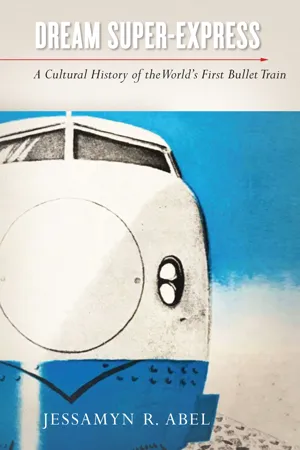
A symbol of the "new Japan" displayed at World's Fairs, depicted in travel posters, and celebrated as the product of a national spirit of innovation, the T?kaid? Shinkansen—the first bullet train, dubbed the "dream super-express"—represents the bold aspirations of a nation rebranding itself after military defeat, but also the deep problems caused by the unbridled postwar drive for economic growth. At the dawn of the space age, how could a train become such an important symbol? In Dream Super-Express, Jessamyn Abel contends that understanding the various, often contradictory, images of the bullet train reveals how infrastructure operates beyond its intended use as a means of transportation to perform cultural and sociological functions. The multi-layered dreams surrounding this high-speed railway tell a history not only of nation-building but of resistance and disruption. Though it constituted neither a major technological leap nor a new infrastructural connection, the train enchanted, enthralled, and enraged government officials, media pundits, community activists, novelists, and filmmakers. This history of imaginations around the monumental rail system resists the commonplace story of progress to consider the tug-of-war over the significance of the new line. Is it a vision of the future or a reminder of the past, an object of international admiration or a formidable threat? Does it enable new relationships and identities or reify existing social hierarchies? Tracing the meanings assigned to high-speed rail shows how it prompted a reimagination of identity on the levels of individual, metropolis, and nation in a changing Japan.
- 304 pages
- English
- ePUB (mobile friendly)
- Available on iOS & Android
eBook - ePub
About this book
Information
Publisher
Stanford University PressYear
2022Print ISBN
9781503629943
9781503610385
Edition
1eBook ISBN
9781503629950
Table of contents
- Cover
- Title Page
- Copyright
- Series Page
- Contents
- Acknowledgments
- Introduction: Dreams of Infrastructure
- 1. Invisible Infrastructures of Protest in Kyoto
- 2. Reconstructing the Tо̄kaidо̄
- 3. Railroad for the Information Society
- 4. Nostalgia for Imperial Japan
- 5. Technology of Cultural Diplomacy
- Conclusion: Bullet Train Dreams in the Twenty-First Century
- Notes
- Bibliography
- Index
- Series List
Trusted by 375,005 students
Access to over 1.5 million titles for a fair monthly price.
Study more efficiently using our study tools.
Frequently asked questions
Yes, you can cancel anytime from the Subscription tab in your account settings on the Perlego website. Your subscription will stay active until the end of your current billing period. Learn how to cancel your subscription
No, books cannot be downloaded as external files, such as PDFs, for use outside of Perlego. However, you can download books within the Perlego app for offline reading on mobile or tablet. Learn how to download books offline
Perlego offers two plans: Essential and Complete
- Essential is ideal for learners and professionals who enjoy exploring a wide range of subjects. Access the Essential Library with 800,000+ trusted titles and best-sellers across business, personal growth, and the humanities. Includes unlimited reading time and Standard Read Aloud voice.
- Complete: Perfect for advanced learners and researchers needing full, unrestricted access. Unlock 1.5M+ books across hundreds of subjects, including academic and specialized titles. The Complete Plan also includes advanced features like Premium Read Aloud and Research Assistant.
We are an online textbook subscription service, where you can get access to an entire online library for less than the price of a single book per month. With over 1.5 million books across 990+ topics, we’ve got you covered! Learn about our mission
Look out for the read-aloud symbol on your next book to see if you can listen to it. The read-aloud tool reads text aloud for you, highlighting the text as it is being read. You can pause it, speed it up and slow it down. Learn more about Read Aloud
Yes! You can use the Perlego app on both iOS and Android devices to read anytime, anywhere — even offline. Perfect for commutes or when you’re on the go.
Please note we cannot support devices running on iOS 13 and Android 7 or earlier. Learn more about using the app
Please note we cannot support devices running on iOS 13 and Android 7 or earlier. Learn more about using the app
Yes, you can access Dream Super-Express by Jessamyn Abel in PDF and/or ePUB format, as well as other popular books in History & 20th Century History. We have over 1.5 million books available in our catalogue for you to explore.