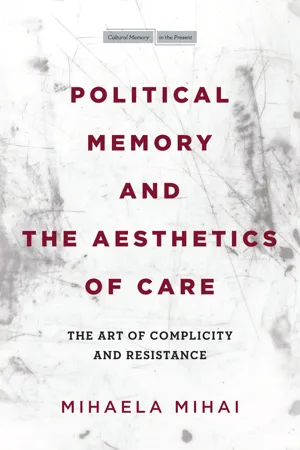
Political Memory and the Aesthetics of Care
eBook - ePub

Political Memory and the Aesthetics of Care

The Art of Complicity and Resistance

  1. 312 pages
  2. English
  3. ePUB (mobile friendly)
  4. Available on iOS & Android
eBook - ePub

Political Memory and the Aesthetics of Care

The Art of Complicity and Resistance

About this book

With this nuanced and interdisciplinary work, political theorist Mihaela Mihai tackles several interrelated questions: How do societies remember histories of systemic violence? Who is excluded from such histories' cast of characters? And what are the political costs of selective remembering in the present?

Building on insights from political theory, social epistemology, and feminist and critical race theory, Mihai argues that a double erasure often structures hegemonic narratives of complex violence: of widespread, heterogeneous complicity and of "impure" resistances, not easily subsumed to exceptionalist heroic models. In dialogue with care ethicists and philosophers of art, she then suggests that such narrative reductionism can be disrupted aesthetically through practices of "mnemonic care," that is, through the hermeneutical labor that critical artists deliver—thematically and formally—within communities' space of meaning. Empirically, the book examines both consecrated and marginalized artists who tackled the memory of Vichy France, communist Romania, and apartheid South Africa. Despite their specificities, these contexts present us with an opportunity to analyze similar mnemonic dynamics and to recognize the political impact of dissenting artistic production.

Crossing disciplinary boundaries, the book intervenes in debates over collective responsibility, historical injustice, and the aesthetics of violence within political theory, memory studies, social epistemology, and transitional justice.

Frequently asked questions

Yes, you can cancel anytime from the Subscription tab in your account settings on the Perlego website. Your subscription will stay active until the end of your current billing period. Learn how to cancel your subscription.
No, books cannot be downloaded as external files, such as PDFs, for use outside of Perlego. However, you can download books within the Perlego app for offline reading on mobile or tablet. Learn more here.
Perlego offers two plans: Essential and Complete
  • Essential is ideal for learners and professionals who enjoy exploring a wide range of subjects. Access the Essential Library with 800,000+ trusted titles and best-sellers across business, personal growth, and the humanities. Includes unlimited reading time and Standard Read Aloud voice.
  • Complete: Perfect for advanced learners and researchers needing full, unrestricted access. Unlock 1.4M+ books across hundreds of subjects, including academic and specialized titles. The Complete Plan also includes advanced features like Premium Read Aloud and Research Assistant.
Both plans are available with monthly, semester, or annual billing cycles.
We are an online textbook subscription service, where you can get access to an entire online library for less than the price of a single book per month. With over 1 million books across 1000+ topics, we’ve got you covered! Learn more here.
Look out for the read-aloud symbol on your next book to see if you can listen to it. The read-aloud tool reads text aloud for you, highlighting the text as it is being read. You can pause it, speed it up and slow it down. Learn more here.
Yes! You can use the Perlego app on both iOS or Android devices to read anytime, anywhere — even offline. Perfect for commutes or when you’re on the go.
Please note we cannot support devices running on iOS 13 and Android 7 or earlier. Learn more about using the app.
Yes, you can access Political Memory and the Aesthetics of Care by Mihaela Mihai in PDF and/or ePUB format, as well as other popular books in Philosophy & Social History. We have over one million books available in our catalogue for you to explore.

Information

Table of contents

  1. Cover
  2. Title Page
  3. Copyright
  4. Series Page
  5. Contents
  6. Acknowledgments
  7. Introduction
  8. 1. Tracing the Double Erasure
  9. 2. The Aesthetics of Care
  10. 3. France’s “Dark Years”
  11. 4. Romania’s Horizons of Hope and Despair
  12. 5. The Spectrum of Apartheid in South Africa
  13. Conclusion Heretic Visions, Responsible Futures
  14. Notes
  15. References
  16. Index
  17. Series List