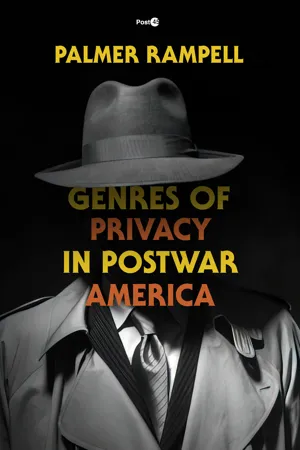
Genres of Privacy in Postwar America
eBook - ePub

Genres of Privacy in Postwar America

  1. 240 pages
  2. English
  3. ePUB (mobile friendly)
  4. Available on iOS & Android
eBook - ePub

Genres of Privacy in Postwar America

About this book

With this incisive work, Palmer Rampell reveals the surprising role genre fiction played in redefining the category of the private person in the postwar period. Especially after the Supreme Court established a constitutional right to privacy in 1965, legal scholars, judges, and the public scrambled to understand the scope of that right. Before and after the Court's ruling, authors of genre fiction and film reformulated their aliens, androids, and monsters to engage in debates about personal privacy as it pertained to issues like abortion, police surveillance, and euthanasia.

Triangulating novels and films with original archival discoveries and historical and legal research, Rampell provides new readings of Patricia Highsmith, Dorothy B. Hughes, Philip K. Dick, Octavia Butler, Chester Himes, Stephen King, Cormac McCarthy, and others. The book pairs the right of privacy for heterosexual sex with queer and proto-feminist crime fiction; racialized police surveillance at midcentury with Black crime fiction; Roe v. Wade (1973) with 1960s and 1970s science fiction; the Child Abuse Prevention and Treatment Act (1974) with horror; and the right to die with westerns. While we are accustomed to defenses of fiction for its capacity to represent fully rendered private life, Rampell suggests that we might value a certain strand of genre fiction for its capacity to theorize the meaning of the protean concept of privacy.

Frequently asked questions

Yes, you can cancel anytime from the Subscription tab in your account settings on the Perlego website. Your subscription will stay active until the end of your current billing period. Learn how to cancel your subscription.
No, books cannot be downloaded as external files, such as PDFs, for use outside of Perlego. However, you can download books within the Perlego app for offline reading on mobile or tablet. Learn more here.
Perlego offers two plans: Essential and Complete
  • Essential is ideal for learners and professionals who enjoy exploring a wide range of subjects. Access the Essential Library with 800,000+ trusted titles and best-sellers across business, personal growth, and the humanities. Includes unlimited reading time and Standard Read Aloud voice.
  • Complete: Perfect for advanced learners and researchers needing full, unrestricted access. Unlock 1.4M+ books across hundreds of subjects, including academic and specialized titles. The Complete Plan also includes advanced features like Premium Read Aloud and Research Assistant.
Both plans are available with monthly, semester, or annual billing cycles.
We are an online textbook subscription service, where you can get access to an entire online library for less than the price of a single book per month. With over 1 million books across 1000+ topics, we’ve got you covered! Learn more here.
Look out for the read-aloud symbol on your next book to see if you can listen to it. The read-aloud tool reads text aloud for you, highlighting the text as it is being read. You can pause it, speed it up and slow it down. Learn more here.
Yes! You can use the Perlego app on both iOS or Android devices to read anytime, anywhere — even offline. Perfect for commutes or when you’re on the go.
Please note we cannot support devices running on iOS 13 and Android 7 or earlier. Learn more about using the app.
Yes, you can access Genres of Privacy in Postwar America by Palmer Rampell in PDF and/or ePUB format, as well as other popular books in Literature & Social History. We have over one million books available in our catalogue for you to explore.

Table of contents

  1. Cover
  2. Title Page
  3. Copyright
  4. Series Page
  5. Dedication
  6. Table of Contents
  7. Introduction: Genres of Privacy
  8. 1. The Queer Art of Murder
  9. 2. Midcentury Black Cops
  10. 3. The Science Fiction of Roe v. Wade
  11. 4. Exorcising Child Abuse in the 1970s
  12. 5. Bury Me Not on the Lone Prairie
  13. Conclusion
  14. Acknowledgments
  15. Notes
  16. Index
  17. Series List