- 344 pages
- English
- ePUB (mobile friendly)
- Available on iOS & Android
About this book
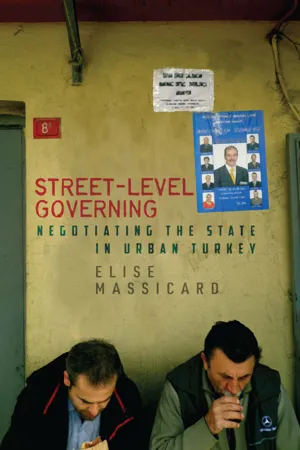
Muhtars, the lowest level elected political position in Turkey, hold an ambiguously defined place within the administrative hierarchy. They are public officials, but local citizens do not always associate them with the central government. Street-Level Governing is the first book to investigate how muhtars carry out their role—not only what they are supposed to do, but how they actually operate—to provide an ethnographic study of the state as viewed from its margins. It starts from the premise that the seeming "margin" of state administration is not peripheral at all, but instructive as to how it functions.
As Elise Massicard shows, muhtars exist at the intersection of everyday life and the exercise of power. Their position offers a personalized point of contact between citizens and state institutions, enabling close oversight of the citizenry, yet simultaneously projecting the sense of an accessible state to individuals. Challenging common theories of the state, Massicard outlines how the position of the muhtar throws into question an assumed dichotomy between domination and social resistance, and suggests that considerations of circumvention and accommodation are normal attributes of state-society functioning.
Frequently asked questions
- Essential is ideal for learners and professionals who enjoy exploring a wide range of subjects. Access the Essential Library with 800,000+ trusted titles and best-sellers across business, personal growth, and the humanities. Includes unlimited reading time and Standard Read Aloud voice.
- Complete: Perfect for advanced learners and researchers needing full, unrestricted access. Unlock 1.4M+ books across hundreds of subjects, including academic and specialized titles. The Complete Plan also includes advanced features like Premium Read Aloud and Research Assistant.
Please note we cannot support devices running on iOS 13 and Android 7 or earlier. Learn more about using the app.
Information
Table of contents
- Cover
- Title Page
- Copyright
- Series Page
- Dedication
- Contents
- Abbreviations
- Acknowledgments
- Introduction
- Part 1. A Hybrid Institution Anchored in Local Society
- Part 2. A Familiar Institution in the Time of Databases
- Part 3. Contrasting Political Effects
- Part 4. Loss of Autonomy at the Microlocal Level
- Conclusion
- Appendix: The Muhtars Studied
- Notes
- References
- Index
- Series List