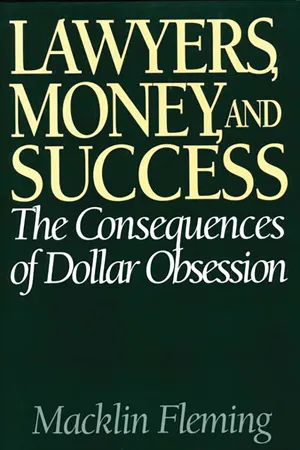
Retired Justice Macklin Fleming argues that in its quest for money, the legal profession has lost sight of its true tasks and responsibilities, with the result that the profession is rife with client dissatisfaction, public distrust, and individual lawyer discontent. Money is now the measure of success, he says, and honesty has been diluted, while fiduciary responsibility has eroded. Fleming elaborates his case with unusual rigor. In the quest for the brass ring of financial success, corner-cutting, absence of candor, and distortions of fact have become increasingly tolerated, to the extent that clients, the public, and lawyers themselves no longer have a sense of trust and confidence in the legal profession. Obviously, changes are needed, and unless they come from within the firms themselves, lawyers can be sure that they will come from individuals, agencies, and organizations outside these firms. Attorneys in all kinds of practices, their clients in all sectors of the economy, and academics concerned with the practice of law in all its dimensions will find Fleming's book informative, challenging, and certainly provocative reading.
Fleming starts by examining what he sees as a paradox: a large increase in lawyers' fees despite a fourfold increase in lawyer numbers and a threefold increase in their proportion of the general population. What happened to the law of supply and demand? he asks. After tracing the history of the large corporate law firm and its dominance within the profession, he shows how cost-effectiveness within large firms has declined while at the same time what he calls the magic of the emperor's new clothes has suspended the law of supply and demand. He discusses excessive legal fees, their resistance to client and court controls, and relates his discussion to the present pervasive distrust of lawyers among the public. Fleming outlines the four existing challenges to business-as-usual by lawyers and law firms, and then ventures his own analysis of the needed future changes in law firms. These include professional law firm management under a less archaic structure, effective integrity and quality controls, cost-controlled delivery of legal services, and increased job satisfaction for its working lawyers.
- 168 pages
- English
- PDF
- Available on iOS & Android
eBook - PDF
Table of contents
- Contents
- Preface
- 1 The Paradox
- 2 Invention of the Corporate Law Firm and Its Evolution into the Large Law Firm
- 3 Emergence of the Large Law Firm as the Dominant Element of the Profession
- 4 The Decline of Cost-Effectiveness Within the Large Law Firm
- 5 The Magic of the Emperor’s New Clothes Suspends the Law of Supply and Demand
- 6 Excessive Legal Fees: The Count Dracula Clients Cannot Stake
- 7 Excessive Legal Fees: Even the Courts Can’t Stake Dracula
- 8 Lawyers and Their Discontents
- 9 The Pervasive Public Distrust of Lawyers
- 10 Through a Glass Darkly
- 11 First Challenge: Client Control of Fees
- 12 Second Challenge: Increased Court Control over Legal Proceedings and Lawyer Conduct
- 13 Third Challenge: The Bite of Competition
- 14 Fourth Challenge: Restlessness in the Workplace
- 15 The Shape of Law Firms to Come: Professional Management
- 16 The Shape of Law Firms to Come: Integrity and Quality Control
- 17 The Shape of Law Firms to Come: Competitiveness and Job Satisfaction
- 18 L’Envoi—Visions in the Crystal Ball
- Notes
- Index
Trusted by 375,005 students
Access to over 1.5 million titles for a fair monthly price.
Study more efficiently using our study tools.
Frequently asked questions
Yes, you can cancel anytime from the Subscription tab in your account settings on the Perlego website. Your subscription will stay active until the end of your current billing period. Learn how to cancel your subscription
No, books cannot be downloaded as external files, such as PDFs, for use outside of Perlego. However, you can download books within the Perlego app for offline reading on mobile or tablet. Learn how to download books offline
Perlego offers two plans: Essential and Complete
- Essential is ideal for learners and professionals who enjoy exploring a wide range of subjects. Access the Essential Library with 800,000+ trusted titles and best-sellers across business, personal growth, and the humanities. Includes unlimited reading time and Standard Read Aloud voice.
- Complete: Perfect for advanced learners and researchers needing full, unrestricted access. Unlock 1.5M+ books across hundreds of subjects, including academic and specialized titles. The Complete Plan also includes advanced features like Premium Read Aloud and Research Assistant.
We are an online textbook subscription service, where you can get access to an entire online library for less than the price of a single book per month. With over 1.5 million books across 990+ topics, we’ve got you covered! Learn about our mission
Look out for the read-aloud symbol on your next book to see if you can listen to it. The read-aloud tool reads text aloud for you, highlighting the text as it is being read. You can pause it, speed it up and slow it down. Learn more about Read Aloud
Yes! You can use the Perlego app on both iOS and Android devices to read anytime, anywhere — even offline. Perfect for commutes or when you’re on the go.
Please note we cannot support devices running on iOS 13 and Android 7 or earlier. Learn more about using the app
Please note we cannot support devices running on iOS 13 and Android 7 or earlier. Learn more about using the app
Yes, you can access Lawyers, Money, and Success by Macklin Fleming in PDF and/or ePUB format, as well as other popular books in Law & Financial Law. We have over 1.5 million books available in our catalogue for you to explore.