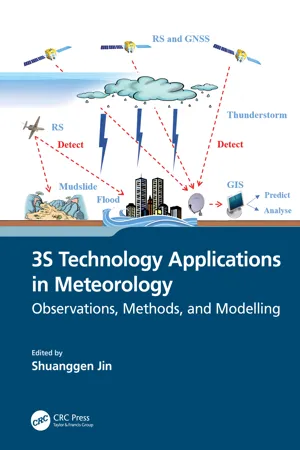
3S Technology Applications in Meteorology
eBook - ePub

3S Technology Applications in Meteorology

Observations, Methods, and Modelling

  1. 427 pages
  2. English
  3. ePUB (mobile friendly)
  4. Available on iOS & Android
eBook - ePub

3S Technology Applications in Meteorology

Observations, Methods, and Modelling

About this book

Spatial information technology and its integration, such as remote sensing, geographic information systems (GIS), and global navigation satellite systems (GNSS), known as 3S technology, have been extensively utilized in managing and monitoring natural disasters. This book illustrates the 3S integrated applications in the field of meteorology and promotes the role of 3S in developing precise and intelligent meteorology. It presents the principles of 3S technology and the methods for monitoring different meteorological disasters and hazards as well as their application progress. The case studies from the United States, Japan, China, and Europe were conducted to help all countries understand the 3S technology functions in handling and monitoring severe meteorological hazards.

FEATURES

  • Presents integral observations from GNSS, GIS, and remote sensing in estimating and understanding meteorological changes
  • Explains how to monitor and retrieve atmospheric parameter changes using GNSS and remote sensing
  • Shows three-dimensional modelling and evaluations of meteorological variation processing based on GIS
  • Helps meteorologists develop and use space-air-ground integrated observations for meteorological applications
  • Illustrates the practices in monitoring meteorological hazards using space information techniques and case studies

This book is intended for academics, researchers, and postgraduate students who specialize in geomatics, atmospheric science, and meteorology, as well as scientists who work in remote sensing and meteorology, and professionals who deal with meteorological hazards.

Frequently asked questions

Yes, you can cancel anytime from the Subscription tab in your account settings on the Perlego website. Your subscription will stay active until the end of your current billing period. Learn how to cancel your subscription.
No, books cannot be downloaded as external files, such as PDFs, for use outside of Perlego. However, you can download books within the Perlego app for offline reading on mobile or tablet. Learn more here.
Perlego offers two plans: Essential and Complete
  • Essential is ideal for learners and professionals who enjoy exploring a wide range of subjects. Access the Essential Library with 800,000+ trusted titles and best-sellers across business, personal growth, and the humanities. Includes unlimited reading time and Standard Read Aloud voice.
  • Complete: Perfect for advanced learners and researchers needing full, unrestricted access. Unlock 1.4M+ books across hundreds of subjects, including academic and specialized titles. The Complete Plan also includes advanced features like Premium Read Aloud and Research Assistant.
Both plans are available with monthly, semester, or annual billing cycles.
We are an online textbook subscription service, where you can get access to an entire online library for less than the price of a single book per month. With over 1 million books across 1000+ topics, we’ve got you covered! Learn more here.
Look out for the read-aloud symbol on your next book to see if you can listen to it. The read-aloud tool reads text aloud for you, highlighting the text as it is being read. You can pause it, speed it up and slow it down. Learn more here.
Yes! You can use the Perlego app on both iOS or Android devices to read anytime, anywhere — even offline. Perfect for commutes or when you’re on the go.
Please note we cannot support devices running on iOS 13 and Android 7 or earlier. Learn more about using the app.
Yes, you can access 3S Technology Applications in Meteorology by Shuanggen Jin in PDF and/or ePUB format, as well as other popular books in Technology & Engineering & Environmental Science. We have over one million books available in our catalogue for you to explore.

Table of contents

  1. Cover
  2. Half Title
  3. Title
  4. Copyright
  5. Contents
  6. Editor
  7. Contributors
  8. Chapter 1 A Review of 3S Technology and Its Applications in Meteorology
  9. Chapter 2 Multi-GNSS Near-Real-Time Tropospheric Parameter Estimation and Meteorological Applications
  10. Chapter 3 Spatial-Temporal Variation of GNSS ZTD and Its Responses to ENSO Events
  11. Chapter 4 Exploration of Cloud and Microphysics Properties from Active and Passive Remote Sensing
  12. Chapter 5 Remote Sensing of Cloud Properties Using Passive Spectral Observations
  13. Chapter 6 Cloud Detection and Aerosol Optical Depth Retrieval from MODIS Satellite Imagery
  14. Chapter 7 Tropical Belt Widening Observation and Implication from GNSS Radio Occultation Measurements
  15. Chapter 8 Upper Atmospheric Mass Density Variations and Space Weather Responses from GNSS Precise Orbits
  16. Chapter 9 Estimation and Variations of Surface Energy Balance from Ground, Satellite, and Reanalysis Data
  17. Chapter 10 Aboveground Carbon Dynamics from SMOS L-Band Vegetation Optical Depth
  18. Chapter 11 Sea Ice Thickness Estimation from Spaceborne GNSS-R
  19. Chapter 12 Global Soil Moisture Retrieval from Spaceborne GNSS-R Based on Machine Learning Method
  20. Chapter 13 Drought Monitoring and Evaluation in Major African Basins from Satellite Gravimetry
  21. Chapter 14 Flood Disaster Monitoring and Extraction Based on SAR Data and Optical Data
  22. Chapter 15 Flood Hydrological Simulation and Risk Assessment Based on GIS
  23. Chapter 16 Numerical Weather Forecast and Multi-Meteorological Data Fusion Based on Artificial Intelligence
  24. Index