A thought-provoking study of how knowledge of provenance was not transferred with enslaved people and goods from the Portuguese trading empire to Renaissance Italy
In the fifteenth and sixteenth centuries, Renaissance Italy received a bounty of "goods" from Portuguese trading voyages—fruits of empire that included luxury goods, exotic animals and even enslaved people. Many historians hold that this imperial "opening up" of the world transformed the way Europeans understood the global. In this book, K.J.P. Lowe challenges such an assumption, showing that Italians of this era cared more about the possession than the provenance of their newly acquired global goods. With three detailed case studies involving Florence and Rome, and drawing on unpublished archival material, Lowe documents the myriad occasions on which global knowledge became dissociated from overseas objects, animals and people. Fundamental aspects of these imperial imports, including place of origin and provenance, she shows, failed to survive the voyage and make landfall in Europe. Lowe suggests that there were compelling reasons for not knowing or caring about provenance, and concludes that geographical knowledge, like all knowledge, was often restricted and not valued.
Examining such documents as ledger entries, journals and public and private correspondence as well as extant objects, and asking previously unasked questions, Lowe meticulously reconstructs the backstories of Portuguese imperial acquisitions, painstakingly supplying the context. She chronicles the phenomenon of mixed-ancestry children at Florence’s foundling hospital; the ownership of inanimate luxury goods, notably those possessed by the Medicis; and the acquisition of enslaved people and animals. How and where goods were acquired, Lowe argues, were of no interest to fifteenth- and sixteenth-century Italians; possession was paramount.
eBook - ePub
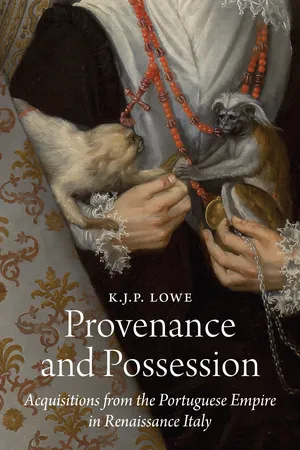
Provenance and Possession
Acquisitions from the Portuguese Empire in Renaissance Italy
- 328 pages
- English
- ePUB (mobile friendly)
- Available on iOS & Android
eBook - ePub
About this book
Information
Publisher
Princeton University PressYear
2024Print ISBN
9780691246857
9780691246840
eBook ISBN
9780691246895
Topic
StoriaSubtopic
Storia economicaTable of contents
- Cover Page
- Series Page
- Title Page
- Copyright Page
- Contents
- Illustrations
- Preface
- Acknowledgements
- Abbreviations
- 1. Provenance and Its Discontents. Evidence, Relevance, Language, Knowledge
- 2. The World beyond Italy. Keeping Up-to-date with Portuguese Overseas Expansion: Tracking and Assimilating the New Global Realities in Fifteenth- and Sixteenth-Century Italy
- 3. Florence’s ‘Black’ Babies. Renaissance Florence Meets Sub-Saharan Africa: Mixed-Ancestry Children at the Ospedale degli Innocenti
- 4. Inanimate Global Goods. Buying for the Medici Collection on the Iberian Peninsula in the 1540s
- 5. Living Global Goods. The Acquisition of Living Goods for the Medici from the Portuguese Trading Empire: Provenance and Possession of Flesh and Blood
- Colour Plates
- 6. Global Sensibilities. Possessing Consciousness of the Global World in Renaissance Italy: A Papal Official’s Experience in 1590s Lisbon
- Parting Thoughts: Knowledge, Ignorance and Non-knowledge
- Bibliography
- Name Index
- Subject Index
Trusted by 375,005 students
Access to over 1.5 million titles for a fair monthly price.
Study more efficiently using our study tools.
Frequently asked questions
Yes, you can cancel anytime from the Subscription tab in your account settings on the Perlego website. Your subscription will stay active until the end of your current billing period. Learn how to cancel your subscription
No, books cannot be downloaded as external files, such as PDFs, for use outside of Perlego. However, you can download books within the Perlego app for offline reading on mobile or tablet. Learn how to download books offline
Perlego offers two plans: Essential and Complete
- Essential is ideal for learners and professionals who enjoy exploring a wide range of subjects. Access the Essential Library with 800,000+ trusted titles and best-sellers across business, personal growth, and the humanities. Includes unlimited reading time and Standard Read Aloud voice.
- Complete: Perfect for advanced learners and researchers needing full, unrestricted access. Unlock 1.5M+ books across hundreds of subjects, including academic and specialized titles. The Complete Plan also includes advanced features like Premium Read Aloud and Research Assistant.
We are an online textbook subscription service, where you can get access to an entire online library for less than the price of a single book per month. With over 1.5 million books across 990+ topics, we’ve got you covered! Learn about our mission
Look out for the read-aloud symbol on your next book to see if you can listen to it. The read-aloud tool reads text aloud for you, highlighting the text as it is being read. You can pause it, speed it up and slow it down. Learn more about Read Aloud
Yes! You can use the Perlego app on both iOS and Android devices to read anytime, anywhere — even offline. Perfect for commutes or when you’re on the go.
Please note we cannot support devices running on iOS 13 and Android 7 or earlier. Learn more about using the app
Please note we cannot support devices running on iOS 13 and Android 7 or earlier. Learn more about using the app
Yes, you can access Provenance and Possession by K. J. P. Lowe in PDF and/or ePUB format, as well as other popular books in Storia & Storia economica. We have over 1.5 million books available in our catalogue for you to explore.