- 362 pages
- English
- PDF
- Available on iOS & Android
eBook - PDF
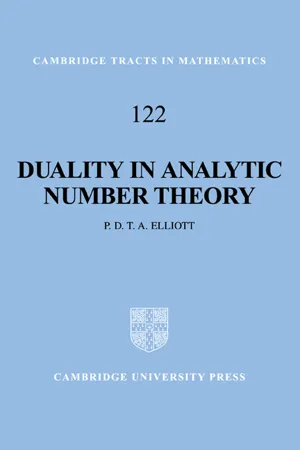
Duality in Analytic Number Theory
About this book
In this stimulating book, aimed at researchers both established and budding, Peter Elliott demonstrates a method and a motivating philosophy that combine to cohere a large part of analytic number theory, including the hitherto nebulous study of arithmetic functions. Besides its application, the book also illustrates a way of thinking mathematically: historical background is woven into the narrative, variant proofs illustrate obstructions, false steps and the development of insight, in a manner reminiscent of Euler. It is shown how to formulate theorems as well as how to construct their proofs. Elementary notions from functional analysis, Fourier analysis, functional equations and stability in mechanics are controlled by a geometric view and synthesized to provide an arithmetical analogue of classical harmonic analysis that is powerful enough to establish arithmetic propositions until now beyond reach. Connections with other branches of analysis are illustrated by over 250 exercises, structured in chains about individual topics.
Information
Topic
MatemáticasSubtopic
Teoría de númerosTable of contents
- Cover
- Frontmatter
- Contents
- Acknowledgements
- Preface
- Notation
- Introduction
- Duality and Fourier analysis
- Background philosophy
- Operator norm inequalities
- Dual norm inequalities
- Exercises: Including the Large Sieve
- The method of the stable dual (1): Deriving the approximate functional equations
- The method of the stable dual (2): Solving the approximate functional equations
- Exercises: Almost linear, Almost exponential
- Additive functions of class ℒα. A first application of the method
- Multiplicative functions of the class ℒα: First Approach
- Multiplicative functions of the class ℒα: Second Approach
- Multiplicative functions of the class ℒα: Third Approach
- Exercises: Why the form?
- Theorems of Wirsing and Halász
- Again Wirsing's Theorem
- Exercises: The prime number theorem
- Finitely distributed additive functions
- Multiplicative functions of the class ℒα. Mean value zero
- Exercises: Including logarithmic weights
- Encounters with Ramanujan's function τ(n)
- The operator T on L 2
- The operator T on L α and other spaces
- Exercises: The operator D and differentiation. The operator T and the convergence of measures
- Pause: Towards the discrete derivative
- Exercises: Multiplicative functions on arithmetic progressions. Wiener phenomenon
- Fractional power Large Sieves. Operators involving primes
- Exercises: Probability seen from number theory
- Additive functions on arithmetic progressions: Small moduli
- Additive functions on arithmetic progressions: Large moduli
- Exercises: Maximal inequalities
- Shift operators and orthogonal duals
- Differences of additive functions. Local inequalities
- Linear forms in shifted additive functions
- Exercises: Stability. Correlations of multiplicative functions
- Further readings
- Rückblick (after the manner of Johannes Brahms)
- References
- Author index
- Subject index
Trusted by 375,005 students
Access to over 1.5 million titles for a fair monthly price.
Study more efficiently using our study tools.
Frequently asked questions
Yes, you can cancel anytime from the Subscription tab in your account settings on the Perlego website. Your subscription will stay active until the end of your current billing period. Learn how to cancel your subscription
No, books cannot be downloaded as external files, such as PDFs, for use outside of Perlego. However, you can download books within the Perlego app for offline reading on mobile or tablet. Learn how to download books offline
Perlego offers two plans: Essential and Complete
- Essential is ideal for learners and professionals who enjoy exploring a wide range of subjects. Access the Essential Library with 800,000+ trusted titles and best-sellers across business, personal growth, and the humanities. Includes unlimited reading time and Standard Read Aloud voice.
- Complete: Perfect for advanced learners and researchers needing full, unrestricted access. Unlock 1.5M+ books across hundreds of subjects, including academic and specialized titles. The Complete Plan also includes advanced features like Premium Read Aloud and Research Assistant.
We are an online textbook subscription service, where you can get access to an entire online library for less than the price of a single book per month. With over 1.5 million books across 990+ topics, we’ve got you covered! Learn about our mission
Look out for the read-aloud symbol on your next book to see if you can listen to it. The read-aloud tool reads text aloud for you, highlighting the text as it is being read. You can pause it, speed it up and slow it down. Learn more about Read Aloud
Yes! You can use the Perlego app on both iOS and Android devices to read anytime, anywhere — even offline. Perfect for commutes or when you’re on the go.
Please note we cannot support devices running on iOS 13 and Android 7 or earlier. Learn more about using the app
Please note we cannot support devices running on iOS 13 and Android 7 or earlier. Learn more about using the app
Yes, you can access Duality in Analytic Number Theory by Peter D. T. A. Elliott in PDF and/or ePUB format, as well as other popular books in Matemáticas & Teoría de números. We have over 1.5 million books available in our catalogue for you to explore.