eBook - PDF
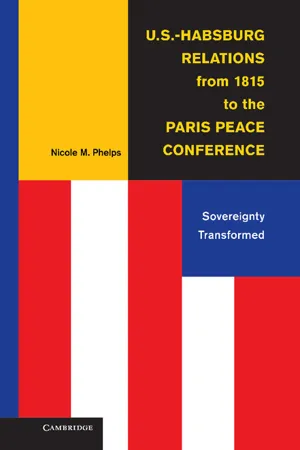
U.S.-Habsburg Relations from 1815 to the Paris Peace Conference
Sovereignty Transformed
- 308 pages
- English
- PDF
- Available on iOS & Android
eBook - PDF
U.S.-Habsburg Relations from 1815 to the Paris Peace Conference
Sovereignty Transformed
About this book
This study provides the first book-length account of US-Habsburg relations from their origins in the early nineteenth century through the aftermath of World War I and the Paris Peace Conference. By including not only high-level diplomacy but also an analysis of diplomats' ceremonial and social activities, as well as an exploration of consular efforts to determine the citizenship status of thousands of individuals who migrated between the two countries, Nicole M. Phelps demonstrates the influence of the Habsburg government on the integration of the United States into the nineteenth-century great power system and the influence of American racial politics on the Habsburg empire's conceptions of nationalism and democracy. In the crisis of World War I, the US-Habsburg relationship transformed international politics from a system in which territorial sovereignty protected diversity to one in which nation-states based on racial categories were considered ideal.
Information
Table of contents
- Cover
- Contents
- Acknowledgments
- Abbreviations
- Introduction: The Habsburg Empire and the United Statesin Transnational Perspective
- Chapter 1: Community and Legitimacy: The Diplomatic Culture of the Great Power System
- Chapter 2: Becoming a Great Power: U.S.-Habsburg Diplomatic Relations and the Integration of the United States into the Great Power System
- Chapter 3: Protection and the Problems of Dual Citizenship: U.S. Consuls in the Habsburg Empire
- Chapter 4: The Limits of State Building: Habsburg Consuls in the United States and the Protection of Lives and Property
- Chapter 5: Racial Identity and Political Citizenship: American Challenges to Habsburg Sovereignty
- Chapter 6: Giving Up on Austria-Hungary: The End of the Great Power System and the Shift to the Nationalist Successors
- Chapter 7: Establishing Sovereignty: The Process of Aligning Race, Place, and Citizenship
- Conclusion: After the Peace
- Index
Trusted by 375,005 students
Access to over 1.5 million titles for a fair monthly price.
Study more efficiently using our study tools.
Frequently asked questions
Yes, you can cancel anytime from the Subscription tab in your account settings on the Perlego website. Your subscription will stay active until the end of your current billing period. Learn how to cancel your subscription
No, books cannot be downloaded as external files, such as PDFs, for use outside of Perlego. However, you can download books within the Perlego app for offline reading on mobile or tablet. Learn how to download books offline
Perlego offers two plans: Essential and Complete
- Essential is ideal for learners and professionals who enjoy exploring a wide range of subjects. Access the Essential Library with 800,000+ trusted titles and best-sellers across business, personal growth, and the humanities. Includes unlimited reading time and Standard Read Aloud voice.
- Complete: Perfect for advanced learners and researchers needing full, unrestricted access. Unlock 1.5M+ books across hundreds of subjects, including academic and specialized titles. The Complete Plan also includes advanced features like Premium Read Aloud and Research Assistant.
We are an online textbook subscription service, where you can get access to an entire online library for less than the price of a single book per month. With over 1.5 million books across 990+ topics, we’ve got you covered! Learn about our mission
Look out for the read-aloud symbol on your next book to see if you can listen to it. The read-aloud tool reads text aloud for you, highlighting the text as it is being read. You can pause it, speed it up and slow it down. Learn more about Read Aloud
Yes! You can use the Perlego app on both iOS and Android devices to read anytime, anywhere — even offline. Perfect for commutes or when you’re on the go.
Please note we cannot support devices running on iOS 13 and Android 7 or earlier. Learn more about using the app
Please note we cannot support devices running on iOS 13 and Android 7 or earlier. Learn more about using the app
Yes, you can access U.S.-Habsburg Relations from 1815 to the Paris Peace Conference by Nicole M. Phelps in PDF and/or ePUB format, as well as other popular books in History & North American History. We have over 1.5 million books available in our catalogue for you to explore.