eBook - PDF
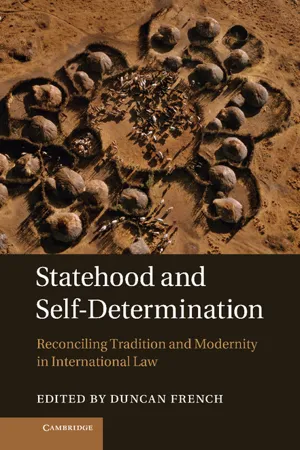
Statehood and Self-Determination
Reconciling Tradition and Modernity in International Law
- 586 pages
- English
- PDF
- Available on iOS & Android
eBook - PDF
Statehood and Self-Determination
Reconciling Tradition and Modernity in International Law
About this book
The concepts of statehood and self-determination provide the normative structure on which the international legal order is ultimately premised. As a system of law founded upon the issue of territorial control, ascertaining and determining which entities are entitled to the privileges of statehood continues to be one of the most difficult and complex issues. Moreover, although the process of decolonisation is almost complete, the principle of self-determination has raised new challenges for the metropolitan territories of established states, including the extent to which 'internal' self-determination guarantees additional rights for minority and other groups. As the controversies surrounding remedial secession have revealed, the territorial integrity of a state can be questioned if there are serious and persistent breaches of a people's human rights. This volume brings together such debates to reflect further on the current state of international law regarding these fundamental issues.
Information
Table of contents
- Cover
- Contents
- Contributors
- Foreword
- Preface
- Table of cases
- Table of treaties and major documents
- List of principal abbreviations
- Introduction
- Part I Statehood and recognition
- 1 Entities that can be states but do not claim to be
- 2 Unilateral declarations of independence in international law
- 3 The myth of remedial secession
- 4 International responses to the secession attempts of Kosovo, Abkhazia and South Ossetia 1989–2009
- 5 The paradox of Kosovo’s parallel legal orders in the reasoning of the Court’s Advisory Opinion
- 6 The politics of recognition: The question about the final status of Kosovo
- 7 Revisiting lessons on the new law of statehood: Palestinian independence in a post-Kosovo world
- 8 Somaliland: scrambled by international law?
- Part II Self-determination
- 9 The internal and external aspects of self-determination reconsidered
- 10 Trading fish or human rights in Western Sahara? Self-determination, non-recognition and the EC–Morocco Fisheries Agreement
- 11 Self-determination, peacemaking and peace-building: recent trends in African intrastate peace agreements
- 12 Can religious norms influence self-determination struggles, and with what implications for international law?
- 13 Self-determination, oil and Islam in the face of the League of Nations: the Mosul Dispute and the ‘non-European’ legal terrain
- 14 The question of indigenous peoples’ rights: a time for reappraisal?
- 15 The Kanak indigenous peoples of New Caledonia: decolonization and self-determination in practice
- 16 The ethnic dichotomy of ‘selfhairsp’ and ‘other’ within Europe: inter-war minority protection in perspective
- Part III Tradition, opportunities and challenges: the changing nature of the state
- 17 A monument, identity and nationhood: the case of the Old Bridge of Mostar
- 18 The impact of supranationalism on state sovereignty from the perspective of the legitimacy of international organisations
- 19 Democracy out of instrumental reason? Global institutions and the promotion of liberal governance
- 20 Federated entities in international law: disaggregating the federal State?
- Index
Trusted by 375,005 students
Access to over 1.5 million titles for a fair monthly price.
Study more efficiently using our study tools.
Frequently asked questions
Yes, you can cancel anytime from the Subscription tab in your account settings on the Perlego website. Your subscription will stay active until the end of your current billing period. Learn how to cancel your subscription
No, books cannot be downloaded as external files, such as PDFs, for use outside of Perlego. However, you can download books within the Perlego app for offline reading on mobile or tablet. Learn how to download books offline
We are an online textbook subscription service, where you can get access to an entire online library for less than the price of a single book per month. With over 1.5 million books across 990+ topics, we’ve got you covered! Learn about our mission
Look out for the read-aloud symbol on your next book to see if you can listen to it. The read-aloud tool reads text aloud for you, highlighting the text as it is being read. You can pause it, speed it up and slow it down. Learn more about Read Aloud
Yes! You can use the Perlego app on both iOS and Android devices to read anytime, anywhere — even offline. Perfect for commutes or when you’re on the go.
Please note we cannot support devices running on iOS 13 and Android 7 or earlier. Learn more about using the app
Please note we cannot support devices running on iOS 13 and Android 7 or earlier. Learn more about using the app
Yes, you can access Statehood and Self-Determination by Duncan French in PDF and/or ePUB format, as well as other popular books in Law & International Law. We have over 1.5 million books available in our catalogue for you to explore.