eBook - PDF
African Voices on Slavery and the Slave Trade: Volume 1, The Sources
- 588 pages
- English
- PDF
- Available on iOS & Android
eBook - PDF
African Voices on Slavery and the Slave Trade: Volume 1, The Sources
About this book
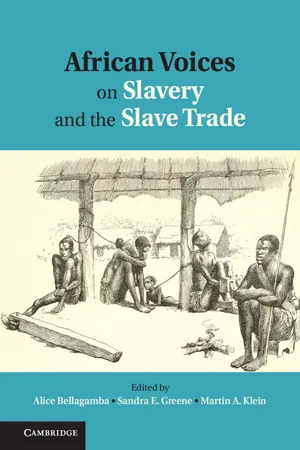
Though the history of slavery is a central topic for African, Atlantic world and world history, most of the sources presenting research in this area are European in origin. To cast light on African perspectives, and on the point of view of enslaved men and women, this group of top Africanist scholars has examined both conventional historical sources (such as European travel accounts, colonial documents, court cases, and missionary records) and less-explored sources of information (such as folklore, oral traditions, songs and proverbs, life histories collected by missionaries and colonial officials, correspondence in Arabic, and consular and admiralty interviews with runaway slaves). Each source has a short introduction highlighting its significance and orienting the reader. This first of two volumes provides students and scholars with a trove of African sources for studying African slavery and the slave trade.
Information
Table of contents
- Cover
- African Voices on Slavery and the Slave Trade
- Title
- Copyright
- Contents
- Figures
- Contributors
- Foreword: Beyond the Printed Word
- Introduction Finding the African Voice
- Part One Remembering Slavery and the Slave Trade
- 1 Introduction: Oral Traditions, Historical Tales, and Interviews
- 2 Oral Traditions about Individuals Enslaved in Asante
- 3 “The Little Things that Would Please Your Heart...”
- 4 Tales of Cowries, Money, and Slaves
- 5 Oral Accounts of Slave-master Relations from Cameroon Noncentralized and Centralized Polities (1750–1950)
- 6 “He Who Is Without Family Will Be the Subject of Many Exactions”
- 7 Common Themes, Individual Voices
- 8 Slavery in Kano Emirate of Sokoto Caliphate as Recounted
- Part Two The Verbal Arts and Everyday Objects
- 9 Introduction: Songs, Prayers, Proverbs, and Material Culture
- 10 Singing Songs and Performing Dances with Embedded Historical Meanings in Somalia
- 11 Song Lyrics as Pathways to Historical Interpretation in Northwestern Côte d’Ivoire
- 12 Slave Voices from the Cameroon Grassfields
- 13 Silent Testimonies, Public Memory
- 14 In Remembrance of Slavery
- Part Three Documenting Our Own Histories and Cultural Practices
- 15 Introduction: Written Accounts by African Authors
- 16 Some Facets of Slavery in the Lamidats of Adamawa in North Cameroon in the Nineteenth and Twentieth Centuries
- 17 Etchu Richard Ayuk’s Manuscript on the Slave Trade and Social Segregation in the Ejaghamland
- 18 Writing about the Slave Trade
- Part Four Slavery Observed: European Travelers’ Accounts
- 19 Introduction: Accounts by European Travelers
- 20 The Story of Saaba
- 21 Zenneb and Saint-André’s Cruise Up the Nile to Dongola
- 22 the Ordeals of Slaves’ Flight in Tunisia
- 23 African Slavery and the Slave Trade in the Manuscript of Jean Godot
- Part Five Administrative Records
- 24 Introduction: Colonial Reports and Documents
- 25 How Kwadwo Regained His Freedom and Put the Slave-traders in Big Trouble
- 26 Witchcraft and Slavery
- 27 Tracing Their “Middle” Passages
- 28 Gender, Migration, and the End of Slavery in the Region of Kayes, French Soudan
- Part Six Legal Records
- 29 Introduction: Voices of Slaves in the Courtroom
- 30 the Expulsion of Dalu Modu
- 31 “Being a Slave, I Was Afraid...”
- 32 Interpreting Gold Coast Supreme Court Records, Sct 5/4/19
- 33 A Tale of Slavery and Beyond in a British Colonial Court Record
- 34 Aballow’s Story
- 35 a Case of Kidnapping and Child Trafficking in Senegal, 1916
- Part Seven Recorded Encounters with the Enslaved: Christian Workers in Africa
- 36 Introduction: Missionary Records
- 37 Experiencing Fear and Despair
- 38 The Testimony of Lamine Filalou
- 39 The Blood Men of Old Calabar – a Slave Revolt of the Nineteenth Century?
- 40 Makua Life Histories
- Part Eight Documents from Muslim Africa
- 41 Introduction: Islamic Sources
- 42 The Arabic Letters of Ghadames Slaves in the Niger Bend, 1860–1900
- 43 The “hidden Transcripts” and Legal Rights of Slaves in the Muslim World
- 44 Slave Wills Along the Swahili Coast
- Part Nine Living with the Past
- 45 Introduction: Contemporary African Societies and the Legacy of Slavery
- 46 Two Soninke “Slave” Descendants and Their Family Biographies
- 47 Without History? Interrogating “Slave” Memories in Ader (Niger)
- Index
Trusted by 375,005 students
Access to over 1.5 million titles for a fair monthly price.
Study more efficiently using our study tools.
Frequently asked questions
Yes, you can cancel anytime from the Subscription tab in your account settings on the Perlego website. Your subscription will stay active until the end of your current billing period. Learn how to cancel your subscription
No, books cannot be downloaded as external files, such as PDFs, for use outside of Perlego. However, you can download books within the Perlego app for offline reading on mobile or tablet. Learn how to download books offline
Perlego offers two plans: Essential and Complete
- Essential is ideal for learners and professionals who enjoy exploring a wide range of subjects. Access the Essential Library with 800,000+ trusted titles and best-sellers across business, personal growth, and the humanities. Includes unlimited reading time and Standard Read Aloud voice.
- Complete: Perfect for advanced learners and researchers needing full, unrestricted access. Unlock 1.5M+ books across hundreds of subjects, including academic and specialized titles. The Complete Plan also includes advanced features like Premium Read Aloud and Research Assistant.
We are an online textbook subscription service, where you can get access to an entire online library for less than the price of a single book per month. With over 1.5 million books across 990+ topics, we’ve got you covered! Learn about our mission
Look out for the read-aloud symbol on your next book to see if you can listen to it. The read-aloud tool reads text aloud for you, highlighting the text as it is being read. You can pause it, speed it up and slow it down. Learn more about Read Aloud
Yes! You can use the Perlego app on both iOS and Android devices to read anytime, anywhere — even offline. Perfect for commutes or when you’re on the go.
Please note we cannot support devices running on iOS 13 and Android 7 or earlier. Learn more about using the app
Please note we cannot support devices running on iOS 13 and Android 7 or earlier. Learn more about using the app
Yes, you can access African Voices on Slavery and the Slave Trade: Volume 1, The Sources by Alice Bellagamba,Sandra E. Greene,Martin A. Klein in PDF and/or ePUB format, as well as other popular books in History & African History. We have over 1.5 million books available in our catalogue for you to explore.