- 1,166 pages
- English
- PDF
- Available on iOS & Android
eBook - PDF
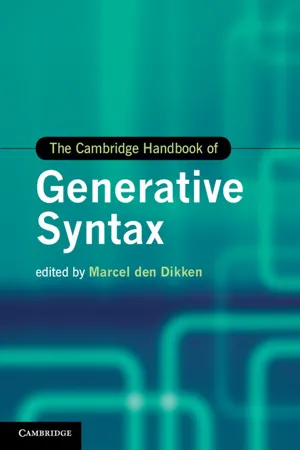
The Cambridge Handbook of Generative Syntax
About this book
Syntax – the study of sentence structure – has been at the centre of generative linguistics from its inception and has developed rapidly and in various directions. The Cambridge Handbook of Generative Syntax provides a historical context for what is happening in the field of generative syntax today, a survey of the various generative approaches to syntactic structure available in the literature and an overview of the state of the art in the principal modules of the theory and the interfaces with semantics, phonology, information structure and sentence processing, as well as linguistic variation and language acquisition. This indispensable resource for advanced students, professional linguists (generative and non-generative alike) and scholars in related fields of inquiry presents a comprehensive survey of the field of generative syntactic research in all its variety, written by leading experts and providing a proper sense of the range of syntactic theories calling themselves generative.
Information
Table of contents
- Cover
- Contents
- Contributors
- Preface
- Part I Background
- 1 Introduction
- 2 Brief overview of the history of generative syntax
- 3 Goals and methods of generative syntax
- Part II Modern generative approaches to the study of sentence structure
- 4 Principles and Parameters theory and Minimalism
- 5 Minimalism and Optimality Theory
- 6 Lexical-Functional Grammar
- 7 Phrase structure grammar
- 8 Tree Adjoining Grammar
- Part III Syntactic structures
- 9 Argument structure and argument structure alternations
- 10 The syntax of predication
- 11 Lexical categories and (extended) projection
- 12 The functional structure of the sentence, and cartography
- 13 Adverbial and adjectival modification
- Part IV Syntactic processes: their nature, locality, and motivation
- 14 Economy of derivation and representation
- 15 Syntax, binding, and patterns of anaphora
- 16 Raising and control
- 17 Agreement and Case
- 18 The locality of syntactic dependencies
- Part V Syntax and the internal interfaces
- 19 Ellipsis phenomena
- 20 Tense, aspect, and modality
- 21 Negation and negative polarity
- 22 The syntax of scope and quantification
- 23 Syntax, information structure, and prosody
- Part VI Syntax and the external interfaces
- 24 Microsyntactic variation
- 25 Parameters: the pluses and the minuses
- 26 Syntax and the brain
- References
- Index of language names
- Index
Trusted by 375,005 students
Access to over 1.5 million titles for a fair monthly price.
Study more efficiently using our study tools.
Frequently asked questions
Yes, you can cancel anytime from the Subscription tab in your account settings on the Perlego website. Your subscription will stay active until the end of your current billing period. Learn how to cancel your subscription
No, books cannot be downloaded as external files, such as PDFs, for use outside of Perlego. However, you can download books within the Perlego app for offline reading on mobile or tablet. Learn how to download books offline
Perlego offers two plans: Essential and Complete
- Essential is ideal for learners and professionals who enjoy exploring a wide range of subjects. Access the Essential Library with 800,000+ trusted titles and best-sellers across business, personal growth, and the humanities. Includes unlimited reading time and Standard Read Aloud voice.
- Complete: Perfect for advanced learners and researchers needing full, unrestricted access. Unlock 1.5M+ books across hundreds of subjects, including academic and specialized titles. The Complete Plan also includes advanced features like Premium Read Aloud and Research Assistant.
We are an online textbook subscription service, where you can get access to an entire online library for less than the price of a single book per month. With over 1.5 million books across 990+ topics, we’ve got you covered! Learn about our mission
Look out for the read-aloud symbol on your next book to see if you can listen to it. The read-aloud tool reads text aloud for you, highlighting the text as it is being read. You can pause it, speed it up and slow it down. Learn more about Read Aloud
Yes! You can use the Perlego app on both iOS and Android devices to read anytime, anywhere — even offline. Perfect for commutes or when you’re on the go.
Please note we cannot support devices running on iOS 13 and Android 7 or earlier. Learn more about using the app
Please note we cannot support devices running on iOS 13 and Android 7 or earlier. Learn more about using the app
Yes, you can access The Cambridge Handbook of Generative Syntax by Marcel den Dikken in PDF and/or ePUB format, as well as other popular books in Languages & Linguistics & Linguistics. We have over 1.5 million books available in our catalogue for you to explore.