eBook - PDF
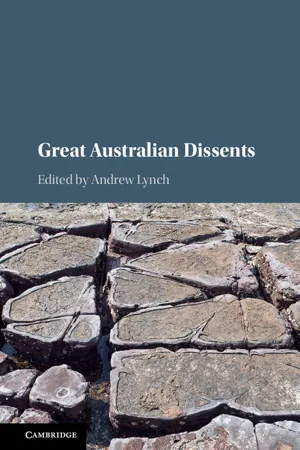
Great Australian Dissents
About this book
When judges disagree, those in the minority write a dissenting opinion. This book considers the great dissents in Australian law. Their worth may derive from numerous factors, including their rhetorical force as a piece of legal reasoning or emotive power as a judicial lament for the 'error' into which the majority has fallen; the general importance of the issue at stake; as a challenge to the orthodoxy; and, sometimes, the subsequent recognition of a dissenting opinion's correctness and its ultimate vindication. On some occasions, all these features may be strongly present, on others only some. Through a diverse selection of memorable dissenting opinions, this book illuminates the topic of judicial disagreement more generally - not only through examples of instances when minority opinions have been distinctly valuable, but by drawing out a richer understanding of the attributes and circumstances which lead some dissents to become iconic, while so many lie forgotten.
Information
Table of contents
- Cover
- Half title
- Title
- Copyright
- Contents
- List of Contributors
- List of Figure
- List of Table
- Acknowledgments
- Table of Cases
- 1 Introduction – What Makes a Dissent ‘Great’?
- 2 Justice Barton and the Demise of the Inter-State Commission in the Wheat Case (1915)
- 3 Unrequited but Still Great – The Dissent of Justices Dixon and Evatt in R v Federal Court of Bankruptcy; Ex parte Lowenstein (1938)
- 4 Justice Evatt and the Lost Child in Chester v Waverley Corporation (1939)
- 5 Uther’s Case (1947): Justice Dixon and the Troubled Legacy of the Commonwealth Immunity Doctrine
- 6 'Lone, vehement and incredulous': Chief Justice Latham in the Communist Party Case (1951)
- 7 Public Prosecutor v Oie Hee Koi (1968): Not So Humbly Advising? Sir Garfield Barwick and the Introduction of Dissenting Reasons to the Judicial Committee of the Privy Council
- 8 The Trouble with Duress: The Dissent of Chief Justice Bray in R v Brown and Morley (1968)
- 9 The ‘Intelligence of a Future Day’: The Vindication of Justice Stephen’s Dissent in Henry v Boehm (1973)
- 10 Justice Mason in the Australian Assistance Plan Case (1975): Nationhood, Federalism and Commonwealth Executive Power
- 11 Justice Murphy's Dissent in Australian Conservation Foundation v Commonwealth (1980): The Birth of Public Interest Standing in Australia?
- 12 The Essence of a Fiduciary Relationship: Justice Mason’s Dissent in Hospital Products Ltd v United States Surgical Corporation (1984)
- 13 The Chamberlain Dissents (1984)
- 14 Treachery or Heroism? The Judgment of Justices Deane and Toohey in Leeth v Commonwealth (1992)
- 15 Justice Dawson's Steadfast Defence of the 'Very Essence of Political Discussion' in Langer v Commonwealth (1996)
- 16 Certainty, Co-existence and the Legacy of Mabo: Justice North in the Miriuwung-Gajerrong Native Title Case (2000)
- 17 When Liberty Divides: Judicial Cleavages and their Consequences in Al-Kateb v Godwin (2004)
- 18 He Who Would Not Be Muzzled: Justice Heydon`s Last Dissent in Monis v The Queen (2013)
- Index
Trusted by 375,005 students
Access to over 1.5 million titles for a fair monthly price.
Study more efficiently using our study tools.
Frequently asked questions
Yes, you can cancel anytime from the Subscription tab in your account settings on the Perlego website. Your subscription will stay active until the end of your current billing period. Learn how to cancel your subscription
No, books cannot be downloaded as external files, such as PDFs, for use outside of Perlego. However, you can download books within the Perlego app for offline reading on mobile or tablet. Learn how to download books offline
Perlego offers two plans: Essential and Complete
- Essential is ideal for learners and professionals who enjoy exploring a wide range of subjects. Access the Essential Library with 800,000+ trusted titles and best-sellers across business, personal growth, and the humanities. Includes unlimited reading time and Standard Read Aloud voice.
- Complete: Perfect for advanced learners and researchers needing full, unrestricted access. Unlock 1.5M+ books across hundreds of subjects, including academic and specialized titles. The Complete Plan also includes advanced features like Premium Read Aloud and Research Assistant.
We are an online textbook subscription service, where you can get access to an entire online library for less than the price of a single book per month. With over 1.5 million books across 990+ topics, we’ve got you covered! Learn about our mission
Look out for the read-aloud symbol on your next book to see if you can listen to it. The read-aloud tool reads text aloud for you, highlighting the text as it is being read. You can pause it, speed it up and slow it down. Learn more about Read Aloud
Yes! You can use the Perlego app on both iOS and Android devices to read anytime, anywhere — even offline. Perfect for commutes or when you’re on the go.
Please note we cannot support devices running on iOS 13 and Android 7 or earlier. Learn more about using the app
Please note we cannot support devices running on iOS 13 and Android 7 or earlier. Learn more about using the app
Yes, you can access Great Australian Dissents by Andrew Lynch in PDF and/or ePUB format, as well as other popular books in Law & Public Law. We have over 1.5 million books available in our catalogue for you to explore.