- 306 pages
- English
- PDF
- Available on iOS & Android
eBook - PDF
About this book
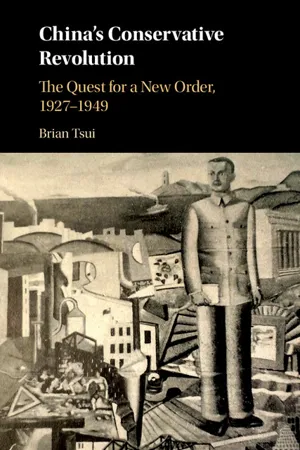
In this ambitious examination of the complex political culture of China under Guomindang rule, Brian Tsui interweaves political ideologies, intellectual trends, social movements and diplomatic maneuvers to demonstrate how the Chinese revolution became conservative after the anti-Communist coup of 1927. Dismissing violent struggles for class equality as incompatible with nationalist goals, Chiang Kai-shek's government should, Tsui argues, be understood in the context of the global ascendance of radical right-wing movements during the inter-war period. The Guomindang's revolutionary nation-building and modernization project struck a chord with China's reformist liberal elite, who were wary of mob rule, while its obsession with Eastern spirituality appealed to Indian nationalists fighting Western colonialism. The Nationalist vision was defined by the party-state's hostility to communist challenges as much as by its ability to co-opt liberalism and Pan-Asianist anti-colonialism. Tsui's revisionist reading revisits the peculiarities of the Guomindang's revolutionary enterprise, resituating Nationalist China in the moment of global radical right ascendancy.
Information
Topic
GeschichteSubtopic
Asiatische GeschichteTable of contents
- Cover
- Half-title page
- Series page
- Title page
- Copyright page
- Contents
- List of Figures
- Acknowledgments
- A Note on Romanization
- 1 Introduction
- 2 Orthodoxy: Purifying the Revolution
- 3 TheMasses: AYouth Movement for the Conservative Revolution
- 4 State Comes First: Wartime Spiritual Revolution
- 5 Convergence: Liberal Sentimentalities and the Conservative Revolution
- 6 World Revolution: China, Pan-Asianism and India
- Epilogue
- Glossary of Selected Romanized Terms
- Bibliography
- Index
Trusted by 375,005 students
Access to over 1.5 million titles for a fair monthly price.
Study more efficiently using our study tools.
Frequently asked questions
Yes, you can cancel anytime from the Subscription tab in your account settings on the Perlego website. Your subscription will stay active until the end of your current billing period. Learn how to cancel your subscription
No, books cannot be downloaded as external files, such as PDFs, for use outside of Perlego. However, you can download books within the Perlego app for offline reading on mobile or tablet. Learn how to download books offline
Perlego offers two plans: Essential and Complete
- Essential is ideal for learners and professionals who enjoy exploring a wide range of subjects. Access the Essential Library with 800,000+ trusted titles and best-sellers across business, personal growth, and the humanities. Includes unlimited reading time and Standard Read Aloud voice.
- Complete: Perfect for advanced learners and researchers needing full, unrestricted access. Unlock 1.5M+ books across hundreds of subjects, including academic and specialized titles. The Complete Plan also includes advanced features like Premium Read Aloud and Research Assistant.
We are an online textbook subscription service, where you can get access to an entire online library for less than the price of a single book per month. With over 1.5 million books across 990+ topics, we’ve got you covered! Learn about our mission
Look out for the read-aloud symbol on your next book to see if you can listen to it. The read-aloud tool reads text aloud for you, highlighting the text as it is being read. You can pause it, speed it up and slow it down. Learn more about Read Aloud
Yes! You can use the Perlego app on both iOS and Android devices to read anytime, anywhere — even offline. Perfect for commutes or when you’re on the go.
Please note we cannot support devices running on iOS 13 and Android 7 or earlier. Learn more about using the app
Please note we cannot support devices running on iOS 13 and Android 7 or earlier. Learn more about using the app
Yes, you can access China's Conservative Revolution by Brian Tsui in PDF and/or ePUB format, as well as other popular books in Geschichte & Asiatische Geschichte. We have over 1.5 million books available in our catalogue for you to explore.