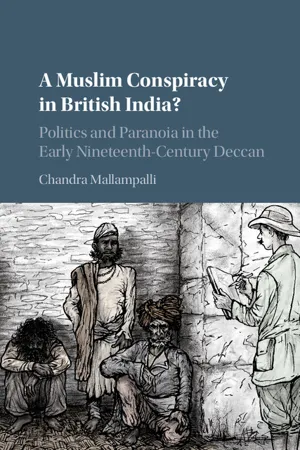
eBook - PDF
A Muslim Conspiracy in British India?
Politics and Paranoia in the Early Nineteenth-Century Deccan
- 254 pages
- English
- PDF
- Available on iOS & Android
eBook - PDF
A Muslim Conspiracy in British India?
Politics and Paranoia in the Early Nineteenth-Century Deccan
About this book
As the British prepared for war in Afghanistan in 1839, rumors spread of a Muslim conspiracy based in India's Deccan region. Colonial officials were convinced that itinerant preachers of jihad - whom they labelled 'Wahhabis' - were collaborating with Russian and Persian armies, and inspiring Muslim princes to revolt. Officials detained and interrogated Muslim travelers, conducted weapons inspections at princely forts, surveyed mosques, and ultimately annexed territories of the accused. Using untapped archival materials, Chandra Mallampalli describes how local intrigues, often having little to do with 'religion', manufactured belief in a global conspiracy against British rule. By skillfully narrating stories of the alleged conspirators, he shows how fears of the dreaded 'Wahhabi' sometimes prompted colonial authorities to act upon thin evidence, while also inspiring Muslim plots against princes not of their liking. At stake were not only questions about Muslim loyalty, but also the very ideals of a liberal empire.
Information
Table of contents
- Cover
- Half-title
- Title page
- Copyright information
- Dedication
- Table of contents
- List of Figures and Maps
- Acknowledgments
- Introduction
- Chapter 1 The Fear of Itinerant Muslims
- Chapter 2 Prince Mubariz ud-Daula: Rebel, Reformer and Mastermind
- Chapter 3 A Fondness for Military Display: Weapons, Wahhabis, and the Conquest of Kurnool
- Chapter 4 A Diamond in the Trough: Lessons from the Fall of Abbas Ali Khan
- Chapter 5 Slaying Men with Faces of Women: The Trial of Sayyid Shah Modin Qadiri
- Conclusions
- Bibliography
- Index
Trusted by 375,005 students
Access to over 1.5 million titles for a fair monthly price.
Study more efficiently using our study tools.
Frequently asked questions
Yes, you can cancel anytime from the Subscription tab in your account settings on the Perlego website. Your subscription will stay active until the end of your current billing period. Learn how to cancel your subscription
No, books cannot be downloaded as external files, such as PDFs, for use outside of Perlego. However, you can download books within the Perlego app for offline reading on mobile or tablet. Learn how to download books offline
Perlego offers two plans: Essential and Complete
- Essential is ideal for learners and professionals who enjoy exploring a wide range of subjects. Access the Essential Library with 800,000+ trusted titles and best-sellers across business, personal growth, and the humanities. Includes unlimited reading time and Standard Read Aloud voice.
- Complete: Perfect for advanced learners and researchers needing full, unrestricted access. Unlock 1.5M+ books across hundreds of subjects, including academic and specialized titles. The Complete Plan also includes advanced features like Premium Read Aloud and Research Assistant.
We are an online textbook subscription service, where you can get access to an entire online library for less than the price of a single book per month. With over 1.5 million books across 990+ topics, we’ve got you covered! Learn about our mission
Look out for the read-aloud symbol on your next book to see if you can listen to it. The read-aloud tool reads text aloud for you, highlighting the text as it is being read. You can pause it, speed it up and slow it down. Learn more about Read Aloud
Yes! You can use the Perlego app on both iOS and Android devices to read anytime, anywhere — even offline. Perfect for commutes or when you’re on the go.
Please note we cannot support devices running on iOS 13 and Android 7 or earlier. Learn more about using the app
Please note we cannot support devices running on iOS 13 and Android 7 or earlier. Learn more about using the app
Yes, you can access A Muslim Conspiracy in British India? by Chandra Mallampalli in PDF and/or ePUB format, as well as other popular books in History & Indian & South Asian History. We have over 1.5 million books available in our catalogue for you to explore.