- 326 pages
- English
- PDF
- Available on iOS & Android
eBook - PDF
About this book
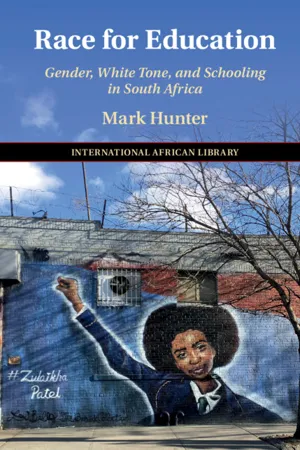
Following the end of apartheid in 1994, the ANC government placed education at the centre of its plans to build a nonracial and more equitable society. Yet, by the 2010s a wave of student protests voiced demands for decolonised and affordable education. By following families and schools in Durban for nearly a decade, Mark Hunter sheds new light on South Africa's political transition and the global phenomenon of education marketisation. He rejects simple descriptions of the country's move from 'race to class apartheid' and reveals how 'white' phenotypic traits like skin colour retain value in the schooling system even as the multiracial middle class embraces prestigious linguistic and embodied practices the book calls 'white tone'. By illuminating the actions and choices of both white and black parents, Hunter provides a unique view on race, class and gender in a country emerging from a notorious system of institutionalised racism.
Information
Table of contents
- Cover
- Half-title
- Series information
- Title page
- Copyright information
- Dedication
- Contents
- Figures
- Maps
- Tables
- Preface and acknowledgements
- 1 Introduction
- Part I Racial modernism – 1950s and 1960s
- Part II Marketised assimilation – late 1970s–1990s
- Part III Schooling and work after apartheid
- Part IV Racialised market – 2000s onwards
- Appendix 1 A note on quantitative and survey data
- Notes
- Bibliography
- Index
Trusted by 375,005 students
Access to over 1.5 million titles for a fair monthly price.
Study more efficiently using our study tools.
Frequently asked questions
Yes, you can cancel anytime from the Subscription tab in your account settings on the Perlego website. Your subscription will stay active until the end of your current billing period. Learn how to cancel your subscription
No, books cannot be downloaded as external files, such as PDFs, for use outside of Perlego. However, you can download books within the Perlego app for offline reading on mobile or tablet. Learn how to download books offline
Perlego offers two plans: Essential and Complete
- Essential is ideal for learners and professionals who enjoy exploring a wide range of subjects. Access the Essential Library with 800,000+ trusted titles and best-sellers across business, personal growth, and the humanities. Includes unlimited reading time and Standard Read Aloud voice.
- Complete: Perfect for advanced learners and researchers needing full, unrestricted access. Unlock 1.5M+ books across hundreds of subjects, including academic and specialized titles. The Complete Plan also includes advanced features like Premium Read Aloud and Research Assistant.
We are an online textbook subscription service, where you can get access to an entire online library for less than the price of a single book per month. With over 1.5 million books across 990+ topics, we’ve got you covered! Learn about our mission
Look out for the read-aloud symbol on your next book to see if you can listen to it. The read-aloud tool reads text aloud for you, highlighting the text as it is being read. You can pause it, speed it up and slow it down. Learn more about Read Aloud
Yes! You can use the Perlego app on both iOS and Android devices to read anytime, anywhere — even offline. Perfect for commutes or when you’re on the go.
Please note we cannot support devices running on iOS 13 and Android 7 or earlier. Learn more about using the app
Please note we cannot support devices running on iOS 13 and Android 7 or earlier. Learn more about using the app
Yes, you can access Race for Education by Mark Hunter in PDF and/or ePUB format, as well as other popular books in History & African History. We have over 1.5 million books available in our catalogue for you to explore.