- 270 pages
- English
- PDF
- Available on iOS & Android
eBook - PDF
About this book
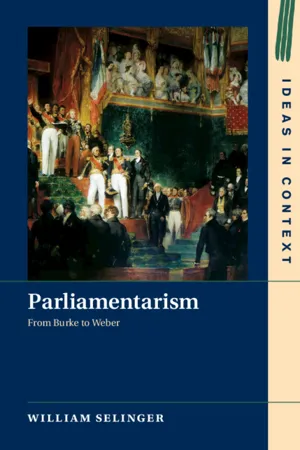
For eighteenth- and nineteenth-century authors such as Burke, Constant, and Mill, a powerful representative assembly that freely deliberated and controlled the executive was the defining institution of a liberal state. Yet these figures also feared that representative assemblies were susceptible to usurpation, gridlock, and corruption. Parliamentarism was their answer to this dilemma: a constitutional model that enabled a nation to be truly governed by a representative assembly. Offering novel interpretations of canonical liberal authors, this history of liberal political ideas suggests a new paradigm for interpreting the development of modern political thought, inspiring fresh perspectives on historical issues from the eighteenth to early twentieth centuries. In doing so, Selinger suggests the wider significance of parliament and the theory of parliamentarism in the development of European political thought, revealing how contemporary democratic theory, and indeed the challenges facing representative government today, are historically indebted to classical parliamentarism.
Information
Table of contents
- Cover
- Half-title
- Series information
- Title page
- Copyright information
- Contents
- Acknowledgments
- Introduction
- Chapter 1 The Eighteenth-Century House of Commons
- Chapter 2 Edmund Burke's Theory of Parliamentary Politics
- Chapter 3 The French Revolution and the Liberal Parliamentary Turn
- Chapter 4 Reinventing Parliamentarism: The Significance of Benjamin Constant
- Chapter 5 Democracy in America, Parliamentarism in France: Tocqueville's Unconventional Parliamentary Liberalism
- Chapter 6 John Stuart Mill and the Victorian Theory of Parliament
- Conclusion
- Bibliography
- Index
Trusted by 375,005 students
Access to over 1.5 million titles for a fair monthly price.
Study more efficiently using our study tools.
Frequently asked questions
Yes, you can cancel anytime from the Subscription tab in your account settings on the Perlego website. Your subscription will stay active until the end of your current billing period. Learn how to cancel your subscription
No, books cannot be downloaded as external files, such as PDFs, for use outside of Perlego. However, you can download books within the Perlego app for offline reading on mobile or tablet. Learn how to download books offline
Perlego offers two plans: Essential and Complete
- Essential is ideal for learners and professionals who enjoy exploring a wide range of subjects. Access the Essential Library with 800,000+ trusted titles and best-sellers across business, personal growth, and the humanities. Includes unlimited reading time and Standard Read Aloud voice.
- Complete: Perfect for advanced learners and researchers needing full, unrestricted access. Unlock 1.5M+ books across hundreds of subjects, including academic and specialized titles. The Complete Plan also includes advanced features like Premium Read Aloud and Research Assistant.
We are an online textbook subscription service, where you can get access to an entire online library for less than the price of a single book per month. With over 1.5 million books across 990+ topics, we’ve got you covered! Learn about our mission
Look out for the read-aloud symbol on your next book to see if you can listen to it. The read-aloud tool reads text aloud for you, highlighting the text as it is being read. You can pause it, speed it up and slow it down. Learn more about Read Aloud
Yes! You can use the Perlego app on both iOS and Android devices to read anytime, anywhere — even offline. Perfect for commutes or when you’re on the go.
Please note we cannot support devices running on iOS 13 and Android 7 or earlier. Learn more about using the app
Please note we cannot support devices running on iOS 13 and Android 7 or earlier. Learn more about using the app
Yes, you can access Parliamentarism by William Selinger in PDF and/or ePUB format, as well as other popular books in Politics & International Relations & Political History & Theory. We have over 1.5 million books available in our catalogue for you to explore.