- 412 pages
- English
- PDF
- Available on iOS & Android
eBook - PDF
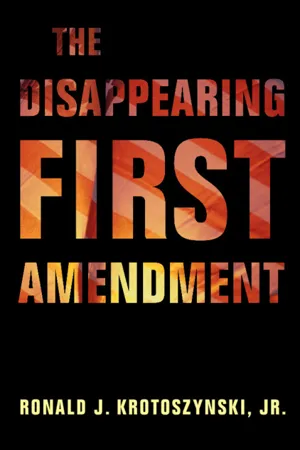
The Disappearing First Amendment
About this book
The standard account of the First Amendment presupposes that the Supreme Court has consistently expanded the scope of free speech rights over time. This account holds true in some areas, but not in others. In this illuminating work, Ronald J. Krotoszynski, Jr acknowledges that the contemporary Supreme Court rigorously enforces the rules against content and viewpoint discrimination for those who possess the wherewithal to speak but when citizens need the government's assistance to speak - for example, access to public property for protest - free speech rights have declined. Instead of using open-ended balancing tests, the Roberts and Rehnquist Courts have opted for bright line, categorical rules that minimize judicial discretion. Opportunities for democratic engagement could be enhanced, however, if the federal courts returned to the Warren Court's balancing approach and vested federal judges with discretionary authority to require government to assist would-be speakers. This book should be read by anyone concerned with free speech and its place in democratic self-government.
Information
Table of contents
- Cover
- Half-title page
- Title page
- Copyright page
- Dedication
- Contents
- Preface
- Acknowledgments
- Table of Cases
- 1 Two Steps Forward, One Step Back: On the Decline of Expressive Freedoms under the Roberts and Rehnquist Courts
- 2 The Public Forum Doctrine and Reduced Access to Government Property for Speech Activity
- 3 The First Amendment As a Source of Positive Rights: The Warren Court and First Amendment Easements to Private Property
- 4 Whistleblowing Speech and Democratic Accountability: The Growing Problem of Reduced First Amendment Protection for Government Employee Speech
- 5 Shedding Their Constitutional Rights at the Schoolhouse Gate: The Decline of Freedom of Speech for Students and Teachers in the Nation’s Public Schools, Colleges, and Universities
- 6 Transborder Speech: Using the Accident of Geography As a Makeweight Justification for Suppressing Expressive Freedoms
- 7 Systemic Failures to Protect Newsgathering Activities by Professional Journalists and Amateur Citizen-Journalists Alike
- 8 The Citizen As Government Sock Puppet and the State Masquerading As a Citizen: The Problem of Coerced and Misattributed Speech
- 9 Using Constitutionally Permissible Statutes to Impede First Amendment Activity: The Supreme Court’s Failure to Address the Abuse of Discretionary Authority by Police, Prosecutors, and Other Nonjudicial Actors
- 10 Conclusion: Enhancing Speech and Promoting Democracy: The Necessary Role of the State in Promoting Democratic Deliberation among Citizen-Speakers
- Notes
- Index
Trusted by 375,005 students
Access to over 1.5 million titles for a fair monthly price.
Study more efficiently using our study tools.
Frequently asked questions
Yes, you can cancel anytime from the Subscription tab in your account settings on the Perlego website. Your subscription will stay active until the end of your current billing period. Learn how to cancel your subscription
No, books cannot be downloaded as external files, such as PDFs, for use outside of Perlego. However, you can download books within the Perlego app for offline reading on mobile or tablet. Learn how to download books offline
Perlego offers two plans: Essential and Complete
- Essential is ideal for learners and professionals who enjoy exploring a wide range of subjects. Access the Essential Library with 800,000+ trusted titles and best-sellers across business, personal growth, and the humanities. Includes unlimited reading time and Standard Read Aloud voice.
- Complete: Perfect for advanced learners and researchers needing full, unrestricted access. Unlock 1.5M+ books across hundreds of subjects, including academic and specialized titles. The Complete Plan also includes advanced features like Premium Read Aloud and Research Assistant.
We are an online textbook subscription service, where you can get access to an entire online library for less than the price of a single book per month. With over 1.5 million books across 990+ topics, we’ve got you covered! Learn about our mission
Look out for the read-aloud symbol on your next book to see if you can listen to it. The read-aloud tool reads text aloud for you, highlighting the text as it is being read. You can pause it, speed it up and slow it down. Learn more about Read Aloud
Yes! You can use the Perlego app on both iOS and Android devices to read anytime, anywhere — even offline. Perfect for commutes or when you’re on the go.
Please note we cannot support devices running on iOS 13 and Android 7 or earlier. Learn more about using the app
Please note we cannot support devices running on iOS 13 and Android 7 or earlier. Learn more about using the app
Yes, you can access The Disappearing First Amendment by Ronald J. Krotoszynski, Jr. in PDF and/or ePUB format, as well as other popular books in Law & Law Theory & Practice. We have over 1.5 million books available in our catalogue for you to explore.