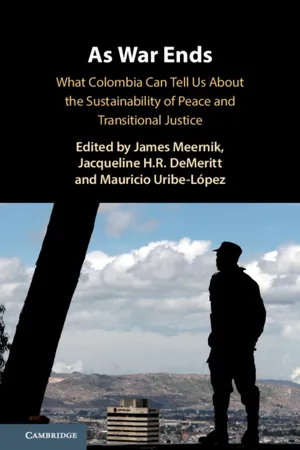
eBook - PDF
As War Ends
What Colombia Can Tell Us About the Sustainability of Peace and Transitional Justice
- 448 pages
- English
- PDF
- Available on iOS & Android
eBook - PDF
As War Ends
What Colombia Can Tell Us About the Sustainability of Peace and Transitional Justice
About this book
For decades a bitter civil war between the Colombia government and armed insurgent groups tore apart Colombian society. After protracted negotiations in Havana, a peace agreement was accepted by the Colombian government and the FARC rebel group in 2016. This volume will provide academics and practitioners throughout the world with critical analyses regarding what we know generally about the post-war peace building process and how this can be applied to the specifics of the Colombian case to assist in the design and implementation of post-war peace building programs and policies. This unique group of Colombian and international scholars comment on critical aspects of the peace process in Colombia, transitional justice mechanisms, the role of state and non-state actors at the national and local levels, and examine what the Colombian case reveals about traditional theories and approaches to peace and transitional justice.
Information
Table of contents
- Cover
- Half-title
- Title page
- Copyright information
- Contents
- Contributors
- Acknowledgments
- Introduction
- 1 The Complexity of the Organizational Design for Implementation of a Peace Accord: A Predictable Obstacle to the Peace Agreement with the FARC?
- 2 Violence, Grassroots Pressure, and Civil War Peace Processes: Insights from the Colombia-FARC Conflict
- 3 Land, Violence, and the Colombian Peace Process
- 4 Determinants of State Strength and Capacity: Understanding Citizen Allegiance
- 5 The Threat of Organized Crime in Post-Conflict Colombia
- 6 Violence after Peace
- 7 Two Emblematic Peacebuilding Initiatives in Antioquia: A Comparative Analysis of Peace Infrastructures
- 8 From Counterinsurgency to Peacebuilding: Addressing Barriers to Lasting Peace in Colombia
- 9 Transitional Justice in the Colombian Final Accord: Text, Context, and Implementation
- 10 The Comprehensive System of Truth, Justice, Reparation, and Non-Repetition: Precedents and Prospects
- 11 Una Tierra Inexplorada: Gendering the Peace Process in Colombia
- 12 Leading the Public to Peace: Trust in Elites, the Legitimacy of Negotiated Peace, and Support for Transitional Justice
- 13 Securing the Peace and Promoting Human Rights in Post-Accord Colombia: The Role of Restorative, Reparative, and Transformative Justice Dimensions
- 14 Achieving an Unpopular Balance: Post-Conflict Justice and Amnesties in Comparative Perspective
- 15 Countering Violent Extremism through Narrative Intervention: For a Decentering of the Local Turn in Peacebuilding
- 16 Geographies of Truth in the Colombian Transitional Justice Process
- 17 Conclusion
- Index
Trusted by 375,005 students
Access to over 1.5 million titles for a fair monthly price.
Study more efficiently using our study tools.
Frequently asked questions
Yes, you can cancel anytime from the Subscription tab in your account settings on the Perlego website. Your subscription will stay active until the end of your current billing period. Learn how to cancel your subscription
No, books cannot be downloaded as external files, such as PDFs, for use outside of Perlego. However, you can download books within the Perlego app for offline reading on mobile or tablet. Learn how to download books offline
Perlego offers two plans: Essential and Complete
- Essential is ideal for learners and professionals who enjoy exploring a wide range of subjects. Access the Essential Library with 800,000+ trusted titles and best-sellers across business, personal growth, and the humanities. Includes unlimited reading time and Standard Read Aloud voice.
- Complete: Perfect for advanced learners and researchers needing full, unrestricted access. Unlock 1.5M+ books across hundreds of subjects, including academic and specialized titles. The Complete Plan also includes advanced features like Premium Read Aloud and Research Assistant.
We are an online textbook subscription service, where you can get access to an entire online library for less than the price of a single book per month. With over 1.5 million books across 990+ topics, we’ve got you covered! Learn about our mission
Look out for the read-aloud symbol on your next book to see if you can listen to it. The read-aloud tool reads text aloud for you, highlighting the text as it is being read. You can pause it, speed it up and slow it down. Learn more about Read Aloud
Yes! You can use the Perlego app on both iOS and Android devices to read anytime, anywhere — even offline. Perfect for commutes or when you’re on the go.
Please note we cannot support devices running on iOS 13 and Android 7 or earlier. Learn more about using the app
Please note we cannot support devices running on iOS 13 and Android 7 or earlier. Learn more about using the app
Yes, you can access As War Ends by James Meernik,Jacqueline H. R. DeMeritt,Mauricio Uribe-López in PDF and/or ePUB format, as well as other popular books in Law & International Law. We have over 1.5 million books available in our catalogue for you to explore.