- 336 pages
- English
- PDF
- Available on iOS & Android
eBook - PDF
Maoist People's War and the Revolution of Everyday Life in Nepal
About this book
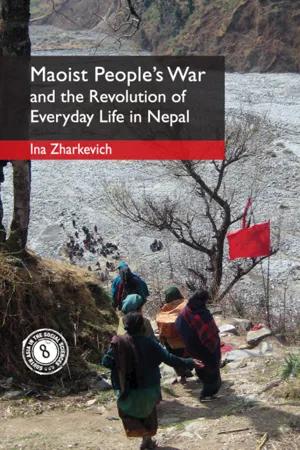
By providing a rich ethnography of wartime social processes in the former Maoist heartland of Nepal, this book explores how the Maoist People's War (1996–2006) transformed Nepali society. Drawing on long-term fieldwork with people who were located at the epicentre of the conflict, including both ardent Maoist supporters and 'reluctant rebels', it explores how a remote Himalayan village was forged as the centre of the Maoist rebellion, how its inhabitants coped with the situation of war and the Maoist regime of governance, and how they came to embrace the Maoist project and maintain ordinary life amidst the war while living in a guerilla enclave. By focusing on people's everyday lives, the book illuminates how the everyday became a primary site of revolution of crafting new subjectivities, introducing 'new' social practices and displacing the 'old' ones, and reconfiguring the ways that people act in and think about the world through the process of 'embodied change'.
Information
Table of contents
- Cover
- Maoist People’s War and the Revolution of Everyday Life in Nepal
- Series
- Title
- Copyright
- Contents
- Figures
- Acknowledgements
- Glossary of Nepali Terms
- Introduction
- 1. Thabang: From Remote Village to Revolutionary Myth
- 2. The Moral Economy of War: The Making of the Base Area
- 3. Becoming Maoist in a Time of Insurgency
- 4. The Marital Economy of War: Reconfiguring Kinship Loyalties and Conjugality
- 5. Remaking the Tribe: ‘A Farewell to Bad Traditions’
- 6. Subverting the ‘Sacred Cow’: When Beef Becomes Edible
- 7. When All Castes Become One: Transgressing Caste Boundaries during War
- 8. When Gods Return to Their Homeland in the Himalayas: Maoism, Religion, and Change
- Conclusion
- Appendices
- Bibliography
- Index
Trusted by 375,005 students
Access to over 1.5 million titles for a fair monthly price.
Study more efficiently using our study tools.
Frequently asked questions
Yes, you can cancel anytime from the Subscription tab in your account settings on the Perlego website. Your subscription will stay active until the end of your current billing period. Learn how to cancel your subscription
No, books cannot be downloaded as external files, such as PDFs, for use outside of Perlego. However, you can download books within the Perlego app for offline reading on mobile or tablet. Learn how to download books offline
Perlego offers two plans: Essential and Complete
- Essential is ideal for learners and professionals who enjoy exploring a wide range of subjects. Access the Essential Library with 800,000+ trusted titles and best-sellers across business, personal growth, and the humanities. Includes unlimited reading time and Standard Read Aloud voice.
- Complete: Perfect for advanced learners and researchers needing full, unrestricted access. Unlock 1.5M+ books across hundreds of subjects, including academic and specialized titles. The Complete Plan also includes advanced features like Premium Read Aloud and Research Assistant.
We are an online textbook subscription service, where you can get access to an entire online library for less than the price of a single book per month. With over 1.5 million books across 990+ topics, we’ve got you covered! Learn about our mission
Look out for the read-aloud symbol on your next book to see if you can listen to it. The read-aloud tool reads text aloud for you, highlighting the text as it is being read. You can pause it, speed it up and slow it down. Learn more about Read Aloud
Yes! You can use the Perlego app on both iOS and Android devices to read anytime, anywhere — even offline. Perfect for commutes or when you’re on the go.
Please note we cannot support devices running on iOS 13 and Android 7 or earlier. Learn more about using the app
Please note we cannot support devices running on iOS 13 and Android 7 or earlier. Learn more about using the app
Yes, you can access Maoist People's War and the Revolution of Everyday Life in Nepal by Ina Zharkevich in PDF and/or ePUB format, as well as other popular books in Politics & International Relations & Asian Politics. We have over 1.5 million books available in our catalogue for you to explore.