eBook - PDF
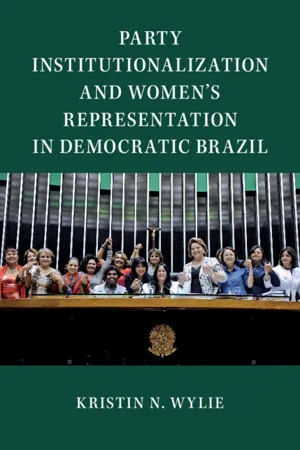
Party Institutionalization and Women's Representation in Democratic Brazil
- 294 pages
- English
- PDF
- Available on iOS & Android
eBook - PDF
Party Institutionalization and Women's Representation in Democratic Brazil
About this book
Brazil's quality of democracy remains limited by enduring obstacles including the weakness of parties and underrepresentation of marginalized groups. Party Institutionalization and Women's Representation in Democratic Brazil theorizes the connections across those problems, explaining how weakly institutionalized and male-dominant parties interact to undermine descriptive representation in Brazil. This book draws on an original multilevel database of 27,653 legislative candidacies spanning six election cycles, over 100 interviews, and field observations from throughout Brazil. Wylie demonstrates that more inclusive participation in candidate-centered elections amidst raced-gendered structural inequities relies on institutionalized parties with the capacity to support women, and the will, heralded by party leadership, to do so. The book illustrates how women leaders in Brazil's more institutionalized parties enable white and Afro-descendant female aspirants to navigate the masculinized terrain of formal politics. It enhances our understanding of how parties mediate electoral rules, as well as institutional and party change in the context of weak but robustly gendered institutions.
Information
Table of contents
- Cover
- Half-title page
- Series page
- Title page
- Copyright page
- Dedication
- Contents
- List of Figures
- List of Tables
- Acknowledgments
- 1 The Puzzle of Women’s Underrepresentation in Brazil
- 2 Willing and Able: Party Institutionalization, Party Leadership, and Women’s Representation
- 3 Brazil’s Quota Law and the Challenges of Institutional Change Amidst Weak and Gendered Institutions
- 4 Overcoming Gendered Obstacles: Voters, Electoral Rules, and Parties
- 5 Electoral Rules, Party Support, and Women’s Unexpected Successes in Elections to the Brazilian Senate
- 6 Supermadres, Lutadoras, and Technocrats: The Bounded Profiles of Brazil’s Female Politicians
- 7 Intersections between Race and Gender in Brazil’s 2014 Chamber of Deputies Elections
- 8 Theoretical Implications and Comparative Perspectives
- Appendices
- List of Interviews
- Bibliography
- Index
Trusted by 375,005 students
Access to over 1.5 million titles for a fair monthly price.
Study more efficiently using our study tools.
Frequently asked questions
Yes, you can cancel anytime from the Subscription tab in your account settings on the Perlego website. Your subscription will stay active until the end of your current billing period. Learn how to cancel your subscription
No, books cannot be downloaded as external files, such as PDFs, for use outside of Perlego. However, you can download books within the Perlego app for offline reading on mobile or tablet. Learn how to download books offline
Perlego offers two plans: Essential and Complete
- Essential is ideal for learners and professionals who enjoy exploring a wide range of subjects. Access the Essential Library with 800,000+ trusted titles and best-sellers across business, personal growth, and the humanities. Includes unlimited reading time and Standard Read Aloud voice.
- Complete: Perfect for advanced learners and researchers needing full, unrestricted access. Unlock 1.5M+ books across hundreds of subjects, including academic and specialized titles. The Complete Plan also includes advanced features like Premium Read Aloud and Research Assistant.
We are an online textbook subscription service, where you can get access to an entire online library for less than the price of a single book per month. With over 1.5 million books across 990+ topics, we’ve got you covered! Learn about our mission
Look out for the read-aloud symbol on your next book to see if you can listen to it. The read-aloud tool reads text aloud for you, highlighting the text as it is being read. You can pause it, speed it up and slow it down. Learn more about Read Aloud
Yes! You can use the Perlego app on both iOS and Android devices to read anytime, anywhere — even offline. Perfect for commutes or when you’re on the go.
Please note we cannot support devices running on iOS 13 and Android 7 or earlier. Learn more about using the app
Please note we cannot support devices running on iOS 13 and Android 7 or earlier. Learn more about using the app
Yes, you can access Party Institutionalization and Women's Representation in Democratic Brazil by Kristin N. Wylie in PDF and/or ePUB format, as well as other popular books in Politics & International Relations & American Government. We have over 1.5 million books available in our catalogue for you to explore.