- 350 pages
- English
- PDF
- Available on iOS & Android
eBook - PDF
About this book
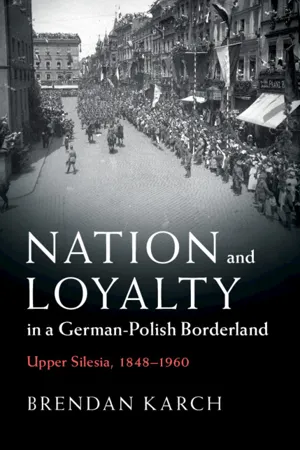
In the bloody twentieth-century battles over Central Europe's borderlands, Upper Silesians stand out for resisting pressure to become loyal Germans or Poles. This work traces nationalist activists' efforts to divide Upper Silesian communities, which were bound by their Catholic faith and bilingualism, into two 'imagined' nations. These efforts, which ranged from the 1848 Revolution to the aftermath of the Second World War, are charted by Brendan Karch through the local newspapers, youth and leisure groups, neighborhood parades, priestly sermons, and electoral outcomes. As locals weathered increasing political turmoil and violence in the German-Polish contest over their homeland, many crafted a national ambiguity that allowed them to pass as members of either nation. In prioritizing family, homeland, village, class, or other social ties above national belonging, a majority of Upper Silesians adopted an instrumental stance towards nationalism. The result was a feedback loop between national radicalism and national skepticism.
Information
Table of contents
- Cover
- Half-title page
- Series page
- Title page
- Copyright page
- Contents
- List of Figures
- List of Tables
- List of Maps
- Acknowledgments
- Note on Translations and Place Names
- List of Abbreviations
- Introduction
- 1 The Battle Before: Catholicism and the Making of Upper Silesians, 1848–1890
- 2 Nationalism’s Debut: Imagining a Polish Community, 1890–1914
- 3 Breakdown: World War I and the Upper Silesian Plebiscite, 1914–1921
- 4 The Weimar Gap: Democracy and Nationalism, 1922–1933
- 5 Reprieve: Jews between Germany, Poland, and the League of Nations
- 6 The Instrumental Volksgemeinschaft: Making “Loyal” Germans, 1933–1944
- 7 The Postwar Ultimatum: Making “Loyal” Poles after 1945
- Epilogue
- Bibliography
- Index
Trusted by 375,005 students
Access to over 1.5 million titles for a fair monthly price.
Study more efficiently using our study tools.
Frequently asked questions
Yes, you can cancel anytime from the Subscription tab in your account settings on the Perlego website. Your subscription will stay active until the end of your current billing period. Learn how to cancel your subscription
No, books cannot be downloaded as external files, such as PDFs, for use outside of Perlego. However, you can download books within the Perlego app for offline reading on mobile or tablet. Learn how to download books offline
Perlego offers two plans: Essential and Complete
- Essential is ideal for learners and professionals who enjoy exploring a wide range of subjects. Access the Essential Library with 800,000+ trusted titles and best-sellers across business, personal growth, and the humanities. Includes unlimited reading time and Standard Read Aloud voice.
- Complete: Perfect for advanced learners and researchers needing full, unrestricted access. Unlock 1.5M+ books across hundreds of subjects, including academic and specialized titles. The Complete Plan also includes advanced features like Premium Read Aloud and Research Assistant.
We are an online textbook subscription service, where you can get access to an entire online library for less than the price of a single book per month. With over 1.5 million books across 990+ topics, we’ve got you covered! Learn about our mission
Look out for the read-aloud symbol on your next book to see if you can listen to it. The read-aloud tool reads text aloud for you, highlighting the text as it is being read. You can pause it, speed it up and slow it down. Learn more about Read Aloud
Yes! You can use the Perlego app on both iOS and Android devices to read anytime, anywhere — even offline. Perfect for commutes or when you’re on the go.
Please note we cannot support devices running on iOS 13 and Android 7 or earlier. Learn more about using the app
Please note we cannot support devices running on iOS 13 and Android 7 or earlier. Learn more about using the app
Yes, you can access Nation and Loyalty in a German-Polish Borderland by Brendan Karch in PDF and/or ePUB format, as well as other popular books in History & European History. We have over 1.5 million books available in our catalogue for you to explore.