- 190 pages
- English
- PDF
- Available on iOS & Android
eBook - PDF
Evil, Terrorism and Psychiatry
About this book
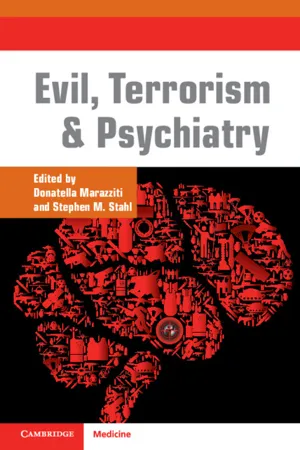
Terrorism has dominated the domestic and international landscape since 9/11. Determining what drives people to commit acts of terrorism is no easy task. The important new book fills a gap in the psychology and psychiatry literature by examining the relationship between evil and mental illness, and in particular amongst terrorists. How can evil, a characteristic of human nature, become extreme, intent on destruction and lead to acts of terrorism? Featuring contributions from leading experts in this field, Evil, Terrorism and Psychiatry explores whether there are specific personality traits, psychological characteristics or psychopathological conditions that may favour a lack of control of violence in terrorists. It also offers possible novel prevention strategies to help understand and prevent these acts in future. Featuring articles from a special issue of CNS Spectrums, this book also includes brand new chapters found exclusively in this book.
Information
Topic
MedicineSubtopic
Psychiatry & Mental HealthTable of contents
- Cover
- Half-title page
- Title page
- Copyright page
- Contents
- List of Contributors
- Foreword
- Preface
- Chapter 1 To Die to Kill: Suicide as a Weapon. Some Historical Antecedents of Suicide Terrorism
- Chapter 2 The Philosophy of Hate and Anger
- Chapter 3 Identity, Alienation, and Violent Radicalization
- Chapter 4 The Mind of Suicide Terrorists
- Chapter 5 Psychopathology of Terrorists
- Chapter 6 Why is Terrorism a Man’s Business?
- Chapter 7 Religion, Violence, and the Brain: a Neuroethical Perspective
- Chapter 8 Brain Alterations Potentially Associated with Aggression and Terrorism
- Chapter 9 Political Terrorism and Affective Polarization in “Black” and “Red” Terrorists in Italy During the Years 1968–1988
- Chapter 10 Conditions of Life and Death of Psychiatric Patients in France During World War II: Euthanasia or Collateral Casualties?
- Chapter 11 Neuropsychiatric Characteristics of Antiterrorist Operation Combatants in the Donbass (Ukraine)
- Chapter 12 The International Scenario of Terrorism
- Chapter 13 Identification and Prevention of Radicalization. Practice and Experiences with a Multidisciplinary Working Model
- Chapter 14 How to Fight Terrorism? Political and Strategic Aspects
- Index
Trusted by 375,005 students
Access to over 1.5 million titles for a fair monthly price.
Study more efficiently using our study tools.
Frequently asked questions
Yes, you can cancel anytime from the Subscription tab in your account settings on the Perlego website. Your subscription will stay active until the end of your current billing period. Learn how to cancel your subscription
No, books cannot be downloaded as external files, such as PDFs, for use outside of Perlego. However, you can download books within the Perlego app for offline reading on mobile or tablet. Learn how to download books offline
Perlego offers two plans: Essential and Complete
- Essential is ideal for learners and professionals who enjoy exploring a wide range of subjects. Access the Essential Library with 800,000+ trusted titles and best-sellers across business, personal growth, and the humanities. Includes unlimited reading time and Standard Read Aloud voice.
- Complete: Perfect for advanced learners and researchers needing full, unrestricted access. Unlock 1.5M+ books across hundreds of subjects, including academic and specialized titles. The Complete Plan also includes advanced features like Premium Read Aloud and Research Assistant.
We are an online textbook subscription service, where you can get access to an entire online library for less than the price of a single book per month. With over 1.5 million books across 990+ topics, we’ve got you covered! Learn about our mission
Look out for the read-aloud symbol on your next book to see if you can listen to it. The read-aloud tool reads text aloud for you, highlighting the text as it is being read. You can pause it, speed it up and slow it down. Learn more about Read Aloud
Yes! You can use the Perlego app on both iOS and Android devices to read anytime, anywhere — even offline. Perfect for commutes or when you’re on the go.
Please note we cannot support devices running on iOS 13 and Android 7 or earlier. Learn more about using the app
Please note we cannot support devices running on iOS 13 and Android 7 or earlier. Learn more about using the app
Yes, you can access Evil, Terrorism and Psychiatry by Donatella Marazziti,Stephen M. Stahl in PDF and/or ePUB format, as well as other popular books in Medicine & Psychiatry & Mental Health. We have over 1.5 million books available in our catalogue for you to explore.