eBook - PDF
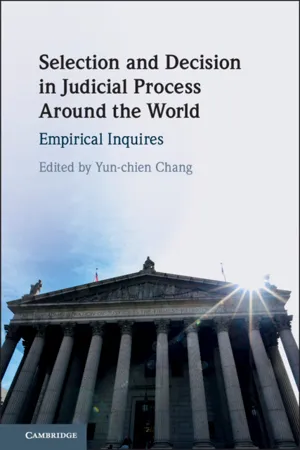
Selection and Decision in Judicial Process around the World
Empirical Inquires
- 314 pages
- English
- PDF
- Available on iOS & Android
eBook - PDF
About this book
This book empirically explores whether and under what conditions the judicial process is efficient. Three specific issues are addressed: first, disputants self-select into litigation. Do they tend to bring cases with merit? Second, filed cases differ in their social import. Do courts select more important cases to devote more resource to? Third, courts establish precedents, affect resource allocation in the cases at hand, and influence future behaviours of transacting parties. Do courts, like Judge Posner asserts, tend to make decisions that enhance allocative efficiency and reduce transaction costs? Positive answers to the above questions attest to the efficiency of the judicial process. What drive efficient or inefficient outcomes are the selections and decisions by litigants, litigators, and judges. Their earlier selections and decisions affect later ones. Eleven chapters in this book, authored by leading empirical legal scholars in the world, deal with these issues in the US, Europe, and Asia.
Information
Table of contents
- Cover
- Half-title
- Title page
- Copyright information
- Dedication
- Contents
- List of Figures
- List of Tables
- List of Contributors
- Acknowledgments
- Introduction
- 1 Do Patent Law Suits Target Invalid Patents?
- 2 Platform Procedure: Using Technology to Facilitate (Efficient) Civil Settlement
- 3 Speedy Adjudication in Hard Cases and Low Settlement Rates in Easy Cases: An Empirical Analysis of Taiwanese Courts with Comparison to US Federal Courts
- 4 How Lower Courts Respond to a Change in a Legal Rule
- 5 Career Judge System and Court Decision Biases: Preliminary Evidence from Japan
- 6 Judges Avoid Ex Post but Not Ex Ante Inefficiency: Theory and Empirical Evidence from Taiwan
- 7 When Winning Is Not Enough: Prevailing-Party Civil Appeals in State Courts
- 8 The Evolution of Case Influence in Modern Consumer Standard Form Contracts
- 9 Judging Insurance Antidiscrimination Law
- 10 Are Judges Harsher with Repeat Offenders?: Evidence from the European Court of Human Rights
- 11 Does Efficiency Trump Legality?: The Case of the German Constitutional Court
- Index
Trusted by 375,005 students
Access to over 1.5 million titles for a fair monthly price.
Study more efficiently using our study tools.
Frequently asked questions
Yes, you can cancel anytime from the Subscription tab in your account settings on the Perlego website. Your subscription will stay active until the end of your current billing period. Learn how to cancel your subscription
No, books cannot be downloaded as external files, such as PDFs, for use outside of Perlego. However, you can download books within the Perlego app for offline reading on mobile or tablet. Learn how to download books offline
Perlego offers two plans: Essential and Complete
- Essential is ideal for learners and professionals who enjoy exploring a wide range of subjects. Access the Essential Library with 800,000+ trusted titles and best-sellers across business, personal growth, and the humanities. Includes unlimited reading time and Standard Read Aloud voice.
- Complete: Perfect for advanced learners and researchers needing full, unrestricted access. Unlock 1.5M+ books across hundreds of subjects, including academic and specialized titles. The Complete Plan also includes advanced features like Premium Read Aloud and Research Assistant.
We are an online textbook subscription service, where you can get access to an entire online library for less than the price of a single book per month. With over 1.5 million books across 990+ topics, we’ve got you covered! Learn about our mission
Look out for the read-aloud symbol on your next book to see if you can listen to it. The read-aloud tool reads text aloud for you, highlighting the text as it is being read. You can pause it, speed it up and slow it down. Learn more about Read Aloud
Yes! You can use the Perlego app on both iOS and Android devices to read anytime, anywhere — even offline. Perfect for commutes or when you’re on the go.
Please note we cannot support devices running on iOS 13 and Android 7 or earlier. Learn more about using the app
Please note we cannot support devices running on iOS 13 and Android 7 or earlier. Learn more about using the app
Yes, you can access Selection and Decision in Judicial Process around the World by Yun-chien Chang in PDF and/or ePUB format, as well as other popular books in Law & Law Theory & Practice. We have over 1.5 million books available in our catalogue for you to explore.