- 252 pages
- English
- PDF
- Available on iOS & Android
eBook - PDF
About this book
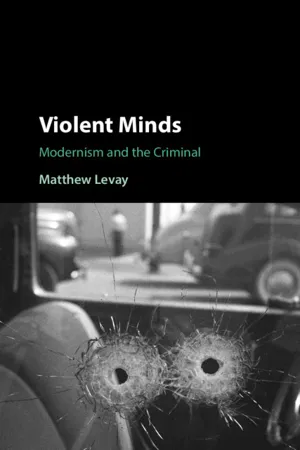
Just as cultural attitudes toward criminality were undergoing profound shifts in the late nineteenth and early twentieth centuries, modernist authors became fascinated by crime and its perpetrators, as well as the burgeoning genre of crime fiction. Throughout the period, a diverse range of British and American novelists took the criminal as a case study for experimenting with forms of psychological representation while also drawing on the conventions of crime fiction in order to imagine new ways of conceptualizing the criminal mind. Matthew Levay traces the history of that attention to criminal psychology in modernist fiction, placing understudied authors like Wyndham Lewis, Dorothy Sayers, Graham Greene, and Patricia Highsmith in dialogue with more canonical contemporaries like Joseph Conrad, Henry James, Dashiell Hammett, and Gertrude Stein. Levay demonstrates criminality's pivotal role in establishing quintessentially modernist forms of psychological representation and brings to light modernism's deep but understudied connections to popular literature, especially crime fiction.
Information
Table of contents
- Cover
- Half-title page
- Title page
- Copyright page
- Contents
- Acknowledgments
- Introduction: Modernism’s Violent Minds
- Chapter 1 Modernist Detection: Minds, Mindlessness, and the Logic of Criminal Pursuit
- Chapter 2 Criminal Types: Anarchism, Terrorism, and the Violence of Chance
- Chapter 3 The Modernist Crime Novel: Popular Literature and the Forms of Experiment
- Chapter 4 Cases of Identity: Late Modernism and the Life of Crime
- Conclusion: The Criminal after Modernism
- Bibliography
- Index
Trusted by 375,005 students
Access to over 1.5 million titles for a fair monthly price.
Study more efficiently using our study tools.
Frequently asked questions
Yes, you can cancel anytime from the Subscription tab in your account settings on the Perlego website. Your subscription will stay active until the end of your current billing period. Learn how to cancel your subscription
No, books cannot be downloaded as external files, such as PDFs, for use outside of Perlego. However, you can download books within the Perlego app for offline reading on mobile or tablet. Learn how to download books offline
Perlego offers two plans: Essential and Complete
- Essential is ideal for learners and professionals who enjoy exploring a wide range of subjects. Access the Essential Library with 800,000+ trusted titles and best-sellers across business, personal growth, and the humanities. Includes unlimited reading time and Standard Read Aloud voice.
- Complete: Perfect for advanced learners and researchers needing full, unrestricted access. Unlock 1.5M+ books across hundreds of subjects, including academic and specialized titles. The Complete Plan also includes advanced features like Premium Read Aloud and Research Assistant.
We are an online textbook subscription service, where you can get access to an entire online library for less than the price of a single book per month. With over 1.5 million books across 990+ topics, we’ve got you covered! Learn about our mission
Look out for the read-aloud symbol on your next book to see if you can listen to it. The read-aloud tool reads text aloud for you, highlighting the text as it is being read. You can pause it, speed it up and slow it down. Learn more about Read Aloud
Yes! You can use the Perlego app on both iOS and Android devices to read anytime, anywhere — even offline. Perfect for commutes or when you’re on the go.
Please note we cannot support devices running on iOS 13 and Android 7 or earlier. Learn more about using the app
Please note we cannot support devices running on iOS 13 and Android 7 or earlier. Learn more about using the app
Yes, you can access Violent Minds by Matthew Levay in PDF and/or ePUB format, as well as other popular books in Literature & English Literary Criticism. We have over 1.5 million books available in our catalogue for you to explore.