eBook - PDF
British Orientalisms, 1759–1835
About this book
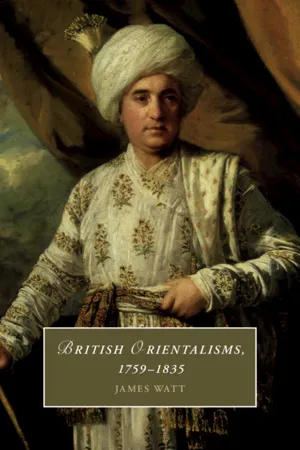
How did Britons understand their relationship with the East in the late eighteenth and early nineteenth centuries? James Watt's new study remaps the literary history of British Orientalisms between 1759, the 'year of victories' in the Seven Years' War, and 1835, when T. B. Macaulay published his polemical 'Minute on Indian Education'. It explores the impact of the war on Britons' cultural horizons, and the different and shifting ways in which Britons conceived of themselves and their nation as 'open' to the East across this period. Considering the emergence of new forms and styles of writing in the context of an age of empire and revolution, Watt examines how the familiar 'Eastern' fictions of the past were adapted, reworked, and reacted against. In doing so he illuminates the larger cultural conflict which animated a nation debating with itself about its place in the world and relation to its others.
Information
Table of contents
- Cover
- Half-title page
- Series page
- Title page
- Copyright page
- Contents
- Acknowledgements
- Introduction: Britain, Empire, and ‘Openness’ to the East
- Chapter 1 ‘Those Islanders’: British Orientalisms and the Seven Years’ War
- Chapter 2 ‘Indian Details’: Fictions of British India, 1774–1789
- Chapter 3 ‘All Asia Is Covered in Prisons’: Oriental Despotism and British Liberty in an Age of Revolutions
- Chapter 4 ‘In Love with the Gopia’: Sir William Jones and His Contemporaries
- Chapter 5 ‘Imperial Dotage’ and Poetic Ornament in Romantic Orientalist Verse Narrative
- Chapter 6 Cockney Translation: Leigh Hunt and Charles Lamb’s Eastern Imaginings
- Chapter 7 ‘It Is Otherwise in Asia’: ‘Character’ and Improvement in Picaresque Fiction
- Conclusion: British Orientalisms, Empire, and Improvement
- Bibliography
- Index
Trusted by 375,005 students
Access to over 1.5 million titles for a fair monthly price.
Study more efficiently using our study tools.
Frequently asked questions
Yes, you can cancel anytime from the Subscription tab in your account settings on the Perlego website. Your subscription will stay active until the end of your current billing period. Learn how to cancel your subscription
No, books cannot be downloaded as external files, such as PDFs, for use outside of Perlego. However, you can download books within the Perlego app for offline reading on mobile or tablet. Learn how to download books offline
Perlego offers two plans: Essential and Complete
- Essential is ideal for learners and professionals who enjoy exploring a wide range of subjects. Access the Essential Library with 800,000+ trusted titles and best-sellers across business, personal growth, and the humanities. Includes unlimited reading time and Standard Read Aloud voice.
- Complete: Perfect for advanced learners and researchers needing full, unrestricted access. Unlock 1.5M+ books across hundreds of subjects, including academic and specialized titles. The Complete Plan also includes advanced features like Premium Read Aloud and Research Assistant.
We are an online textbook subscription service, where you can get access to an entire online library for less than the price of a single book per month. With over 1.5 million books across 990+ topics, we’ve got you covered! Learn about our mission
Look out for the read-aloud symbol on your next book to see if you can listen to it. The read-aloud tool reads text aloud for you, highlighting the text as it is being read. You can pause it, speed it up and slow it down. Learn more about Read Aloud
Yes! You can use the Perlego app on both iOS and Android devices to read anytime, anywhere — even offline. Perfect for commutes or when you’re on the go.
Please note we cannot support devices running on iOS 13 and Android 7 or earlier. Learn more about using the app
Please note we cannot support devices running on iOS 13 and Android 7 or earlier. Learn more about using the app
Yes, you can access British Orientalisms, 1759–1835 by James Watt in PDF and/or ePUB format, as well as other popular books in Literature & English Literary Criticism. We have over 1.5 million books available in our catalogue for you to explore.