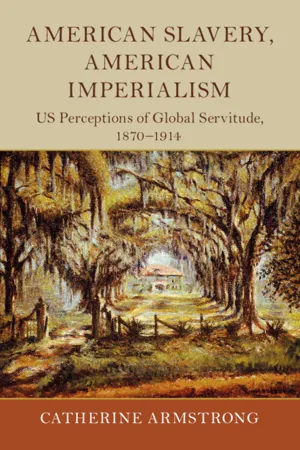
eBook - PDF
American Slavery, American Imperialism
US Perceptions of Global Servitude, 1870–1914
- 300 pages
- English
- PDF
- Available on iOS & Android
eBook - PDF
American Slavery, American Imperialism
US Perceptions of Global Servitude, 1870–1914
About this book
Slavery casts a long shadow over American history; despite the cataclysmic changes of the Civil War and emancipation, the United States carried antebellum notions of slavery into its imperial expansion at the turn of the twentieth-century. African American, Chinese and other immigrant labourers were exploited in the name of domestic economic development, and overseas, local populations were made into colonial subjects of America. How did the U.S. deal with the paradox of presenting itself as a global power which abhorred slavery, while at the same time failing to deal with forced labour at home? Catherine Armstrong argues that this was done with rhetorical manoeuvres around the definition of slavery. Drawing primarily on representations of slavery in American print culture, this study charts how definitions and depictions of slavery both changed and stayed the same as the nation became a prominent actor on the world stage. In doing so, Armstrong challenges the idea that slavery is a merely historical problem, and shows its relevance in the contemporary world.
Information
Topic
GeschichteSubtopic
Afroamerikanische GeschichteTable of contents
- Cover
- Half-title page
- Series page
- Title page
- Copyright page
- Contents
- List of Figures
- Acknowledgements
- Introduction
- 1 A Rhetorical Continuum? How Representations of Antebellum Slavery Endure in Post-War Culture
- 2 Global Contexts: How External Factors Drive US Perceptions of Slavery
- 3 Othering the Slave Owner
- 4 Othering the Enslaved
- 5 Gender and the Rhetoric of Slavery
- 6 Resistance and the Slavery Counter-Narrative
- Conclusion
- Bibliography
- Index
Trusted by 375,005 students
Access to over 1.5 million titles for a fair monthly price.
Study more efficiently using our study tools.
Frequently asked questions
Yes, you can cancel anytime from the Subscription tab in your account settings on the Perlego website. Your subscription will stay active until the end of your current billing period. Learn how to cancel your subscription
No, books cannot be downloaded as external files, such as PDFs, for use outside of Perlego. However, you can download books within the Perlego app for offline reading on mobile or tablet. Learn how to download books offline
Perlego offers two plans: Essential and Complete
- Essential is ideal for learners and professionals who enjoy exploring a wide range of subjects. Access the Essential Library with 800,000+ trusted titles and best-sellers across business, personal growth, and the humanities. Includes unlimited reading time and Standard Read Aloud voice.
- Complete: Perfect for advanced learners and researchers needing full, unrestricted access. Unlock 1.5M+ books across hundreds of subjects, including academic and specialized titles. The Complete Plan also includes advanced features like Premium Read Aloud and Research Assistant.
We are an online textbook subscription service, where you can get access to an entire online library for less than the price of a single book per month. With over 1.5 million books across 990+ topics, we’ve got you covered! Learn about our mission
Look out for the read-aloud symbol on your next book to see if you can listen to it. The read-aloud tool reads text aloud for you, highlighting the text as it is being read. You can pause it, speed it up and slow it down. Learn more about Read Aloud
Yes! You can use the Perlego app on both iOS and Android devices to read anytime, anywhere — even offline. Perfect for commutes or when you’re on the go.
Please note we cannot support devices running on iOS 13 and Android 7 or earlier. Learn more about using the app
Please note we cannot support devices running on iOS 13 and Android 7 or earlier. Learn more about using the app
Yes, you can access American Slavery, American Imperialism by Catherine Armstrong in PDF and/or ePUB format, as well as other popular books in Geschichte & Afroamerikanische Geschichte. We have over 1.5 million books available in our catalogue for you to explore.